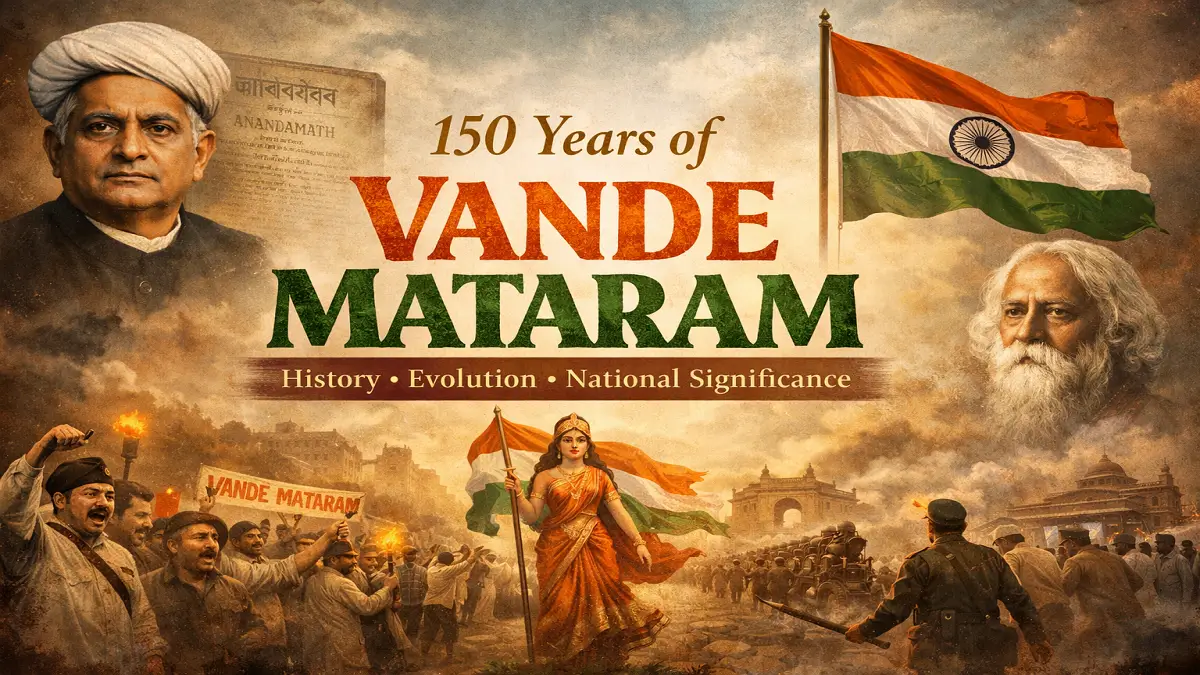
Vande Mataram is more than just a song, it is an emotion woven into India’s freedom struggle. As India marks 150 years of Vande Mataram, the hymn continues to symbolize patriotism, sacrifice, and national unity. From its literary birth in the 19th century to its place in India’s constitutional history, the journey of this iconic composition reflects the spirit of a nation rising toward independence.
Origins of Vande Mataram
According to historical records, Bankimchandra Chattopadhyay composed Vande Mataram around 1875. The song later gained wide recognition when it appeared in his famous novel Anandamath, serialized in Bangadarshan magazine in 1881.
The hymn was not merely poetry — it was a literary expression of devotion to the motherland. Freedom fighter and philosopher Sri Aurobindo later wrote in his journal Bande Mataram (1907) that the song captured the deep spiritual force behind India’s patriotic awakening.
Literary Context: Anandamath
The novel Anandamath is set during the late 18th century and narrates the story of the Santanas — a group of ascetic warriors determined to free the land from oppression. Their loyalty is directed not toward a religious idol, but toward Bharat Mata, the personified motherland.
Symbolism of the Three Mothers
In the Santanas’ temple, three symbolic images of the Mother are shown:
- The Mother That Was – representing India’s glorious and powerful past
- The Mother That Is – symbolising a weakened and suffering nation
- The Mother That Will Be – depicting a rejuvenated and triumphant future
These powerful symbols helped readers visualise India’s journey from past glory to colonial subjugation and eventual resurgence.
From Song to Slogan: A Nationalist Cry
By the early 20th century, Vande Mataram transformed from literature into a political slogan. It became one of the most powerful rallying cries of India’s freedom movement.
Role in the Swadeshi and Anti-Partition Movement
When Lord Curzon partitioned Bengal in 1905, mass protests erupted across the country. During this time, Vande Mataram became the emotional heartbeat of resistance. It energized:
- Boycott movements
- Protest marches
- Nationalist newspapers and organizations
A historic moment occurred in 1906 at Barisal, where over 10,000 Hindus and Muslims marched together shouting Vande Mataram, showing its early inclusive and unifying appeal.
Prominent leaders who popularized the slogan included Rabindranath Tagore, Bipin Chandra Pal, and Sri Aurobindo, who gave it spiritual as well as political meaning.
Colonial Repression and Defiance
The British government quickly realized the slogan’s power to mobilize people. As a result, authorities attempted to suppress it by:
- Imposing fines on students
- Ordering police lathi-charges
- Banning public gatherings
- Threatening expulsion from schools and colleges
Despite repression, chanting Vande Mataram became an act of courage and nationalist defiance across Bengal and the Bombay Presidency.
Vande Mataram on the Global Stage
In 1907, freedom fighter Madam Bhikaji Cama unfurled one of the earliest versions of the Indian tricolour at Stuttgart, Germany. The flag bore the words Vande Mataram, introducing the slogan to the international community as a symbol of India’s freedom struggle.
Adoption by the Indian National Congress
The Indian National Congress (INC) played a major role in spreading the cultural and political importance of Vande Mataram.
1896: Tagore’s Iconic Rendition
At the Calcutta session of the Congress in 1896, Rabindranath Tagore sang Vande Mataram, bringing it to national attention and embedding it in Congress traditions.
1905: Formal Adoption
During the Swadeshi Movement, the Congress formally adopted the song for all-India gatherings. By then, it had already become the anthem of political awakening.
1937: Use of Only the First Two Stanzas
By the 1930s, concerns were raised about certain later verses that contained religious imagery. To maintain inclusivity, the Congress Working Committee in 1937 decided that only the first two stanzas — seen as non-sectarian — would be used at official events.
This decision helped balance cultural heritage with national unity in a diverse society.
Constituent Assembly Recognition (1950)
On January 24, 1950, just before India became a Republic, Dr. Rajendra Prasad, President of the Constituent Assembly, made an important announcement:
- Jana Gana Mana would be India’s National Anthem
- Vande Mataram would receive equal honour and status due to its historic role in the freedom struggle
This decision ensured that while the anthem represented modern India, Vande Mataram remained a pillar of national heritage and sacrifice.
Enduring National Significance
Even after 150 years, Vande Mataram continues to inspire patriotism. It reminds citizens of the sacrifices made during the freedom movement and reinforces the idea of India as a shared motherland beyond divisions.
For government exam aspirants, understanding its history is important not only for culture and polity sections but also for appreciating how literature influenced India’s national movement.


 IIM Ahmedabad Launches Krishnamurthy Tan...
 Supreme Court Panel Urges Union Governme...
 PM Modi to Attend G7 Summit 2026 in Fran...