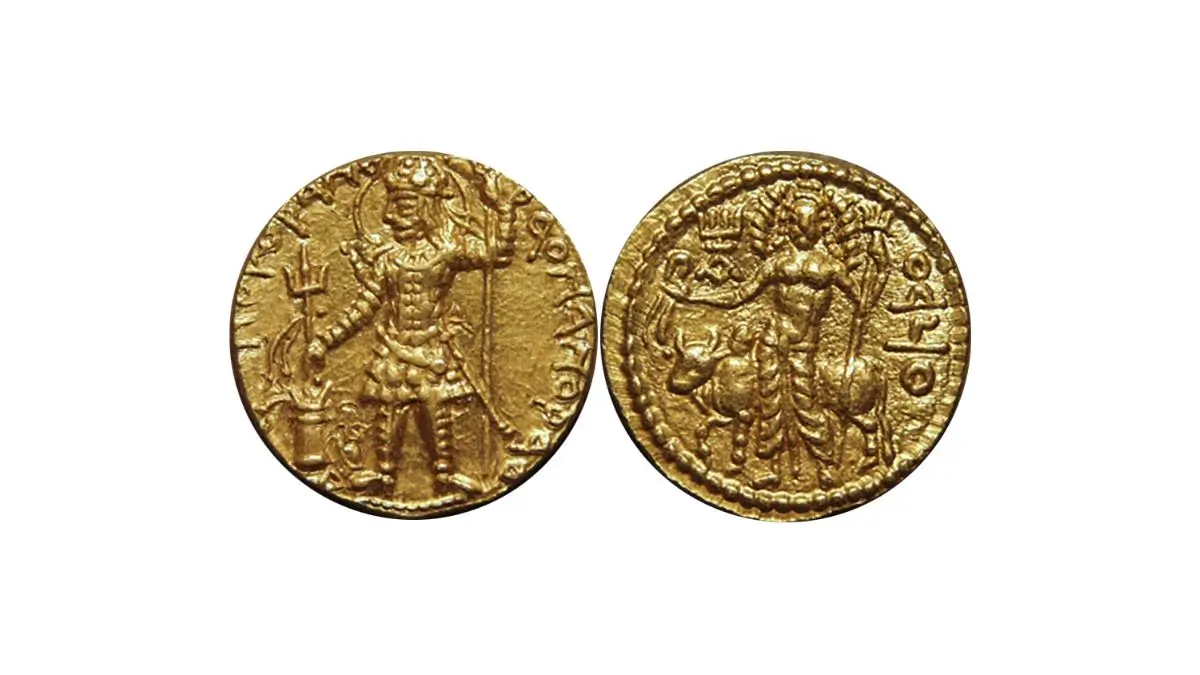
Archaeologists in Pakistan have discovered 2,000-year-old Kushan Empire coins and lapis lazuli fragments at Bhir Mound near Taxila in Rawalpindi. The coins belong to the era of King Vasudeva, one of the last great Kushan rulers. The discovery highlights the region’s ancient trade links, religious diversity, and historical importance during the early centuries of the Common Era.
Details of the Archaeological Discovery
- The excavation team unearthed bronze coins along with fragments of lapis lazuli, a prized semi-precious stone.
- Experts estimate that while the stones date back to the 6th century BC, the coins belong to the 2nd century AD, firmly placing them in the Kushan period.
- Scientific dating and numismatic analysis confirmed that the coins feature Emperor Vasudeva, regarded by historians as the last great Kushan ruler.
Coin Imagery and Religious Pluralism
- According to archaeologists, the obverse of the coins depicts King Vasudeva, while the reverse shows a female religious deity.
- This combination reflects the religious pluralism of the Kushan era, when rulers patronized multiple faiths.
- Kushan coinage often blended imagery from Indian, Iranian, Greek, and Buddhist traditions, offering valuable insight into the empire’s inclusive theological outlook.
Significance of the Discovery
- The findings underline Taxila’s political and economic importance under the Kushans.
- The religious imagery on the coins shows religious pluralism, while the presence of lapis lazuli indicates long-distance trade networks across Central and South Asia.
Kushan Rule and Taxila
The Kushan Empire flourished between the 1st and 3rd centuries AD. Under rulers like Kanishka the Great, Taxila became a major centre of administration, Buddhism, trade, and Gandharan art, blending Greek, Persian, Roman, and Indian influences.
| Origin | Kushans (Kuei-Shang) were one of the five clans of the Yueh-chi (Yuezhi)
Nomadic people from Central Asian steppes near China |
| Time Period | 1st-3rd centuries CE |
| Extent | From Oxus to Ganges
From Khorasan (Central Asia) to Pataliputra (Bihar) |
| History | Yuezhi conquered Bactria (2nd century BCE)
Kujula Kadphises unified the Kushans and displaced the Sakas Expanded into Gandhara, Kabul Valley, Indus and Gangetic regions |
| Administration & Titles | Rulers used title Devaputra (“Son of God”)
Influenced by Chinese idea of Son of Heaven |
| Religion & Culture | Major patrons of Buddhism
Religious tolerance towards Hinduism and Greek religions Developed Gandhara School of Art |
| Important Rulers | Kujula Kadphises: Founder of the empire
Vima Kadphises: Expanded empire, issued gold coins, Shaivite Kanishka the Great: Greatest ruler; held 4th Buddhist Council, spread Buddhism to Central Asia and China Huvishka: Promoted Buddhism and Zoroastrianism Vasudeva I: Period of decline begins |
| Coinage | High-quality gold, silver, and copper coins
Followed Roman weight standards Titles like King of Kings, Caesar, Lord of All Lands |
| Significance | Strengthened Silk Route trade
Spread Buddhism across Asia Cultural link between India, Central Asia, China, and Rome |
Question
Q. The recently discovered Kushan coins in Pakistan belong to which ruler?
A. Kanishka
B. Kujula Kadphises
C. Vasudeva
D. Huvishka


 Gulf of Hormuz vs Strait of Malacca: Whi...
 Explained: Why Kharg Island Matters to G...
 India-New Zealand Plan Major Sports Part...