The 77th Republic Day Parade on January 26, 2026, stood out as one of the most dynamic and technology-driven celebrations in recent years. Held along Kartavya Path in New Delhi, the 90-minute ceremonial event blended military strength, indigenous defense innovation, and rich cultural heritage. This year’s parade was especially notable for several historic first-time appearances, making it highly important for students preparing for competitive exams and readers tracking India’s defense developments.
Major Firsts at Republic Day Parade 2026
Debut of Suryastra Rocket Launcher System
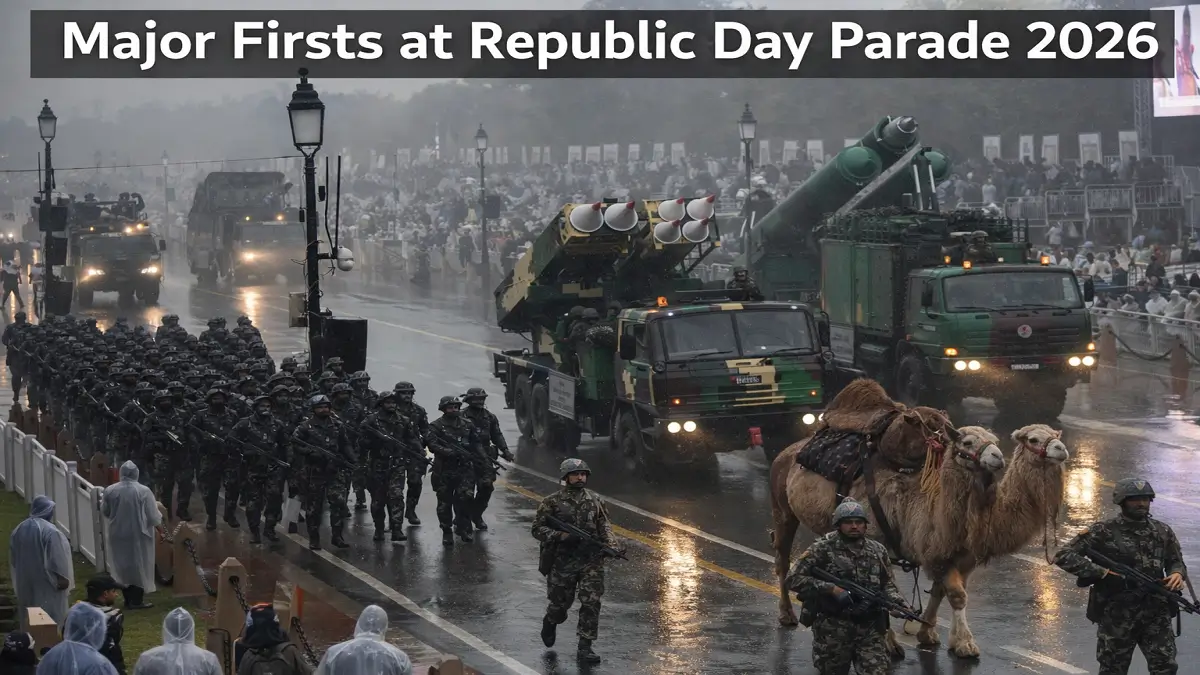
One of the biggest highlights was the first-ever parade appearance of the Universal Rocket Launcher System (URLS) ‘Suryastra’. This indigenous deep-strike rocket system has the capability to hit surface-to-surface targets up to 300 kilometers away. Its presence underlines India’s growing focus on long-range precision strike capability and self-reliance in defense production.
Bhairav Light Commando Battalion Makes Parade Entry
The newly raised Bhairav Light Commando Battalion also marched for the first time in a Republic Day parade. Created to bridge the operational gap between regular infantry and special forces, this unit is designed for high-mobility, rapid-response missions in challenging terrains. The battalion had earlier made its public debut during the Army Day Parade in Jaipur.
Animal Contingent Joins for the First Time
In a unique and symbolic addition, an animal contingent was included in the parade. It featured:
- Zanskar ponies suited for high-altitude terrain
- Bactrian camels known for desert operations
- Raptors (birds of prey)
- Indian Army dogs
These animals are considered force multipliers, especially in difficult terrains where vehicles cannot operate efficiently.
New ‘Phased Battle Array’ Format
A significant change in presentation style was the introduction of a “phased battle array formation.” Instead of purely ceremonial marching, Army units and equipment moved in a sequence similar to real battlefield deployment. The formation began with reconnaissance elements, followed by heavy platforms, logistics, and personnel in full battle gear. This new format aimed to make the parade more realistic and operationally relevant.
61 Cavalry Regiment in Battle Gear
Traditionally known for their ceremonial uniforms and distinctive headgear, the iconic 61 Cavalry Regiment appeared this year in combat battle gear for the first time. This shift symbolized the Army’s evolving focus on operational readiness while maintaining tradition.
Debut of Shaktiban Artillery Regiment
Another first was the participation of the newly raised Shaktiban Regiment from the artillery. This regiment represents the future of modern warfare, being equipped with:
- Drones
- Counter-drone systems
- Loitering munitions
This highlights India’s growing emphasis on unmanned and network-centric warfare technologies.
Advanced Weapon Systems on Display
The parade showcased some of India’s most powerful and modern defense platforms, including:
- BrahMos supersonic cruise missile
- Akash surface-to-air missile system
- MRSAM (Medium Range Surface-to-Air Missile) system
- ATAGS (Advanced Towed Artillery Gun System)
- Dhanush artillery gun
- Static display of various military drones
These systems demonstrate India’s progress in air defense, artillery modernization, and indigenous missile development.
Grand Aerial Flypast
The Indian Air Force flypast was conducted in two phases and featured 29 aircraft, including:
- Rafale fighter jets
- Su-30 MKI
- MiG-29
- P-8I maritime aircraft
- Apache attack helicopters
- Light Combat Helicopter (LCH)
- Advanced Light Helicopter (ALH)
- Mi-17 helicopters
- C-130 and C-295 transport aircraft
The aircraft performed in battle formations, symbolizing air dominance and joint operational capability.
Marching Contingents and Bands
The parade included 18 marching contingents and 13 military bands, creating a vibrant and disciplined display. A mixed scouts contingent, dressed in heavy thermal gear, also participated for the first time, highlighting inclusivity and youth representation.
International Participation
Adding diplomatic significance, top leaders from the European Union attended as chief guests. A small EU military delegation also participated, reflecting India’s growing strategic partnerships on the global stage.


 India Approves New NDC Targets for 2031-...
 IRCTC Food Quality Row: Fine Imposed Aft...
 What is UDAN 2.0? Full Details of India’...