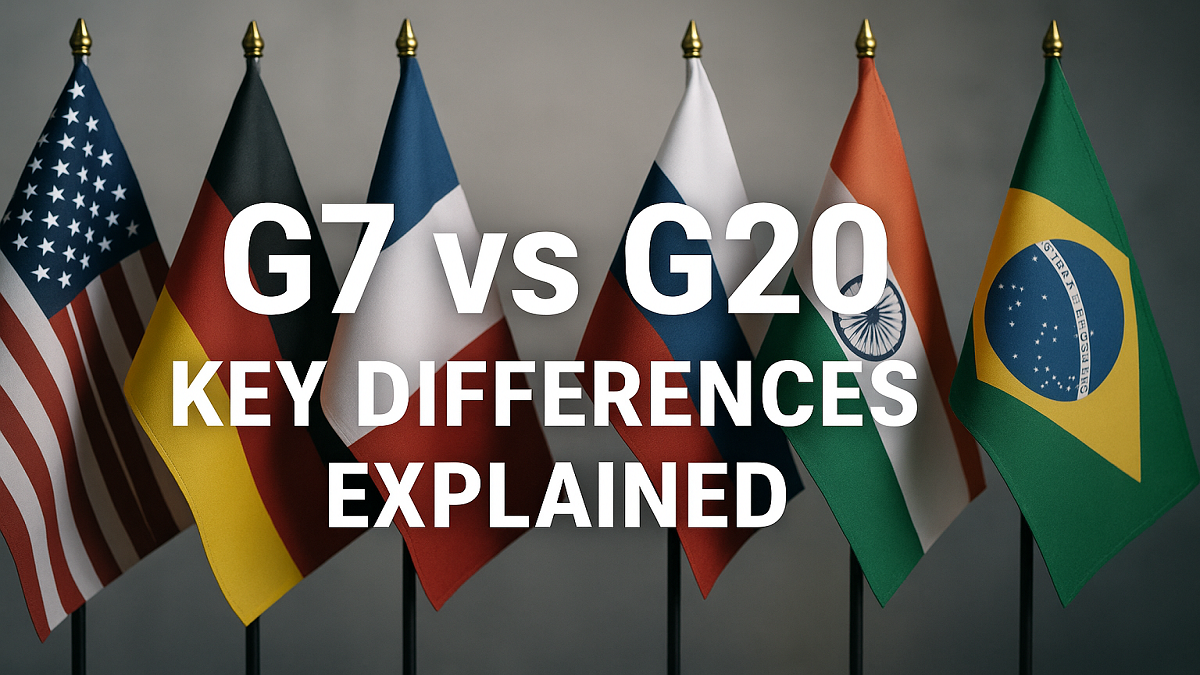
The G7 and G20 are two of the most influential international groupings shaping global economic and political governance. While both aim to address global issues, their composition, objectives, and scope differ significantly. This article provides a clear, comparative understanding of G7 vs G20—an important topic for static GK and government exams.
What is G7?
The Group of Seven (G7) is an informal bloc of advanced economies founded in 1975 to discuss and coordinate economic policies. The group focuses on global economic stability, international security, climate change, and development.
G7 Members (as of 2025):
- United States
- United Kingdom
- Germany
- France
- Italy
- Canada
- Japan
-
European Union (as an invitee/observer)
What is G20?
The Group of Twenty (G20) was formed in 1999 in response to the Asian Financial Crisis. It is a broader platform representing both developed and developing economies, working to foster international financial stability and sustainable development.
G20 Members (as of 2025):
Includes all G7 countries plus:
8. Argentina
9. Australia
10. Brazil
11. China
12. India
13. Indonesia
14. Mexico
15. Russia
16. Saudi Arabia
17. South Africa
18. South Korea
19. Turkey
-
European Union
Key Differences Between G7 and G20
| Feature | G7 | G20 |
|---|---|---|
| Established | 1975 | 1999 |
| Members | 7 countries + EU (observer) | 19 countries + EU (member) |
| Nature | Informal forum of advanced economies | Broader forum of developed & developing economies |
| Key Focus Areas | Global security, economic policy, climate change | Global economy, financial stability, sustainable development |
| Representation | ~10% of world population, ~45% of global GDP | ~80% of world GDP, ~60% of global population |
| Meetings | Annual Summit of heads of states | Annual Leaders’ Summit, finance ministers’ meetings |
| India’s Membership | Not a member (only invited occasionally) | Full member since inception |
| Headquarters | No permanent HQ | No permanent HQ |
India’s Role in G7 and G20
- G7: India is not a permanent member but has been regularly invited as a guest nation (e.g., in 2019, 2021, 2023, and 2024).
- G20: India is a founding member and hosted the G20 Presidency in 2023, with the summit held in New Delhi.
Importance in Global Governance
- G7 is influential in setting the political tone of the West and making decisions on global crises (e.g., Russia-Ukraine war, climate change).
- G20 plays a broader role in setting economic agendas, dealing with financial crises, debt restructuring, and inclusive growth.
Criticism
- G7: Seen as elitist, often criticized for being exclusive and unrepresentative of the global south.
- G20: Praised for inclusivity but criticized for lack of enforcement and actionable outcomes due to consensus-based decision-making.








 PM Modi Turns 76: 5 Numbers That Capture...
 World’s Best Performing Banks 2026: HD...
 Which Country is the Largest Uranium Pro...