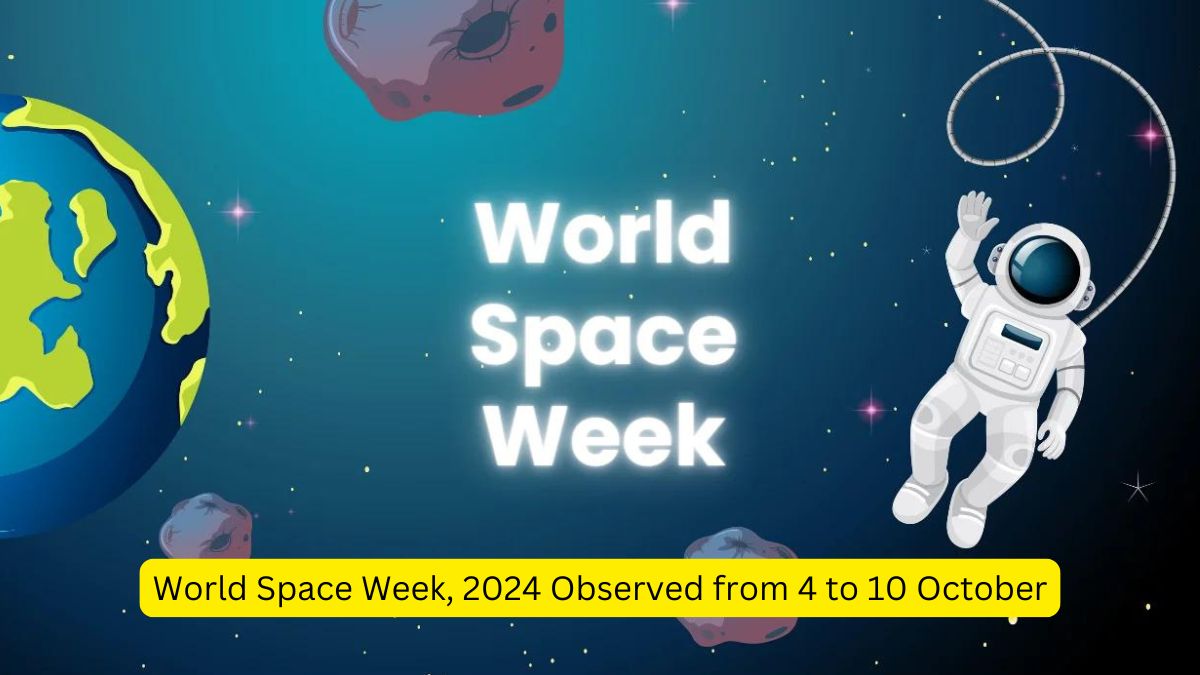
World Space Week (WSW) is an international celebration of science and technology, and their contribution to the betterment of the human condition. The United Nations General Assembly declared in 1999 that World Space Week will be held each year from October 4-10.
Theme of 2024 WSW
- “Space & Climate Change”
- Objective of this theme is to celebrate the transformative impact of space technology in our ongoing battle against climate change, emphasizing the proactive role space exploration plays in enhancing our understanding and management of Earth’s climate.
A Week of Discovery and Action
- World Space Week 2024 is set to educate, inspire and connect the global community, focusing on the powerful alliance between space technology and climate science.
- This significant week of space celebration will highlight the critical role of satellites and space technology in monitoring environmental shifts and formulating strategies to mitigate the impacts of climate change.
Significance of this Dates
- October 4, 1957: Launch of the first human-made Earth satellite, Sputnik 1, thus opening the way for space exploration
- October 10, 1967: The signing of the Treaty on Principles Governing the Activities of States in the Exploration and Peaceful Uses of Outer Space, including the Moon and Other Celestial Bodies.
Goals of the WSW
- Provide unique leverage in space outreach and education
- Educate people around the world about the benefits that they receive from space
- Encourage greater use of space for sustainable economic development
- Demonstrate public support for space programs
- Excite young people about science, technology, engineering, and math
- Foster international cooperation in space outreach and education
UN Declaration on WSW
- In 1999, the UN General Assembly proclaimed World Space Week by resolution 54/68.
- The main aim is to celebrate the contributions of space science and technology to the betterment of the human condition.
Partners
- World Space Week is coordinated by the United Nations with the support of the World Space Week Association (WSWA).
- The WSWA leads a global team of National Coordinators, who promote the celebration of World Space Week within their own countries.
- The celebration of World Space Week is under the guidance of the UN Committee on the Peaceful Uses of Outer Space (COPUOS) and the UN Office for Outer Space Affairs (UNOOSA) based in Vienna, Austria.
- The UNOOSA is the UN office responsible for promoting international cooperation in the peaceful uses of outer space.
- It serves as the secretariat for the General Assembly’s only committee dealing exclusively with international cooperation in the peaceful uses of outer space (COPUOS).
World Space Week Association
Mission
The mission of World Space Week Association (WSWA) is to strengthen the link between space and society through public education, participation, and dialogue on the future of space activity using World Space Week as a focus.
Strategy
To achieve this mission, the strategy of the Association is to expand UN-declared World Space Week, 4-10 October annually, to efficiently focus global attention on space through widespread events that week and associated media coverage. Specifically, the Association shall:
- Institutionalize World Space Week in the plans of other organizations globally on the largest possible scale;
- Seek media coverage of the resulting celebration;
- Provide participating organizations with coordination and assistance;
- Hold events at a global level.
Goal
The long-term goal of the Association is to sufficiently institutionalize UN-declared World Space Week such that it continues to grow throughout the world by itself.
Themes of Previous Year’s
2023 : Space and Entrepreneurship
2022 : Space and Sustainability
2021 : Women in Space
2020 : Satellite Improves Life
| Summary/Static | Details |
| Why in the news? | World Space Week (WSW) is an international celebration of science and technology. The United Nations General Assembly declared in 1999 that World Space Week will be held each year from October 4-10. |
| Event Name | World Space Week (WSW) |
| Dates | October 4-10 (Annually) |
| UN Declaration | Proclaimed by the UN General Assembly in 1999 (Resolution 54/68) |
| Objective | Celebrate the contribution of space science and technology to humanity |
| 2024 Theme | “Space & Climate Change” |
| 2024 Goal | Highlight space technology’s role in understanding and combating climate change |
| Themes of Previous Years | 2023: Space and Entrepreneurship
2022: Space and Sustainability 2021: Women in Space 2020: Satellite Improves Life |
| Significance of Dates | October 4, 1957: Launch of Sputnik 1 (first human-made satellite)
October 10, 1967: Signing of the Outer Space Treaty |
| Partners | Coordinated by the United Nations (UN) and World Space Week Association (WSWA) |
| WSWA Mission | Strengthen the link between space and society through public education and events |









 India’s Artificial Sun: New Gyrotron B...
 India Crosses 80 Lakh HPV Vaccine Doses ...
 TRISHNA Mission: ISRO and France Join Ha...