
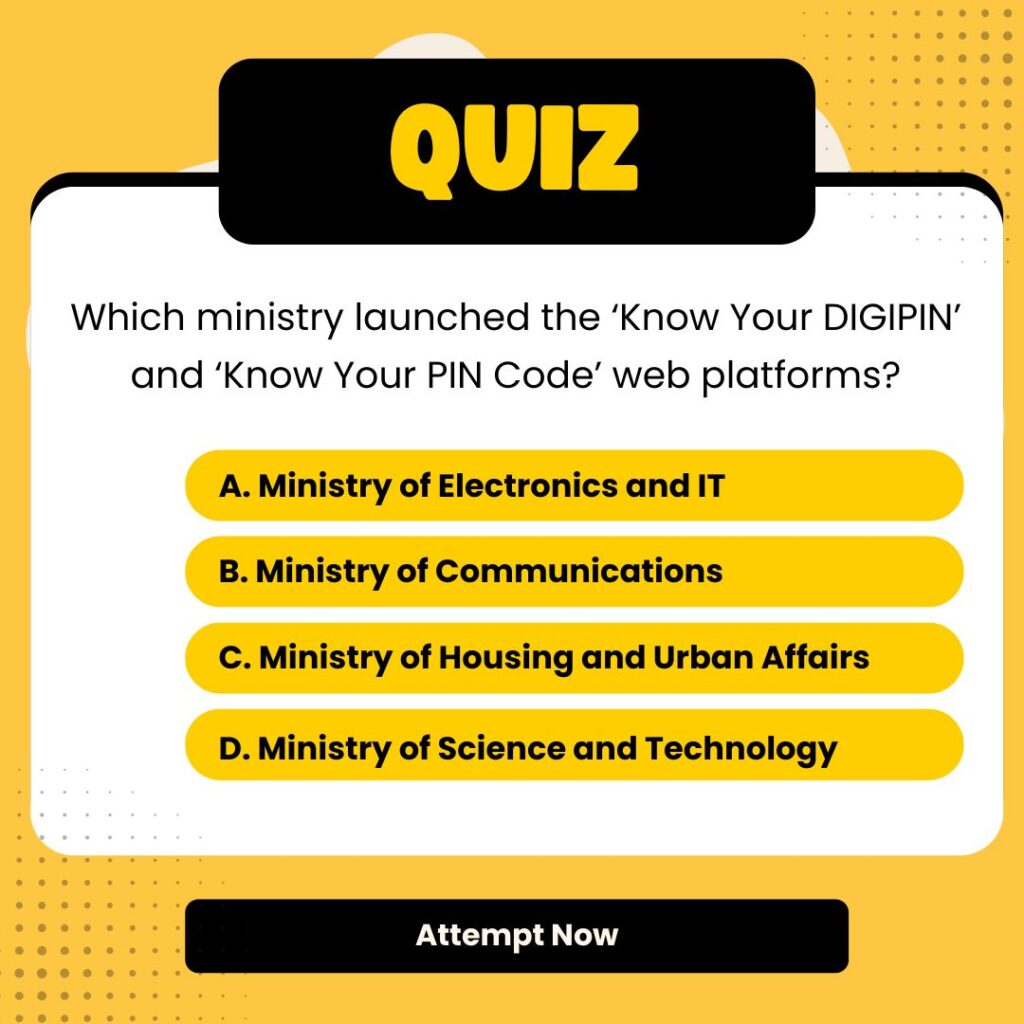
In a landmark initiative aimed at advancing India’s geospatial and digital infrastructure, the Department of Posts, Ministry of Communications, launched two innovative web platforms—‘Know Your DIGIPIN’ and ‘Know Your PIN Code’—on May 27, 2025. These tools, aligned with the National Geospatial Policy 2022, aim to improve location precision, enhance last-mile delivery, and enable efficient public service delivery by modernising India’s addressing systems.
Why in News?
The Government of India launched two digital portals—Know Your DIGIPIN and Know Your PIN Code—as part of its strategy to integrate advanced geospatial technologies into public governance. These platforms are intended to support Digital India goals, especially by improving address accuracy, logistics efficiency, and emergency response capabilities across rural and urban India.
Key Highlights
1. Know Your DIGIPIN Web Application
- Developed by the Department of Posts in collaboration with IIT Hyderabad and NRSC-ISRO.
- Part of the Department’s Address-as-a-Service (AaaS) initiative.
Enables
- Retrieval of DIGIPIN using geolocation.
- Input of latitude/longitude to fetch DIGIPIN.
- Reverse lookup from DIGIPIN to coordinates.
- Based on open-source, interoperable, and geo-coded grid system.
Enhances
- Location mapping
- Last-mile service delivery
- Disaster and emergency response
- Integrated with the National Geospatial Policy 2022.
- Technical documentation and source code available on GitHub.
2. Know Your PIN Code Web Application
- Improves India’s traditional 6-digit PIN Code system introduced in 1972.
Uses GNSS (Global Navigation Satellite System) to,
- Identify the correct PIN based on location.
- Collect user feedback to refine PIN boundaries.
- Backed by a national geofencing exercise.
- Dataset published on Open Government Data Platform.
Objectives and Significance
- Geospatial Precision: Accurate address mapping for all citizens.
- Digital Inclusion: Ensures digital services reach underserved rural areas.
- Interoperability: Usable by all ministries, departments, private entities.
- Open Collaboration: Promotes public participation in digital transformation.
- Policy Alignment: Conforms with National Geospatial Policy 2022.
Access Information
- Know Your DIGIPIN: https://dac.indiapost.gov.in/mydigipin/home
- Know Your PIN Code: https://dac.indiapost.gov.in/mypincode/home
- GitHub Repository (DIGIPIN): https://github.com/CEPT-VZG/digipin
- Geo-JSON Dataset: https://www.data.gov.in/catalog/all-india-pincode-boundary-geo-json
| Summary/Static | Details |
| Why in the news? | India Post Launches ‘Know Your DIGIPIN’ and ‘Know Your PIN Code’ to Modernise Address Infrastructure |
| Launched By | Department of Posts, Ministry of Communications |
| Platforms | Know Your DIGIPIN & Know Your PIN Code |
| Developed With | IIT Hyderabad, NRSC (ISRO) |
| Based On | National Geospatial Policy 2022 |
| DIGIPIN Type | Geo-coded, grid-based, open-source digital address system |
| PIN Code | Modernisation GNSS-enabled location mapping with user feedback |
| Significance | Enhances precision governance, digital delivery, emergency response |







 Cabinet Raised EPFO Wage Ceiling from â‚...
 Kishau Dam Project Clears 8-Year Hurdle ...
 Seva Sankalp Abhiyan 2026: Objectives, D...