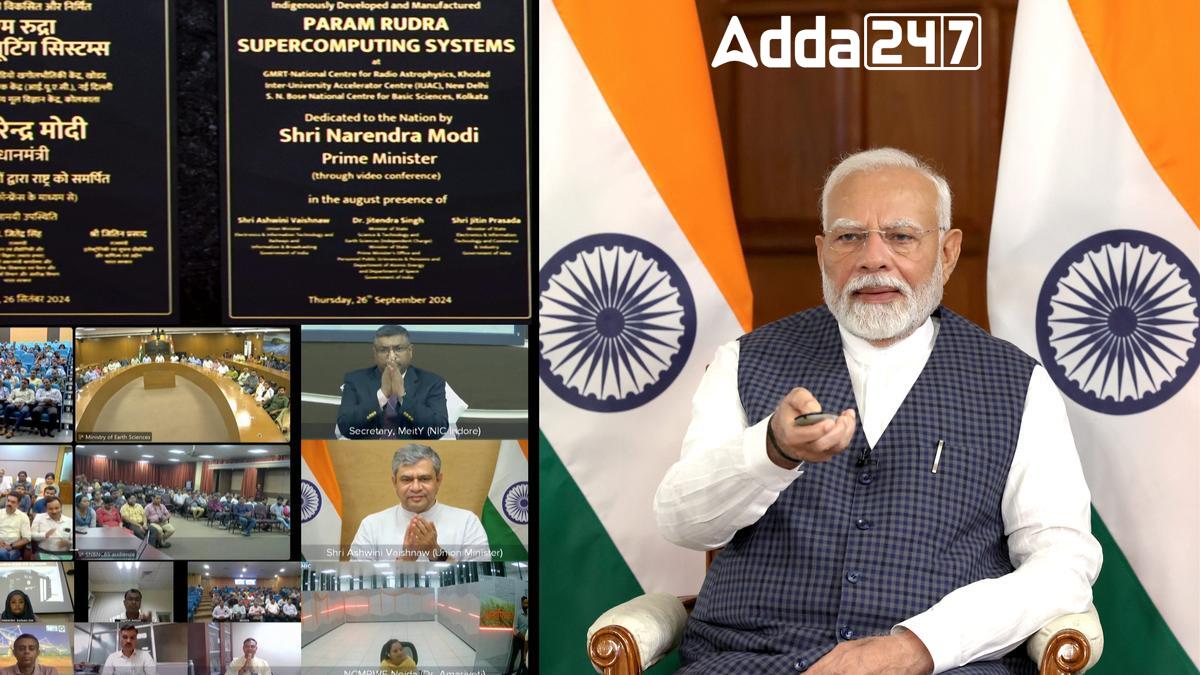
Prime Minister Narendra Modi virtually launched three PARAM Rudra supercomputers on September 26, 2024, emphasizing the importance of technological advancements for empowering the underprivileged. Developed indigenously under the National Supercomputing Mission (NSM) at a cost of ₹130 crore each, these high-performance computing systems are strategically deployed in Pune, Delhi, and Kolkata. With a total investment of ₹850 crore in the project, these supercomputers aim to facilitate pioneering scientific research across various disciplines.
Objectives and Applications
The PARAM Rudra supercomputers will support advanced scientific research in diverse fields. For instance, the Giant Metre Radio Telescope (GMRT) in Pune will utilize the supercomputers to explore astronomical phenomena such as Fast Radio Bursts (FRBs). Meanwhile, the Inter-University Accelerator Centre (IUAC) in Delhi will focus on enhancing research in material science and atomic physics, and the S N Bose Centre in Kolkata will drive studies in physics, cosmology, and earth sciences.
Driving Innovation and Self-Reliance
During the launch, Modi highlighted that “no sector can function without technology and computing capability.” He reiterated the goal of achieving self-reliance in high-performance computing, stating that India’s contributions should extend beyond mere bits and bytes to terabytes and petabytes. The initiative represents a significant step towards bolstering India’s computing capabilities and driving innovation in science and technology.
A Missed Visit
Although Modi initially planned to visit Pune for the launch, he had to cancel his trip due to heavy rains in the city. Officials noted that he was also scheduled to flag off a Metro train line and inaugurate development projects worth ₹22,600 crore.








 World Bank Ranks India Among Top 10 Emer...
 Elon Musk to Rename SpaceXAI as SpaceXSI
 Kerala Develops AI-Based Dengue Early Wa...