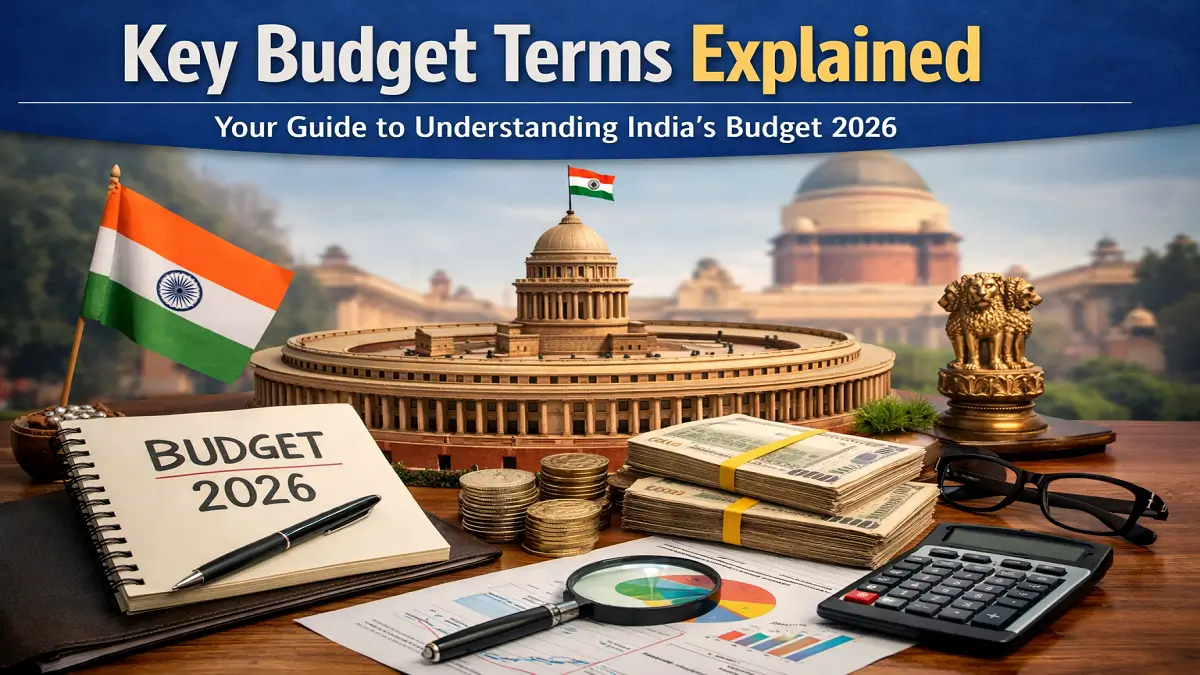
The Union Budget to be presented on February 1, 2026, by Finance Minister Nirmala Sitharaman is the Government’s blueprint on expenditure, taxes it plans to levy, and other transactions that affect the economy and lives of citizens. It will be presented against a backdrop of geopolitical uncertainties, including a steep 50% U.S. tariff on shipments from India.
To help you understand the budget discussions better, here are the key terms that shape how public spending and revenues are discussed:
Revenue and Spending Terms
Union Budget
A statement of the estimated receipts and expenditure of the government for a particular year. It outlines how much money the government will collect and spend, and on what items.
Fiscal Policy
It is what a government does to influence the course of an economy through decisions on taxes and spending. Fiscal policy is implemented through the budget. It’s the government’s tool to manage economic growth and inflation.
Monetary Policy
Monetary policy is what a central bank (Reserve Bank of India – RBI) does to influence the course of an economy through decisions on money supply and interest rates. While fiscal policy is about spending and taxes, monetary policy focuses on controlling money circulation.
Budget Categories
Capital Budget
The Capital Budget consists of capital receipts and payments. It includes investments in shares, loans and advances granted by the Central Government to State Governments, Government companies, corporations and other parties. This is about long-term assets and investments.
Capital Receipts
Capital receipts are the funds that either create liabilities or reduce assets. These include loans raised by the government (market loans), borrowings through the sale of Treasury Bills, loans received from foreign governments and bodies, and recoveries of loans from State and Union Territories.
Capital Expenditure (Capex)
Capital expenditure or capex is the money spent by the government on development or to acquire, upgrade, or maintain machinery or assets. This includes spending on land, buildings, machinery, equipment, investments in shares, and loans and advances to State Governments, Union Territories, Government companies, and Corporations. These are productive investments.
Revenue Budget
The revenue budget consists of revenue receipts of the government and its expenditure. It focuses on day-to-day spending and income that is not repayable.
Revenue Receipts
Income received by the government that is not repayable is revenue receipts. Revenue receipts are divided into two categories: tax and non-tax revenue. Tax revenues include income tax, corporate tax, excise, customs, service and other duties that the government levies. Non-tax revenue sources include interest on loans and dividends on investments.
Revenue Expenditure
Revenue expenditure doesn’t create or generate future returns. The government pays for salaries, pensions, and subsidies from revenue expenditure. This is for immediate consumption and recurring expenses, unlike capital expenditure which is for creating assets.
Types of Taxes
Direct Tax
A tax, such as income tax and corporate tax, which has to be borne directly by the person or entity it is imposed on. The tax collector is the same person who bears the tax burden.
Examples:
- Income Tax: Tax on personal and professional income
- Corporate Tax: Tax on company profits
- Property Tax: Tax on real estate ownership
Indirect Tax
A tax on goods and services, typically levied on an entity but paid by another. They are paid by consumers when they buy goods and services. The tax burden can be shifted to the consumer.
Examples:
- Goods and Services Tax (GST)
- Excise duty
- Customs duty
Excise Duty
An indirect tax levied on goods manufactured in India and meant for home consumption. It’s collected from producers and manufacturers rather than consumers directly.
Examples:
- Tax on alcohol, tobacco, petroleum products, and other goods manufactured domestically
Customs Duty
These are levies charged when goods are imported into, or exported from, the country. They are paid by the importer or exporter. Usually, these are also passed on to the consumer in the form of higher prices.
Purpose: To protect domestic industries and generate government revenue
Deficits Explained
Fiscal Deficit
A fiscal deficit arises when the government’s total expenditure exceeds its total revenue, excluding the money borrowed. In simple terms, it’s when the government spends more money than it collects as taxes and other revenues.
Impact:
- The government must borrow money to cover the deficit
- Higher borrowing can lead to inflation and interest rate increases
- It’s not always bad—governments often run deficits to invest in development
Revenue Deficit
The difference between revenue expenditure and revenue receipts is known as the revenue deficit. It shows the shortfall of the government’s current receipts over current expenditure. A revenue deficit means the government cannot even cover day-to-day expenses from its current income.
More concerning than fiscal deficit because it indicates structural spending problems.
Primary Deficit
The primary deficit is the fiscal deficit minus interest payments. It tells how much of the government’s borrowings are going towards meeting expenses other than interest payments. A smaller primary deficit is considered healthy.
Formula: Primary Deficit = Fiscal Deficit – Interest Payments
Goods and Services Tax (GST)
GST
Rolled out in India from April 1, 2016, the GST seeks to make the indirect tax structure simpler and efficient by replacing a slew of levies such as octroi, central sales tax, State sales tax, and entry tax.
Key Features:
- Unified indirect tax system across India
- Simplified compliance for businesses
- Transparent tax collection
- Reduced cascading of taxes (tax on tax)
Current GST Slabs: 0%, 5%, 12%, 18%, and 28%
Economic Measurement
Gross Domestic Product (GDP)
Gross Domestic Product (GDP) refers to the total market value of all finished goods and services produced within a country over a specified period of time. It’s the primary measure of a country’s economic size and health.
What GDP Includes:
- Manufacturing output
- Service sector contribution
- Agricultural production
- Construction activities
- All legal economic activities
Why It Matters:
- Indicates economic growth or contraction
- Used to compare countries’ relative economic size
- Helps policymakers make decisions
GDP Growth Rate
The year-on-year percentage increase in GDP. A 7% GDP growth, for example, means the economy grew 7% compared to the previous year.
Government Assets
Disinvestment
The sale of shares of public sector undertakings by the government is called disinvestment. The shares of government companies held by the government are assets at the disposal of the government. If these shares are sold to get cash, earning assets are converted into cash, so it’s referred to as disinvestment.
Purpose:
- Raise funds for government expenditure
- Improve efficiency of public enterprises
- Reduce government’s holding in companies
Recent Examples: Disinvestment in Air India, ONGC, and other PSUs
Why Understanding These Terms Matters
- Informed Citizenship: You can better understand news and policy announcements
- Personal Finance Decisions: Understanding taxation and inflation helps you plan investments and savings
- Democratic Participation: You can evaluate government policies and make informed voting decisions
- Economic Awareness: You understand how government decisions affect the overall economy and your daily life
Key Takeaways
- The Union Budget is the government’s financial plan for the year
- Fiscal policy (taxes and spending) and monetary policy (interest rates) are two main tools to manage the economy
- Capital expenditure creates assets while revenue expenditure is for immediate spending
- Direct taxes are borne by the payer; indirect taxes are passed on to consumers
- A fiscal deficit means the government spends more than it earns
- GDP measures the total economic output of a country








 World Bank Raises India’s GDP Growth F...
 Centre to Borrow ₹7.86 Trillion Throug...
 India Records Record FDI of $94.53 Billi...