
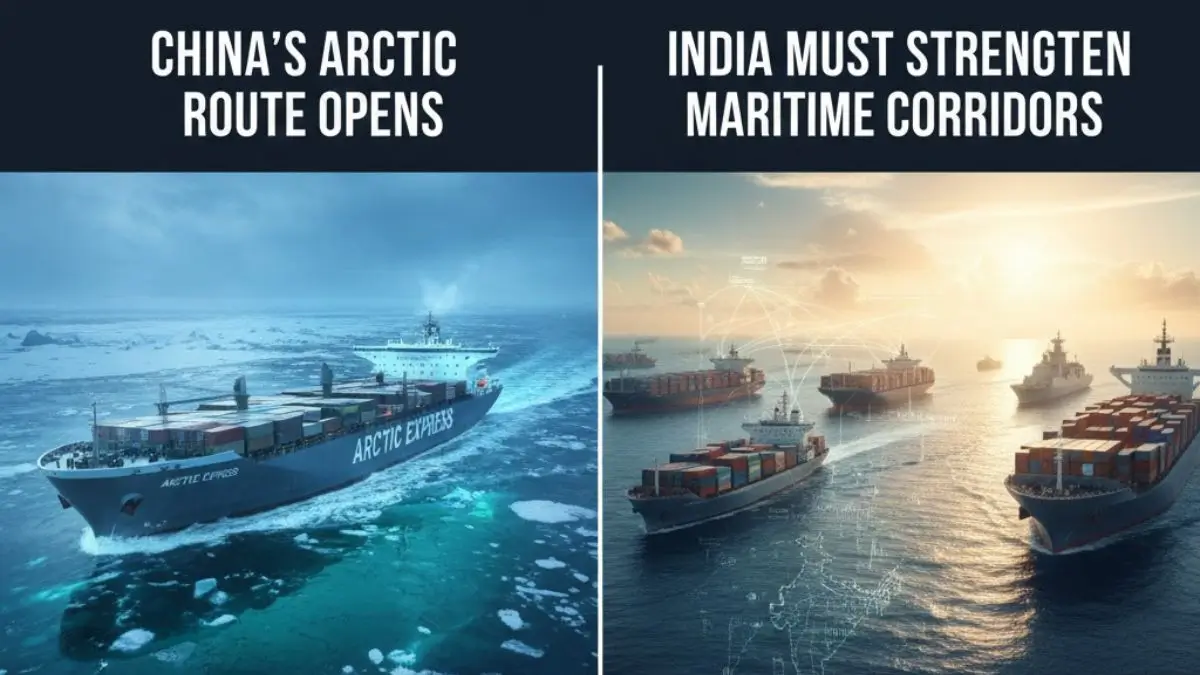
In a major move that could redefine global shipping dynamics, China launched the Arctic Express route in 2025, dramatically reducing transit time between Asia and Europe to just 18 days via the Northern Sea Route (NSR). This strategic development, aligned with China’s “Polar Silk Road” vision, bypasses traditional routes like the Suez Canal and Cape of Good Hope.
For India, the shift signals an urgent need to strengthen its maritime corridors, reinforce strategic partnerships, especially with Russia, and realign its geopolitical and trade strategies to remain competitive and connected in an evolving global order.
What Is the Arctic Express?
The Arctic Express is China’s first commercial Arctic shipping service between Ningbo-Zhoushan Port and the UK’s Felixstowe Port via the Northern Sea Route. The route,
- Cuts transit time to 18 days (vs. 40+ via the Suez Canal)
- Reduces logistics costs and carbon emissions by nearly 50%
- Avoids congested or volatile choke points like the Red Sea and Hormuz
The route also passes through geopolitically stable areas and offers faster, greener, and more secure logistics options — making it attractive to shippers and logistics firms globally.
Implications for India
Risk of Marginalisation
As Arctic shipping gains traction, traditional trade hubs like India risk being bypassed unless they offer competitive and reliable alternatives. India currently relies heavily on traditional sea routes, many of which are chokepoints vulnerable to conflict, piracy, or geopolitical instability.
Strategic and Economic Concerns
- Geopolitical Influence: Losing control over emerging trade corridors could reduce India’s strategic leverage in Indo-Pacific and Eurasian trade.
- Trade Competitiveness: Without faster alternatives, Indian exports may face higher transit times and costs compared to rivals using Arctic routes.
- Energy and Resource Access: India’s growing energy partnerships with Russia could benefit from Arctic proximity, particularly for LNG and crude oil imports.
India’s Response: Maritime Corridors in Focus
1. Chennai–Vladivostok Maritime Corridor (CVMC)
A 10,300 km direct sea route between India and Russia’s Far East, this corridor is designed to,
- Reduce travel time from 40 to 24 days
- Enhance Indo-Russian trade, especially in energy and heavy goods
- Serve as a potential link to Arctic routes via Russian ports
2. International North South Transport Corridor (INSTC)
- A 7,200 km multi-modal corridor connecting India to Europe via Iran, Central Asia and Russia.
- Cuts freight time and costs vs. Suez route
- Offers alternative trade pathways to the Arctic and Eurasia
3. India-Middle East-Europe Economic Corridor (IMEC)
- A recently launched initiative to connect Indian ports to the Arabian Gulf and on to Europe via rail and sea.
- Enhances connectivity with Western markets
- Offers a long-term counterbalance to China’s Arctic and BRI routes
India’s Arctic Engagement
India has been building its Arctic presence since 2008, with the Himadri Research Station in Svalbard and active participation in the Arctic Council as a permanent observer. India’s Arctic Policy (2022) outlines goals in,
- Scientific research
- Climate and environmental monitoring
- Connectivity through Arctic sea lanes
India’s ONGC Videsh has also shown interest in Russian Arctic LNG projects, underlining the energy-security aspect of Arctic engagement.
Key Takeaways
- China’s Arctic Express is a game-changer in global trade, offering faster and greener routes.
- India must act swiftly to develop competitive maritime corridors like Chennai–Vladivostok and INSTC.
- Strengthening port infrastructure, shipbuilding, and Arctic diplomacy is essential to safeguard economic and strategic interests.
- Arctic engagement is no longer optional — India must integrate polar trade routes into its long-term trade and energy security strategies.
- India’s Maritime Vision 2030 and Arctic Policy 2022 provide the blueprint — now execution and urgency are key.


 Mongolia Gets New Prime Minister Amid Po...
 Myanmar Military Chief Min Aung Hlaing B...
 Costa Rica Launches Snake Identification...











