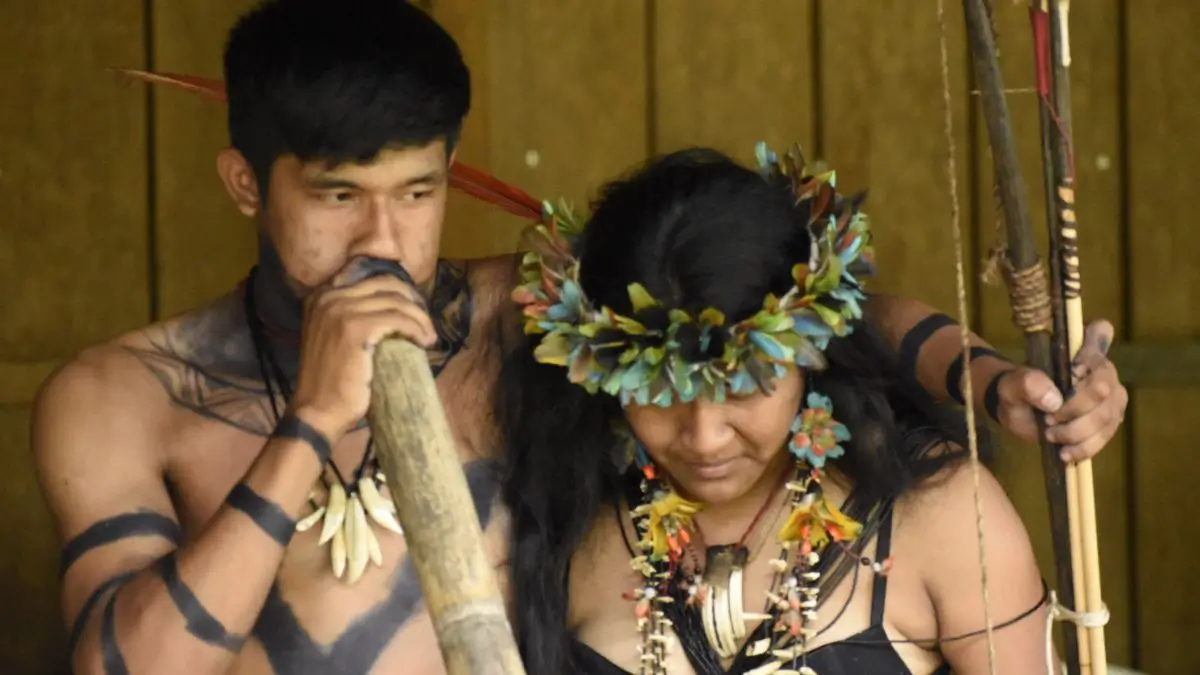
The Amondawa tribe, a small Indigenous community in the Amazon rainforest which appears to experience life differently from most modern societies. Their language reportedly has no word for “time”, no months, no years and no numerical ages. Instead of marking life by birthdays or calendars, people move through socially defined life stages and roles. Daily life centres on immediate needs, relationships, and the surrounding natural world rather than abstract schedules or future timelines.
Amondawa Tribe and the “No Word for Time” Claim
The Amondawa tribe first came to wider attention in 1986.
- Researchers from the University of Portsmouth and the Federal University of Rondonia studied their language and culture.
- According to Professor Chris Sinha, the tribe can describe events but does not treat time as an independent concept.
- Time does not “float above events” as an abstract framework.
Importantly, this does not mean the Amondawa cannot understand sequences of events. They clearly can distinguish before and after.
No Clocks, No Years: Life Organized by Stages
The Amondawa do not count age in years.
- Individuals are identified by life stages, social roles or achievements.
- Transitions in life are marked by ceremonies and responsibilities not dates.
- There is no mapping of events onto weeks, months or calendars.
- The focus remains on events themselves rather than on a linear timeline.
In this system, life is experienced as a series of meaningful changes rather than as movement along a numbered scale of years.
Spatial Mapping of Time: A Missing Concept?
In many languages, people describe time using space-based metaphors. For example,
- The future is “ahead.”
- The past is “behind.”
- The Amondawa reportedly do not use such spatial mapping of time. Words describing movement are used literally for physical landscapes rivers, forests, hills not for abstract temporal concepts.
- Some researchers suggest that the absence of clocks, calendars, and advanced number systems may influence this linguistic pattern. Without “time technology,” abstract time may not develop as a separate cultural category.
Amondawa Language and Portuguese Influence
The Amondawa are increasingly exposed to Portuguese.
- Researchers report they can learn and use temporal concepts from other languages.
- This suggests abstract time is not beyond their cognitive ability.
- Rather, it is simply not central to their traditional cultural framework.
As integration with wider Brazilian society grows, traditional ways of thinking about events and life stages may gradually change.
Question
Q. The Amondawa tribe primarily organizes life based on,
A. Calendar years
B. Clock time
C. Life stages and roles
D. Astrological charts


 Raja Ravi Varma Painting Breaks Records ...
 Shah Rukh Khan Debuts in Hurun Global Ri...
 NIM–JIM&WS Team Successfully Summits...