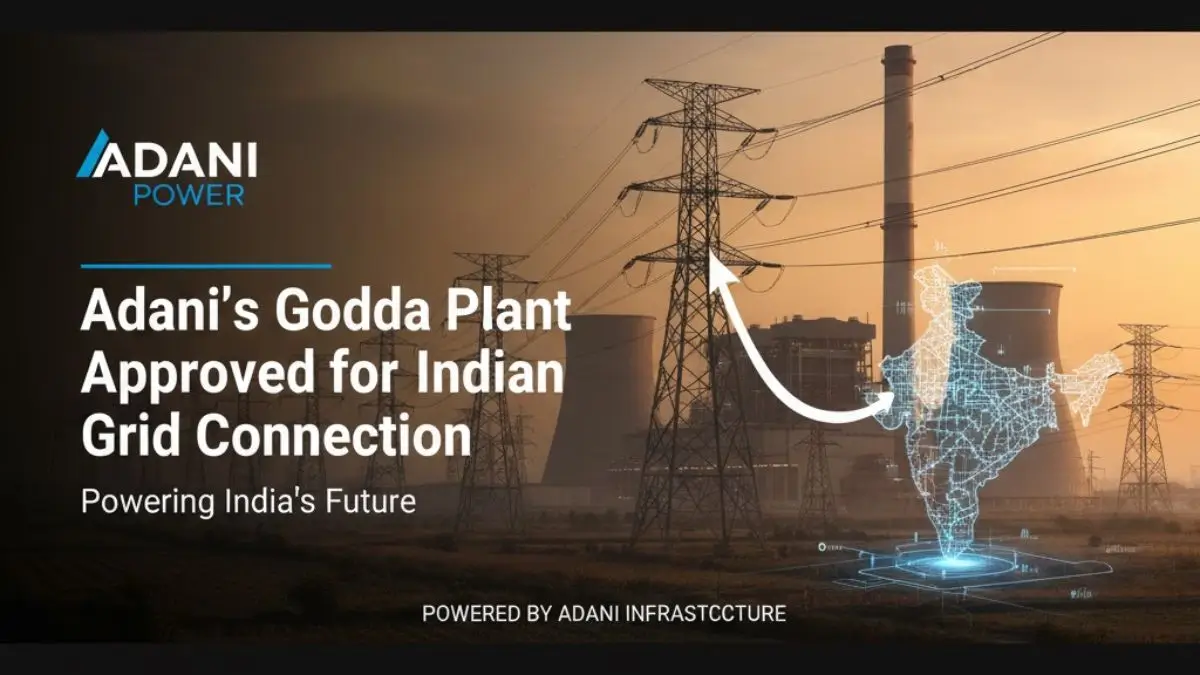
In a significant policy shift, the Government of India has approved the connection of Adani Power’s Godda Ultra Super Critical Thermal Plant to the national electricity grid. This 1,600 MW plant in Jharkhand, previously built to export electricity exclusively to Bangladesh, will now also supply power domestically — a decision expected to reshape the landscape of India’s cross-border power trade and grid strategy.
What is the Godda Power Plant?
- Located in Godda district of Jharkhand, the Godda plant is a coal-based ultra supercritical thermal power station built by Adani Power Limited (APL). It was commissioned primarily to export power to Bangladesh under a long-term agreement.
- Now, in 2025, this export-only status is changing.
Grid Connection Details
- APL has been granted permission to connect the plant to the Indian national grid using a “Line-In Line-Out” (LILO) arrangement on the Kahalgaon–Maithon B 400 kV transmission line.
- This permission was granted under Section 164 of the Electricity Act, 2003, which allows the Ministry of Power to provide transmission line laying rights akin to those under the Indian Telegraph Act, 1885.
- The LILO route will cover 56 villages across Godda and Poreyahat tehsils.
- The approval is valid for 25 years, subject to obtaining clearances from bodies such as Railways, Civil Aviation, Highways, Defence, and local authorities, including wildlife and environment regulations.
Why Is This Significant?
1. Strategic Grid Flexibility
- The decision allows the Godda plant, initially an export-only asset, to act as a dual-purpose power provider — supporting domestic grid demand during high consumption periods.
2. Boosting National Supply
- Adds 1,600 MW to India’s domestic electricity availability.
- Meets rising power demand across sectors.
- Improves plant utilization, especially if exports are limited or delayed.
3. Policy Precedent
- This case marks a first-of-its-kind precedent for an export-oriented power plant to be integrated into the domestic Inter-State Transmission System (ISTS).
Regulatory and Policy Adjustments
To enable this shift, the following policy and regulatory frameworks were amended,
- Ministry of Power: Revised cross-border electricity trade guidelines (August 2024)
- CentralElectricity Authority (CEA): Modified procedures for cross-border power flow
- Central Electricity Regulatory Commission (CERC): Amended General Network Access (GNA) and ISTS regulations
Benefits to India
- Improved Power Security: Adds critical capacity to national grid.
- Better Asset Utilisation: Reduces underuse of a high-investment asset.
- Geopolitical Risk Hedging: Reduces reliance on external power demand (Bangladesh).
- Private Sector Integration: Encourages more public-private synergy in India’s power grid.


 What is the Strait of Hormuz? Know About...
 Which Country is the Largest Consumer of...
 Amol Palekar to Receive META Lifetime Ac...