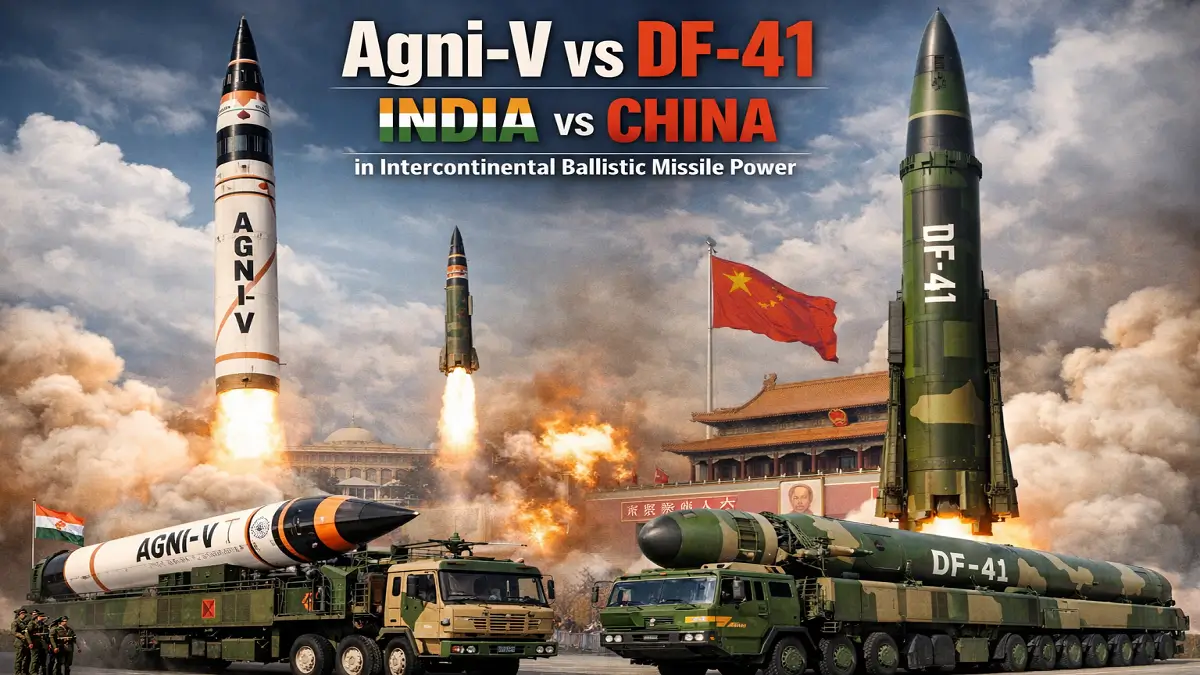
In today’s strategic environment, Intercontinental Ballistic Missiles (ICBMs) represent the highest level of land-based military deterrence. These missiles can travel thousands of kilometers and deliver nuclear warheads with high precision.
Two major Asian powers — India and China — have developed advanced long-range missile systems to strengthen their nuclear deterrence capabilities. India’s Agni-V and China’s Dongfeng-41 (DF-41) are among the most powerful missiles in their respective arsenals. Understanding the differences between them is important for students preparing for defence, international relations, and security-related exams.
What Is an Intercontinental Ballistic Missile (ICBM)?
An ICBM is a long-range ballistic missile designed to carry nuclear warheads over distances greater than 5,500 km. It travels in a high arc, briefly exiting the Earth’s atmosphere before re-entering to strike its target.
ICBMs form a crucial part of a country’s nuclear triad, which includes:
-
Land-based missiles
-
Submarine-launched missiles
-
Strategic bombers
This triad ensures a second-strike capability, meaning a country can retaliate even after facing a nuclear attack.
Agni-V: India’s Long-Range Strategic Missile
The Agni-V is India’s most advanced long-range ballistic missile, developed by the Defence Research and Development Organisation (DRDO). It significantly strengthens India’s land-based nuclear deterrent.
Key Features of Agni-V
- Type: Three-stage, solid-fuel ballistic missile
- Range: Approximately 5,000–8,000 km
- Payload: Around 1.5 tonnes, nuclear capable
- Launch System: Canisterised road-mobile launcher
- Guidance: Advanced navigation and guidance system for improved accuracy
- MIRV Capability: Designed to carry Multiple Independently Targetable Reentry Vehicles (MIRVs)
Why Agni-V Is Important
The missile allows India to cover most of Asia and parts of Europe, including strategic regions deep inside potential adversary territory. Its canister launch system improves mobility, reduces launch preparation time, and enhances survivability.
For India, Agni-V supports its doctrine of credible minimum deterrence and No First Use (NFU) policy.
DF-41: China’s Most Powerful ICBM
The DF-41 (Dongfeng-41) is one of the most advanced and longest-range ICBMs in the world. It represents a key pillar of China’s rapidly modernizing nuclear forces.
Key Features of DF-41
- Type: Three-stage, solid-fuel ICBM
- Range: Approximately 12,000–15,000 km
- Payload: Can carry multiple nuclear warheads
- MIRV Capability: Yes, capable of deploying several warheads on different targets
- Launch Options: Road-mobile, rail-mobile, and silo-based
- Accuracy: High precision with modern guidance systems
Why DF-41 Is Important
The DF-41 gives China the ability to reach targets across continents, including North America and Europe. Its mobility and multiple deployment modes make it harder to detect and destroy, increasing its survivability during conflict.
Agni-V vs DF-41: Direct Comparison
| Feature | Agni-V (India) | DF-41 (China) |
|---|---|---|
| Range | 5,000–8,000 km | 12,000–15,000 km |
| Type | Solid-fuel, 3-stage | Solid-fuel, 3-stage |
| MIRV | Yes | Yes (higher capacity) |
| Mobility | Road-mobile, canisterised | Road, rail, and silo |
| Payload | ~1.5 tonnes | Larger payload capacity |
| Strategic Reach | Primarily regional | Global reach |
Strategic Role in National Security
India’s Perspective
For India, the Agni-V is mainly aimed at strengthening deterrence against regional adversaries, particularly China. It ensures India can respond effectively to threats across Asia. The focus is on credible deterrence, not arms racing.
China’s Perspective
China’s DF-41 reflects its ambition for global strategic deterrence. With longer range and higher MIRV capacity, it is designed to maintain nuclear balance with major global powers and enhance second-strike capability.
Key Takeaways for Exam Preparation
- Agni-V is India’s longest-range operational missile and supports regional deterrence.
- DF-41 has intercontinental global reach, making it one of the world’s most powerful ICBMs.
- Both missiles use solid fuel, which allows faster launch readiness.
- MIRV technology increases strike effectiveness by allowing multiple warheads from a single missile.
- The comparison highlights the difference between India’s regional security focus and China’s global deterrence strategy.


 Indian Air Force to Equip MiG-29 Jets wi...
 Indian Navy Hosts IONS Maritime Exercise...
 Indian Army Gets First Batch of Prahar L...