
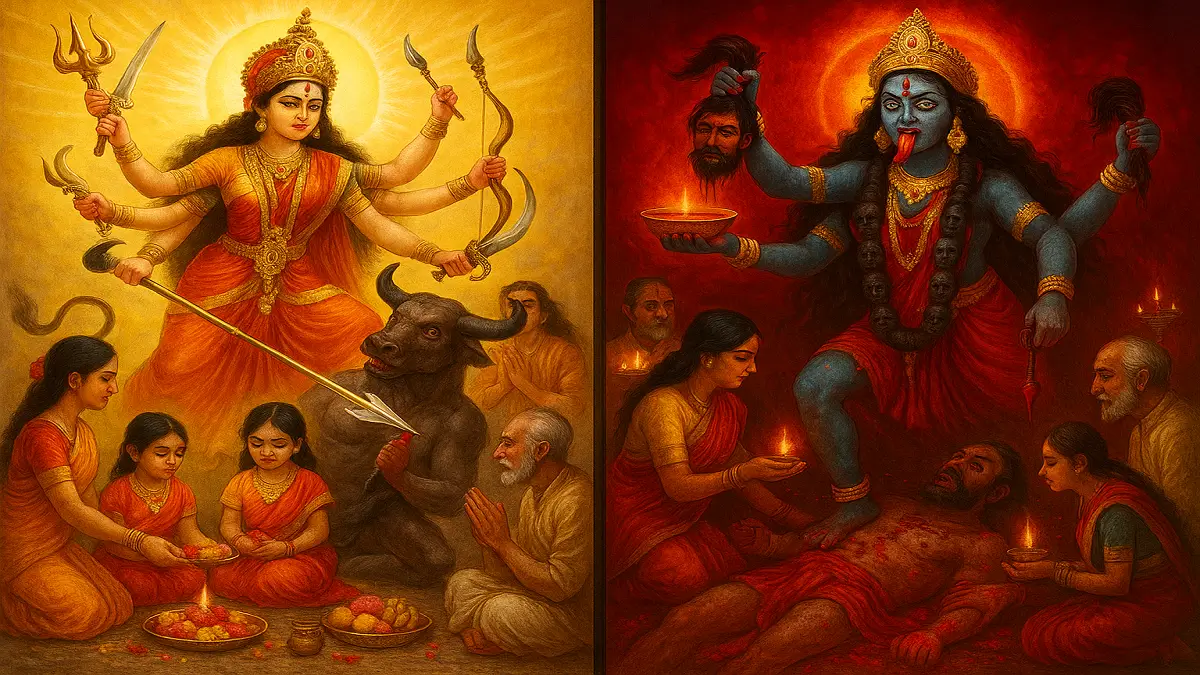
Navratri is one of the most celebrated Hindu festivals, dedicated to Goddess Durga and her nine divine forms. Each day of Navratri has special importance, but the eighth day (Ashtami) and ninth day (Navami) are considered the most sacred. Interestingly, while some devotees perform the main rituals on Durga Ashtami, others prefer to do them on Maha Navami. This difference often confuses people, but it actually has deep cultural and spiritual roots.
Significance of Ashtami
- Durga Ashtami (eighth day of Navratri) is believed to be the day when Goddess Durga killed the demon Mahishasura, marking the victory of good over evil.
- It is especially important in North India (Uttar Pradesh, Haryana, Punjab, Himachal Pradesh, and Delhi).
- On this day, devotees perform Kanya Pujan (worship of young girls as the form of Devi) and Havan (fire ritual).
- Many families complete their Navratri fasts on this day, considering it the most powerful tithi.
Significance of Navami
- Maha Navami (ninth day of Navratri) is equally important. According to beliefs, Goddess Durga destroyed the demon Raktabija on this day, putting an end to her fierce battle with evil forces.
- It holds special value in West Bengal, Odisha, Bihar, and South India, where Navami is celebrated with grandeur.
- In Bengal’s Durga Puja, Navami is the day of the grand rituals before immersion (Visarjan) on Vijayadashami.
- Many devotees also perform Kanya Pujan and charity on Navami instead of Ashtami.
Why the Difference Exists
- Regional Traditions – Different regions of India follow different customs, passed down over generations.
- Family Practices – Some families have the tradition of Ashtami puja, while others observe Navami.
- Scriptural Flexibility – Hindu scriptures consider both days auspicious for completing rituals, giving devotees the freedom to choose.
- Spiritual Belief – Some believe Ashtami represents the beginning of victory, while Navami signifies its completion.
Key Difference in Celebration
| Aspect | Ashtami (8th Day) | Navami (9th Day) |
|---|---|---|
| Demon Defeated | Mahishasura | Raktabija |
| Main Regions | North India | East & South India |
| Main Rituals | Kanya Pujan, Havan | Kanya Pujan, Durga Puja rituals |
| Belief | Beginning of victory | Completion of victory |


 Which Place is known as the Onion Hub of...
 Who were the Seven Sisters of Petroleum?...
 What is the State Flower of Florida? Che...











