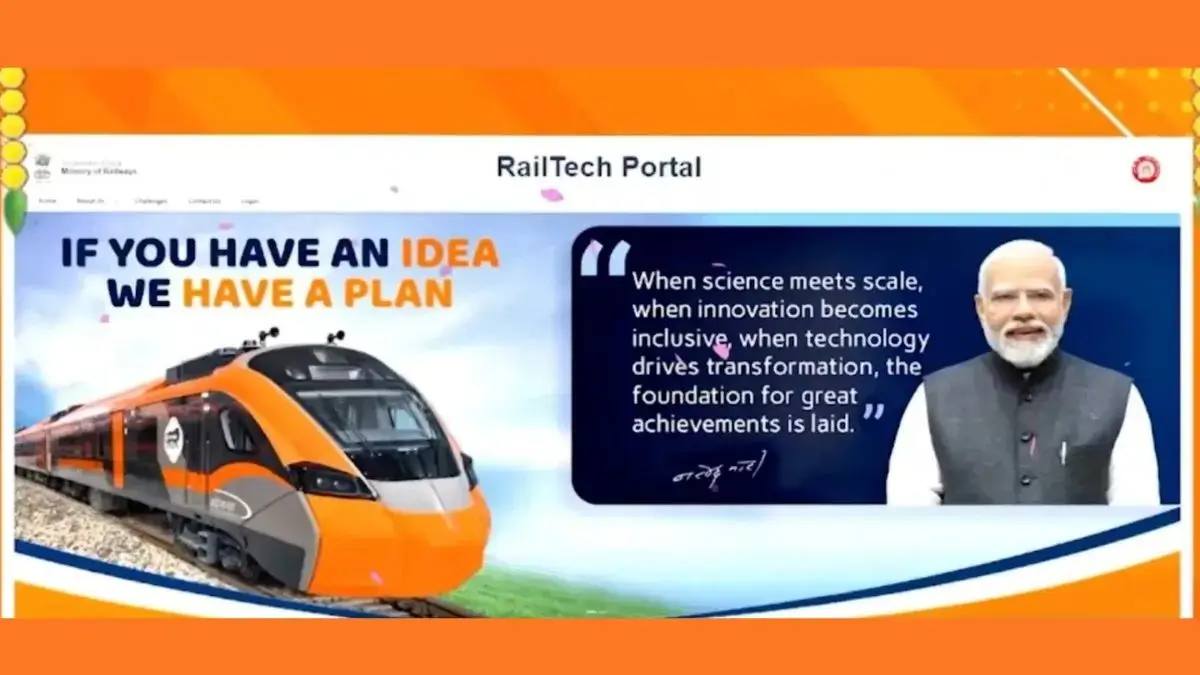
Indian railway system is getting a major digital upgrade. Union Minster of Railways Ashwini Vaishnaw announced the Rail Tech Policy 2026, the Rail Tech Portal, and the e-Railway Claims Tribunal (e-RCT) in New Delhi. These steps are part of Indian Railways ambitious plan of 52 reforms in 52 weeks. The reforms focus on technology adoption, innovation, safety and faster digital justice delivery. The minister said these changes will modernize railway operations and make services more transparent and citizen-friendly.
Rail Tech Policy 2026: Massive Technology Push in Indian Railways
The Rail Tech Policy 2026 aims to promote large scale adoption of the advanced technology across Indian Railways. Key highlights include,
- Systematic induction of modern technologies into railway operations.
- Engagement with innovators, startups, industry and academic institutions.
- Focus on improving safety, efficiency and reliability.
- Creation of a structured framework to test and scale innovations.
- Encouragement of public-private collaboration for technology deployment.
The Rail Tech Policy 2026 signals a shift toward data driven, AI powered and innovation led railway governance.
AI in Indian Railways Under Rail Tech Policy 2026
A major feature of the Rail Tech Policy 2026 is the use of Artificial Intelligence for safety and monitoring. Key innovation areas include,
- AI-based Elephant Intrusion Detection System to prevent wildlife accidents.
- AI-based fire detection system in coaches for faster emergency response.
- Drone based broken rail detection system to identify track faults.
- Obstruction detection in foggy conditions for safer train movement.
These AI-driven systems under the Rail Tech Policy 2026 aim to reduce accidents and improve operational efficiency.
Rail Tech Portal India: Innovation Platform for Startups
Along with the Rail Tech Policy 2026, the minister launched the Rail Tech Portal India. The portal is designed to bring innovators and railway authorities onto a common digital platform.
Key features of the Rail Tech Portal India include,
- Online submission of innovative proposals.
- Transparent evaluation and approval process.
- Direct engagement with railway departments.
- Opportunity for startups and institutions to pilot projects.
- Faster adoption of successful technologies.
The Rail Tech Portal India is expected to accelerate innovation within Indian Railways.
e-Railway Claims Tribunal: Digital Justice Reform
The fourth reform announced is the e-Railway Claims Tribunal (e-RCT) system. This reform aims to modernize case handling in the Railway Claims Tribunal.
Main objectives of the e-Railway Claims Tribunal include,
- Online filing and tracking of cases.
- Faster processing and adjudication of claims.
- Increased transparency and accountability.
- Accessibility from anywhere in India.
- Full digitisation of 23 Railway Claims Tribunal benches within 12 months.
The e-Railway Claims Tribunal marks a citizen-centric digital transformation in railway dispute resolution.
52 Reforms in 52 Weeks: Bigger Reform Agenda
The Rail Tech Policy 2026 and e-Railway Claims Tribunal are part of a larger reform agenda. Indian Railways has committed to implementing 52 reforms in 52 weeks this year.
Earlier reforms included,
- Improvements in onboard passenger services.
- Expansion of Gati Shakti Cargo Terminals with better facilities.
- The Rail Tech Policy 2026 fits into this broader modernization roadmap focused on efficiency, transparency and technology-driven governance.
Significance Indian Railways Modernization Drive
- Indian Railways is one of the largest railway networks in the world, carrying millions of passengers daily.
- In recent years the focus has shifted toward digitisation, safety enhancement and infrastructure expansion.
- Technology adoption has become central to reforms, including AI-based monitoring, smart ticketing and cargo digitization.
- The Rail Tech Policy 2026 strengthens this direction by creating a formal framework for innovation.
- With increasing freight targets and passenger demand, systematic technology integration is critical for future-ready railway operations.
Question
Q. The Rail Tech Policy 2026 focuses primarily on,
A) Fare revision
B) Technology adoption in Indian Railways
C) Privatisation of railways
D) Ticket subsidy reforms


 Operation HimSetu: Army Completes High R...
 What Is NHAI’s 'Arogya Van' Initiative? ...
 India Withdraws Its Plan to Host COP33 S...