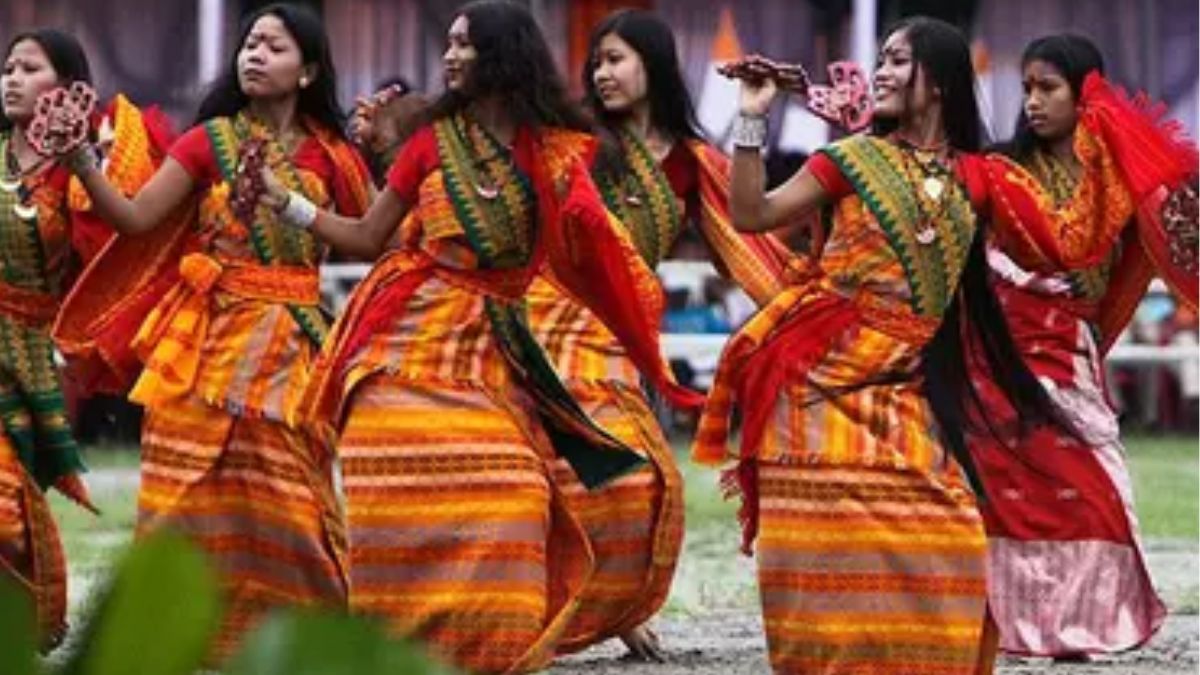
In a landmark move ahead of the upcoming national census, the Bathou religion, practiced by the Bodo community of Assam, has been granted a separate code—a first-time recognition of its religious identity at the national level. This official acknowledgment marks a significant step toward preserving and promoting the cultural and spiritual heritage of one of Northeast India’s most prominent indigenous groups.
What is Bathou Religion?
- The Bathou religion is an ancient spiritual practice centered around the worship of nature and the five fundamental elements—earth, water, fire, air, and sky.
- The faith emphasizes harmonious coexistence with nature, and its rituals are deeply embedded in the Bodo people’s everyday lives.
- The central symbol of Bathou is the Sijou plant, considered sacred and planted in the courtyard of believers as a representation of Bathoubwrai, the supreme god.
- Followers of the religion practice spiritual rites that predate modern institutional religions, and the faith remains a strong cultural anchor among the Bodo population.
A Historic Recognition
- The announcement of a distinct census code for Bathou religion has been welcomed as a historic and long-overdue recognition.
- Previously, followers of Bathou were often grouped under the umbrella of ‘Others’ in census records, which led to a lack of visibility for their distinct identity.
- Promod Boro, leader of the United Peoples’ Party-Liberal (UPPL) and former Chief Executive Member of the Bodoland Territorial Council (BTC), expressed gratitude to Union Home Minister Amit Shah for fulfilling a long-standing demand.
- Boro hailed the decision as a form of national acknowledgment of Bathou’s spiritual and cultural importance.
Instructions for Census Enumerators
- To ensure accurate documentation of religious data, the Registrar General of India has issued specific instructions to census enumerators.
- Enumerators are now required to record the religion exactly as stated by respondents, without altering or reclassifying them under broad categories.
- This protocol ensures that all minority, tribal, and regional faiths—including Bathou—are fairly and distinctly represented in census data.
- This directive was officially communicated to Sarada Prasad Mashahari, Chairman of the Bathou Traditional and Cultural Centre in Kokrajhar, a key institution advocating for the religion’s recognition.


 Amaravati Set to Become The Andhra Prade...
 How Many Seats Are There in Bihar Legisl...
 Nitish Kumar Resigns as Legislative Coun...