
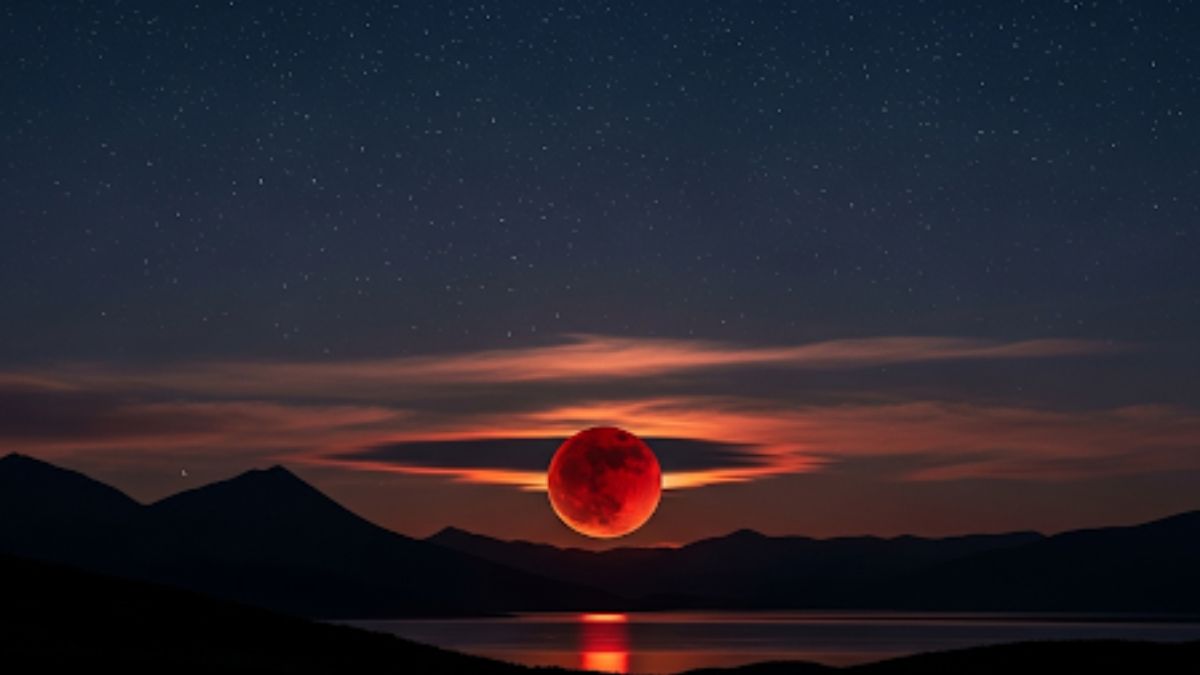
On the night of September 7–8, 2025, skywatchers across much of the Eastern Hemisphere will witness one of the most striking astronomical events of the decade—a total lunar eclipse popularly known as a Blood Moon. For 82 minutes, the Moon will bathe in a dramatic deep red hue, making it the longest total lunar eclipse of 2025 and one of the most widely visible.
This eclipse will offer an extended window for observers to enjoy the spectacle, particularly across Asia, Africa, Europe, and Australia, where visibility will be optimal. For enthusiasts, photographers, and students preparing for competitive exams, this event is both visually stunning and scientifically significant.
What is a Blood Moon?
A Blood Moon occurs during a total lunar eclipse when the Earth comes directly between the Sun and the Moon, casting its shadow over the Moon. Instead of disappearing into darkness, the Moon glows red due to Rayleigh scattering—the same effect that causes sunsets to appear red.
As sunlight passes through Earth’s atmosphere, shorter blue wavelengths scatter, and longer red wavelengths bend toward the Moon. The result is a reddish glow that varies depending on dust, pollution, and cloud density in Earth’s atmosphere.
Eclipse Timeline and Duration
The eclipse’s timeline is as follows (all times in UTC),
- Penumbral Eclipse Begins: 15:28
- Partial Eclipse Begins: 16:27
- Totality Begins: 17:30
- Maximum Eclipse: 18:11
- Totality Ends: 18:52
- Partial Eclipse Ends: 19:56
- Penumbral Eclipse Ends: 20:55
Totality will last 82 minutes, longer than the usual 60–70 minutes, offering ample time to observe the Moon’s transformation.
Where Will the Blood Moon Be Visible?
This eclipse will be visible across a vast portion of the globe,
- Asia and Australia: Will see the full eclipse from start to finish.
- Eastern Africa and much of Europe: Best visibility during totality.
- North and South America: Unfortunately, not visible due to daytime skies.
- Countries like India, China, Japan, Australia, and parts of Africa and Europe are best placed to enjoy the full spectacle.
How to Watch: No Special Gear Required
One of the best things about a lunar eclipse is that it’s completely safe to view with the naked eye. You don’t need any special equipment, though the experience can be enhanced with,
- Binoculars or telescopes to see craters and surface details.
- A dark, open sky away from urban light pollution.
- Clear weather, as clouds can obstruct the view.
For those in regions where the eclipse isn’t visible, several platforms will live-stream the event, including,
- TimeandDate.com (starting 12 p.m. EDT)
- Virtual Telescope Project (1:45 p.m. EDT)
- NASA, along with local observatories, offering real-time commentary and visuals.
Why This Eclipse Matters
Beyond its beauty, this September 2025 Blood Moon holds scientific and cultural significance,
- Longest Total Eclipse of 2025: At 82 minutes, it exceeds typical durations.
- Scientific Insight: The Moon’s color helps assess Earth’s atmospheric conditions.
- Cultural Resonance: Historically linked to myths, harvest festivals, and rituals. This eclipse coincides with the Harvest Moon, marking seasonal traditions.
- Rare Visibility for Some Regions: North America won’t see it; their next chance comes March 2–3, 2026.


 Meet MAI-Transcribe-1: Microsoft’s Fast,...
 What is Outer Space Treaty 1967? Princip...
 What Is Mission Mitra? ISRO’s New Experi...











