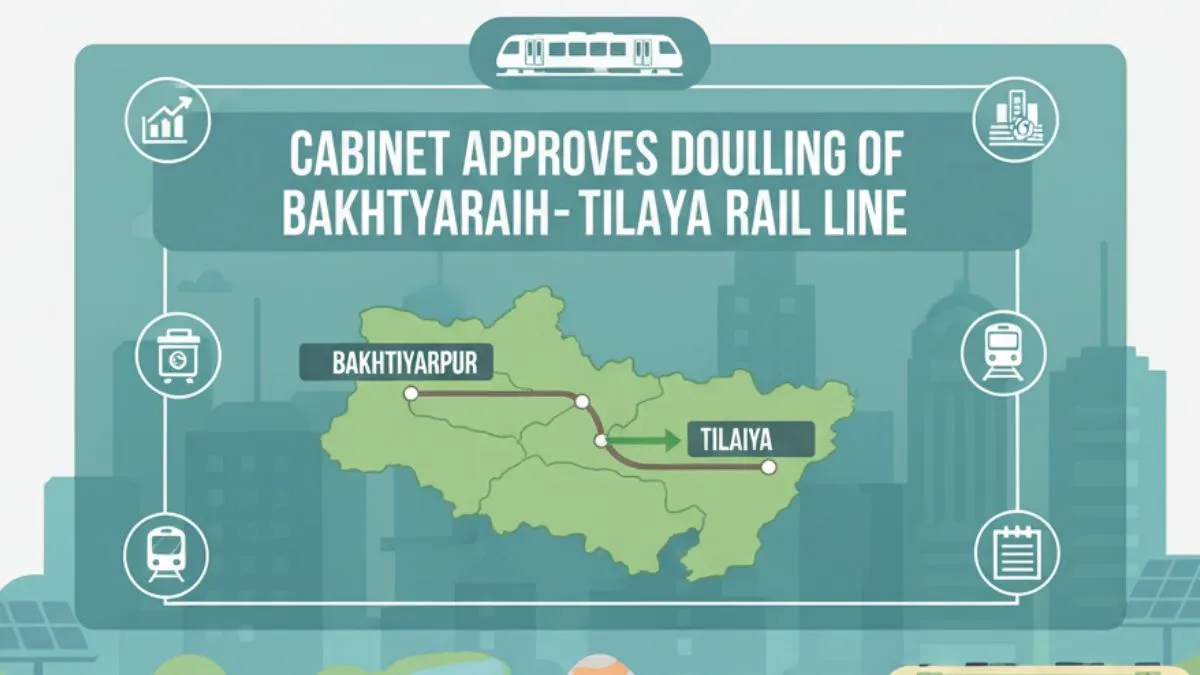
In a major boost to railway infrastructure in Bihar, the Cabinet Committee on Economic Affairs (CCEA), chaired by Prime Minister Narendra Modi, approved the doubling of the 104-km Bakhtiyarpur–Rajgir–Tilaiya railway line. With an estimated cost of ₹2,192 crore, the project is poised to transform regional connectivity, promote freight movement, and enhance tourism in the area.
This critical infrastructure upgrade aligns with the government’s focus on multi-modal logistics, climate goals, and inclusive regional development, and is part of the PM Gati Shakti National Master Plan.
Project Overview
- Railway Line Section: Bakhtiyarpur – Rajgir – Tilaiya
- Total Distance: 104 km
- Project Cost: ₹2,192 crore (approx.)
- Districts Covered: 4 districts in Bihar
- Villages Benefited: Approx. 1,434 villages
- Population Benefited: Around 13.46 lakh
- Aspirational Districts Covered: Gaya and Nawada
The project will result in the doubling of the existing single-track line, thereby expanding the operational capacity and improving the mobility of both passenger and freight trains.
Strategic Importance
1. Freight and Economic Efficiency
The section is vital for the transport of bulk commodities like,
- Coal
- Cement
- Clinker
- Fly ash
Once completed, the route is expected to handle additional freight traffic of 26 MTPA (Million Tonnes Per Annum). This will help decongest other busy routes and reduce overall logistics costs, benefiting industries and exporters.
2. Environmental Benefits
The project aligns with India’s climate action goals. Key environmental gains include,
- Oil import reduction: Estimated savings of 5 crore litres
- CO2 emission cut: 24 crore kg, equivalent to planting 1 crore trees
- Promotion of rail-based freight, a more energy-efficient and eco-friendly alternative to road transport
3. Tourism and Pilgrimage Boost
The railway line connects prominent religious and historical destinations,
- Rajgir (famous for Shanti Stupa)
- Nalanda (ancient Buddhist learning center)
- Pawapuri (Jain pilgrimage site)
This connectivity is expected to attract pilgrims and tourists from across India, strengthening the region’s economy.
4. Socio-Economic Impact
The project enhances mobility for 13.46 lakh people across 1,434 villages, contributing to,
- Improved access to markets and services
- Better employment and self-employment opportunities
- Faster regional development under the Aspirational Districts Programme
Alignment with PM Gati Shakti Plan
The project is part of the PM Gati Shakti National Master Plan, which aims to create a digitally integrated, multi-modal transport ecosystem in India. Through integrated planning and stakeholder consultations, such projects aim to,
- Enhance logistics efficiency
- Minimize delays through infrastructure synchronization
- Reduce cost of movement for people, goods, and services
The new line capacity will help decongest critical routes, making train operations smoother, faster, and more reliable.
Static Facts
- Project: Doubling of Bakhtiyarpur–Rajgir–Tilaiya line (104 km)
- Cost: ₹2,192 crore
- Coverage: 4 districts, 1,434 villages, 13.46 lakh people
- Benefits: 26 MTPA freight, tourism, Aspirational Districts, Gati Shakti alignment
- PM Gati Shakti Launch Date: 13 October 2021
- Total Length of Indian Railways Network: Over 68,000 km (as of 2023)
- Railway Ministry: Under Ministry of Railways, Government of India
- Indian Railways Freight Share: About 27% of total freight in India
- Aspirational District Programme: Launched in January 2018, coordinated by NITI Aayog


 PM Modi Launches Kaynes Semiconductor Pl...
 India Census 2027 Digital: Phase 1 Start...
 PM Modi Inaugurates Samrat Samprati Muse...