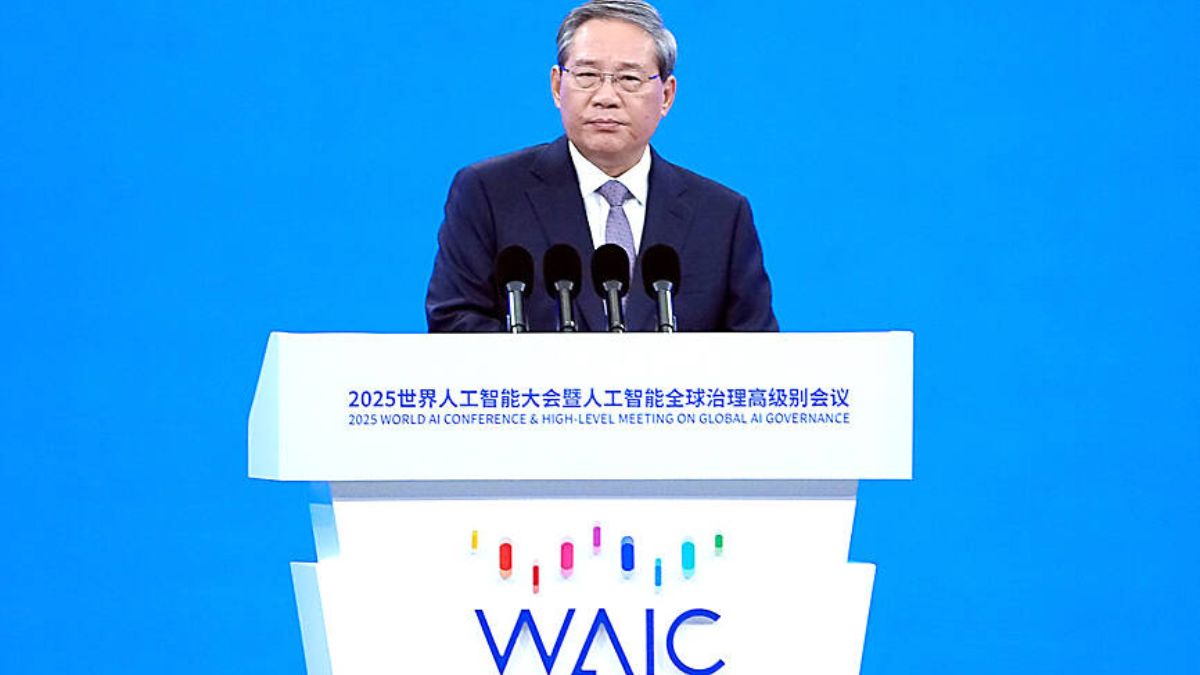
At the World Artificial Intelligence Conference (WAIC) 2025 held in Shanghai, Chinese Premier Li Qiang stressed the urgent need for a global consensus on balancing the development of artificial intelligence (AI) with its security risks. His remarks come at a time when the US-China technology race continues to intensify, with both nations striving for global AI leadership.
China’s Position on AI Governance
Need for Balance Between Innovation and Security
Premier Li Qiang highlighted that while AI promises immense opportunities for growth and innovation, it also brings significant risks and challenges. These include the spread of misinformation, potential job losses, ethical concerns, and the danger of losing technological control. He emphasized that the world urgently requires a shared framework to balance AI advancement with safety regulations.
Push for Open-Source Development
Li announced the establishment of a Chinese-led international body for AI cooperation. He underscored that open-source AI would be actively promoted, allowing developing countries to benefit from cutting-edge technologies. He warned that if nations engaged in technological monopolies and blockades, AI would remain limited to only a few powerful countries and corporations.
US Strategy and Its Impact
Trump’s Deregulation Drive
The remarks by Li came just after US President Donald Trump unveiled a low-regulation strategy to boost AI innovation. Trump promised to remove red tape and onerous regulations that could restrict private sector growth, aiming to solidify US dominance in the AI sector.
Restrictions on China
At the same time, Washington has been expanding its restrictions on the export of advanced chips to China, citing concerns that such technologies could strengthen Beijing’s military systems and threaten US technological supremacy.
China’s Path to Technological Self-Reliance
Overcoming Bottlenecks
Premier Li acknowledged that the shortage of computing power and chips remains a major bottleneck for China’s AI development. However, he pointed to significant domestic progress. For example, in January 2025, the Chinese startup DeepSeek unveiled an AI model that rivaled top US systems, despite using less powerful chips.
AI as a National Priority
China has identified AI development as a pillar of its technological self-reliance strategy, with the government pledging strong policy support and investments to strengthen the sector.
Global Concerns and Ethical Dimensions
Warnings from Experts
During the WAIC, Nobel Prize-winning physicist Geoffrey Hinton, often referred to as the “Godfather of AI,” likened AI development to raising a tiger cub. He warned that without careful governance, AI could become uncontrollable, just like a grown tiger turning on its owner.
International Call for Cooperation
In a video address, UN Secretary-General Antonio Guterres called AI governance a “defining test of international cooperation.” Similarly, France’s AI envoy Anne Bouverot highlighted the urgent need for global action to ensure safe and ethical AI deployment.
At an earlier AI Summit in Paris (February 2025), 58 countries, including China, France, and India, along with the European Union and the African Union Commission, pledged to strengthen cooperation on AI governance. However, the US and UK declined to sign, warning against excessive regulation that could hinder innovation.


 Preeti Saran Re-Elected as UN Committee ...
 Global Trade Hits New High in 2025: Key ...
 Iran–US Ceasefire: Iran’s 10 Conditions ...