The Conference of the Parties (COP) serves as the supreme decision-making body of the UN Framework Convention on Climate Change (UNFCCC). Every country that has signed the Convention, known as “Parties”, takes part in these meetings. The main goal is simple yet vital: to assess how nations are performing in reducing greenhouse gas emissions and to make decisions that ensure the effective implementation of the Convention.
At each COP, member countries review reports on national emissions and climate actions, discuss progress, and adopt new measures to strengthen climate governance. The COP also handles administrative and institutional arrangements to ensure the Convention’s objectives are met globally.
How did the COP start, and how often does it meet?
The first COP meeting was held in Berlin, Germany, in March 1995. Since then, COP sessions have been organized every year, unless decided otherwise by the Parties. These meetings are hosted either in Bonn, Germany—home to the UNFCCC Secretariat—or by a country that volunteers to host.
The presidency of the COP rotates among the five recognized UN regions:
- Africa
- Asia
- Latin America and the Caribbean
- Central and Eastern Europe
- Western Europe and Others
This rotation also often influences where the sessions are held. For instance, recent meetings have taken place in Africa (Egypt, 2022), Asia (UAE, 2023), and Europe (Poland, 2018).
What are the key tasks of the COP?
A major task of the COP is to review national climate reports and emission inventories submitted by countries. These documents show what each nation is doing to reduce emissions and adapt to climate change impacts. Based on these, the COP assesses progress toward the Convention’s ultimate objective—stabilising greenhouse gas concentrations to prevent dangerous interference with the climate system.
The COP also serves as a platform for new agreements and frameworks, such as the historic Kyoto Protocol (1997) and the Paris Agreement (2015), which remain crucial to global climate action.
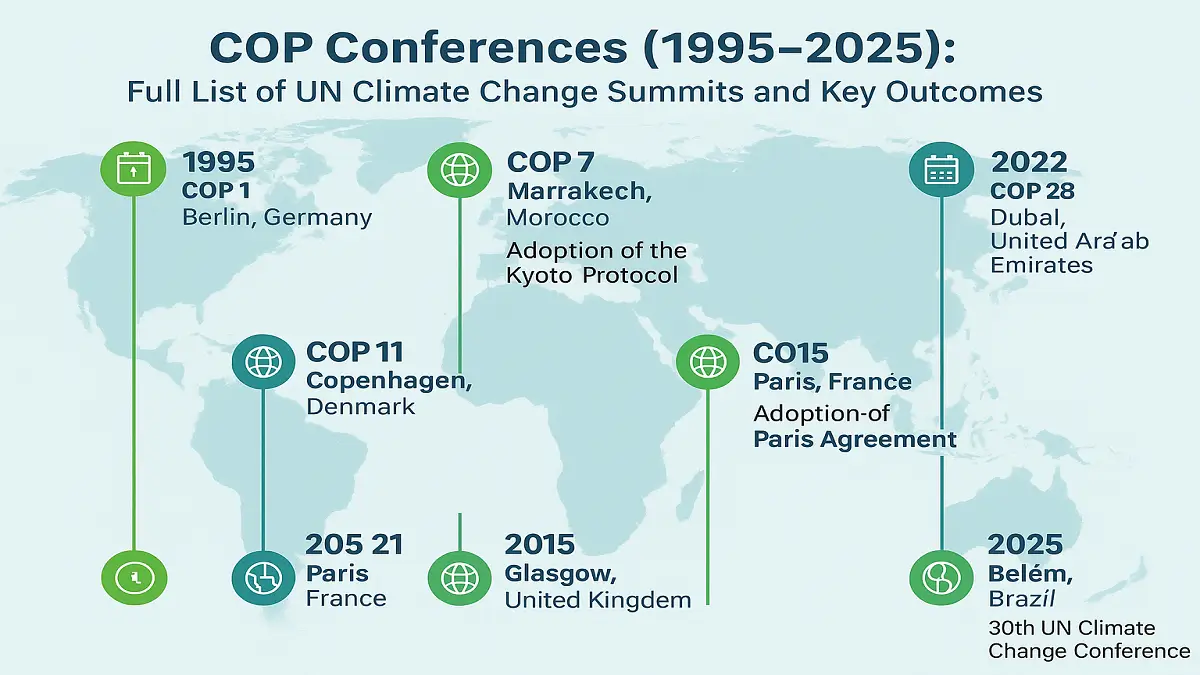
List of COP Conferences (1995–2025)
Here’s a look at where each COP took place since 1995:
| COP Number | Year | Location (City, Country) | Official Name / Key Notes |
|---|---|---|---|
| COP 1 | 1995 | Berlin, Germany | Berlin Climate Change Conference |
| COP 2 | 1996 | Geneva, Switzerland | Geneva Climate Change Conference |
| COP 3 | 1997 | Kyoto, Japan | Adoption of the Kyoto Protocol |
| COP 4 | 1998 | Buenos Aires, Argentina | Buenos Aires Climate Change Conference |
| COP 5 | 1999 | Bonn, Germany | Bonn Climate Change Conference |
| COP 6 | 2000 | The Hague, Netherlands | The Hague Climate Change Conference |
| COP 6-2 | 2001 | Bonn, Germany | Resumed COP6 – Bonn Climate Change Conference |
| COP 7 | 2001 | Marrakech, Morocco | Marrakech Climate Change Conference |
| COP 8 | 2002 | New Delhi, India | New Delhi Climate Change Conference |
| COP 9 | 2003 | Milan, Italy | Milan Climate Change Conference |
| COP 10 | 2004 | Buenos Aires, Argentina | Buenos Aires Climate Change Conference |
| COP 11 | 2005 | Montreal, Canada | Montreal Climate Change Conference |
| COP 12 | 2006 | Nairobi, Kenya | Nairobi Climate Change Conference |
| COP 13 | 2007 | Bali, Indonesia | Bali Road Map adopted |
| COP 14 | 2008 | Poznań, Poland | Poznań Climate Change Conference |
| COP 15 | 2009 | Copenhagen, Denmark | Copenhagen Accord discussed |
| COP 16 | 2010 | Cancún, Mexico | Cancún Agreements adopted |
| COP 17 | 2011 | Durban, South Africa | Durban Platform for Enhanced Action |
| COP 18 | 2012 | Doha, Qatar | Doha Amendment to Kyoto Protocol |
| COP 19 | 2013 | Warsaw, Poland | Warsaw Framework for REDD+ |
| COP 20 | 2014 | Lima, Peru | Lima Call for Climate Action |
| COP 21 | 2015 | Paris, France | Adoption of the Paris Agreement |
| COP 22 | 2016 | Marrakech, Morocco | Implementation of the Paris Agreement |
| COP 23 | 2017 | Bonn, Germany (hosted by Fiji) | Talanoa Dialogue launched |
| COP 24 | 2018 | Katowice, Poland | Katowice Rulebook adopted |
| COP 25 | 2019 | Madrid, Spain (hosted by Chile) | Further negotiations on Article 6 |
| COP 26 | 2021 | Glasgow, United Kingdom | Glasgow Climate Pact |
| COP 27 | 2022 | Sharm el-Sheikh, Egypt | Loss and Damage Fund established |
| COP 28 | 2023 | Dubai, United Arab Emirates | First Global Stocktake under Paris Agreement |
| COP 29 | 2024 | Baku, Azerbaijan | Focus on Climate Finance and Accountability |
| COP 30 | 2025 | Belém, Brazil | 30th UN Climate Change Conference – Focus on Global Implementation and Collective Action |
What Makes COP30 in Brazil So Significant?
The upcoming COP30, scheduled for November 2025 in Belém, Brazil, will mark a major milestone—it’s the 30th global climate summit since the UNFCCC’s creation. The choice of Brazil, a country with vast rainforests and rich biodiversity, underscores the urgency of protecting ecosystems central to global climate stability.
At COP30, leaders will revisit commitments made in previous conferences and evaluate whether countries are on track to meet net-zero emission goals. The summit is expected to emphasize:
- Collective climate action, since greenhouse gases know no borders.
- Support for developing nations, especially those facing rising seas and extreme weather.
- Stronger adaptation and financing mechanisms to implement climate promises effectively.
By the time COP30 takes place, twenty-nine earlier COP meetings will have set the foundation through goals, guidelines, and pledges for climate action. The challenge now is turning those commitments into measurable, real-world results.


 Which River is known as the Rhine of Ind...
 Where is the World's Highest ATM Located...
 Top 10 Most Valuable Banks in the World ...