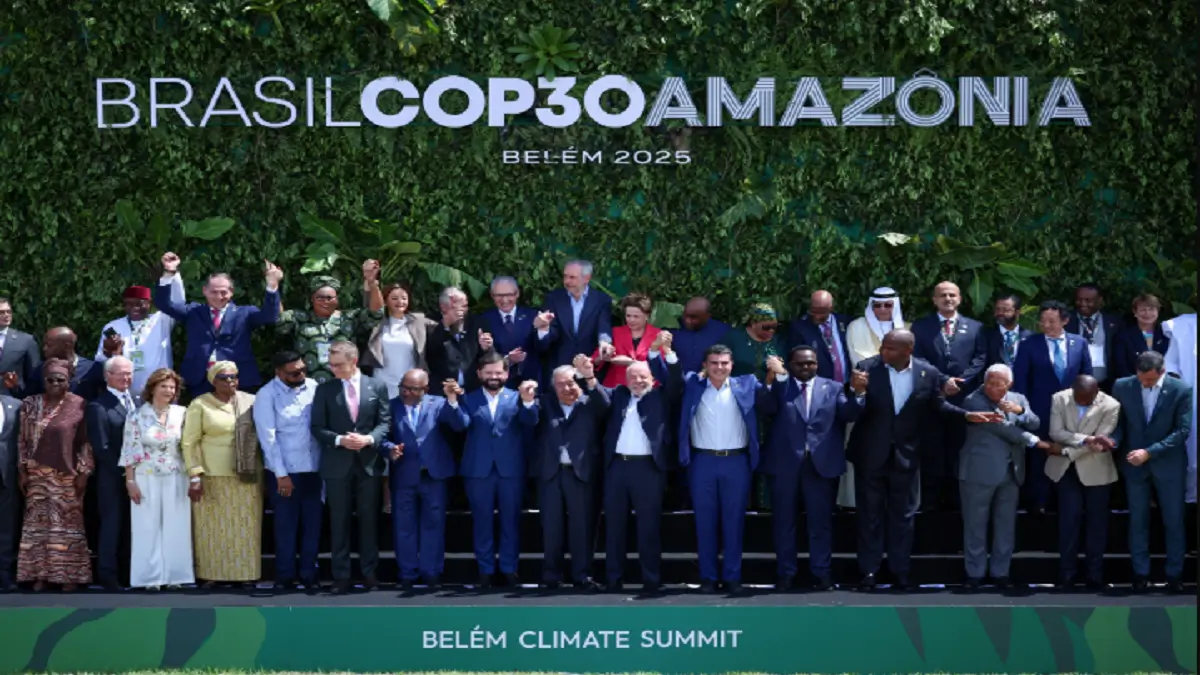
What is COP30?
COP30 stands for the 30th meeting of the Parties to the United Nations Framework Convention on Climate Change (UNFCCC) — a global platform where nearly 200 countries discuss and negotiate international efforts to combat climate change.
This edition is particularly significant because it shifts focus from pledges to implementation, ensuring that commitments under the Paris Agreement are turned into real-world actions to limit global warming and protect vulnerable communities.
Host Country and Venue
- Host Country: Brazil
- Host City: Belém, in the state of Pará, situated in the heart of the Amazon rainforest
- Dates: 10 to 21 November 2025
- Heads of State Summit: 6–7 November 2025
- Venue: Hangar Convention and Fair Centre of the Amazon, Belém
The choice of the Amazon as the location underscores the vital role forests play in global climate stability.
Theme and Key Focus Areas
The broad theme of COP30 is centred around implementation, inclusion, and innovation. It highlights the urgency of delivering climate actions, protecting ecosystems, and empowering vulnerable communities.
Key thematic priorities include:
- Adaptation: Strengthening communities and ecosystems against climate impacts like floods, droughts, and rising sea levels.
- Nature-based Solutions: Using forests, mangroves, and wetlands as natural carbon sinks.
- Climate Finance: Mobilising both public and private funds to support developing nations.
- Technology and Innovation: Encouraging clean-energy systems and sustainable industrial practices.
- Just Transition: Ensuring a fair and inclusive shift towards low-carbon economies.
The Six Pillars of COP30 (Action Agenda)
The Action Agenda of COP30 rests on six foundational pillars that define its direction:
- Mitigation: Reducing greenhouse gas emissions to slow global warming.
Example: Transitioning from coal-based to renewable power sources. - Adaptation: Enhancing resilience of communities, nature, and infrastructure.
Example: Constructing flood defences and early-warning systems in coastal regions. - Finance: Mobilising funds to support global climate initiatives.
Example: A proposed $1.3 trillion climate finance roadmap from “Baku to Belém.” - Technology: Promoting innovation and sharing clean technologies worldwide.
Example: Supporting electric vehicle development and renewable energy systems. - Capacity-Building: Strengthening local governance, institutions, and expertise.
Example: Training local bodies to design and execute climate-resilient policies. - Means of Implementation: Integrating the above elements into policies and frameworks that turn commitments into concrete action.
Agenda and Objectives of COP30
The COP30 agenda focuses on accelerating global climate progress through collective efforts:
- Reviewing the first Global Stocktake to measure progress toward Paris Agreement goals.
- Encouraging nations to submit updated Nationally Determined Contributions (NDCs).
- Boosting climate finance and technology transfer for developing countries.
- Promoting adaptation and resilience measures, especially for vulnerable communities.
- Strengthening multilevel cooperation between governments, private sectors, and civil society.
List of Participating Countries
Nearly 198 Parties (countries) under the UNFCCC are expected to take part in COP30. These include almost all the world’s nations. While some major emitters’ leaders might not attend the summit, most countries will send delegations comprising policymakers, scientists, and civil society representatives.
| S.No. | Country / Party Name | S.No. | Country / Party Name |
|---|---|---|---|
| 1 | Afghanistan | 101 | Monaco |
| 2 | Albania | 102 | Mongolia |
| 3 | Algeria | 103 | Montenegro |
| 4 | Andorra | 104 | Morocco |
| 5 | Angola | 105 | Mozambique |
| 6 | Antigua and Barbuda | 106 | Myanmar |
| 7 | Argentina | 107 | Namibia |
| 8 | Armenia | 108 | Nauru |
| 9 | Australia | 109 | Nepal |
| 10 | Austria | 110 | Netherlands |
| 11 | Azerbaijan | 111 | New Zealand |
| 12 | Bahamas | 112 | Nicaragua |
| 13 | Bahrain | 113 | Niger |
| 14 | Bangladesh | 114 | Nigeria |
| 15 | Barbados | 115 | Niue |
| 16 | Belarus | 116 | North Macedonia |
| 17 | Belgium | 117 | Norway |
| 18 | Belize | 118 | Oman |
| 19 | Benin | 119 | Pakistan |
| 20 | Bhutan | 120 | Palau |
| 21 | Bolivia (Plurinational State of) | 121 | Panama |
| 22 | Bosnia and Herzegovina | 122 | Papua New Guinea |
| 23 | Botswana | 123 | Paraguay |
| 24 | Brazil (Host) | 124 | Peru |
| 25 | Brunei Darussalam | 125 | Philippines |
| 26 | Bulgaria | 126 | Poland |
| 27 | Burkina Faso | 127 | Portugal |
| 28 | Burundi | 128 | Qatar |
| 29 | Cabo Verde | 129 | Republic of Korea (South Korea) |
| 30 | Cambodia | 130 | Republic of Moldova |
| 31 | Cameroon | 131 | Romania |
| 32 | Canada | 132 | Russian Federation |
| 33 | Central African Republic | 133 | Rwanda |
| 34 | Chad | 134 | Saint Kitts and Nevis |
| 35 | Chile | 135 | Saint Lucia |
| 36 | China | 136 | Saint Vincent and the Grenadines |
| 37 | Colombia | 137 | Samoa |
| 38 | Comoros | 138 | San Marino |
| 39 | Congo | 139 | Sao Tome and Principe |
| 40 | Cook Islands | 140 | Saudi Arabia |
| 41 | Costa Rica | 141 | Senegal |
| 42 | Côte d’Ivoire | 142 | Serbia |
| 43 | Croatia | 143 | Seychelles |
| 44 | Cuba | 144 | Sierra Leone |
| 45 | Cyprus | 145 | Singapore |
| 46 | Czech Republic | 146 | Slovakia |
| 47 | Democratic People’s Republic of Korea (North Korea) | 147 | Slovenia |
| 48 | Democratic Republic of the Congo | 148 | Solomon Islands |
| 49 | Denmark | 149 | Somalia |
| 50 | Djibouti | 150 | South Africa |
| 51 | Dominica | 151 | South Sudan |
| 52 | Dominican Republic | 152 | Spain |
| 53 | Ecuador | 153 | Sri Lanka |
| 54 | Egypt | 154 | State of Palestine |
| 55 | El Salvador | 155 | Sudan |
| 56 | Equatorial Guinea | 156 | Suriname |
| 57 | Eritrea | 157 | Sweden |
| 58 | Estonia | 158 | Switzerland |
| 59 | Eswatini (Swaziland) | 159 | Syrian Arab Republic |
| 60 | Ethiopia | 160 | Tajikistan |
| 61 | European Union (Regional Economic Integration Organization) | 161 | Thailand |
| 62 | Fiji | 162 | Timor-Leste |
| 63 | Finland | 163 | Togo |
| 64 | France | 164 | Tonga |
| 65 | Gabon | 165 | Trinidad and Tobago |
| 66 | Gambia | 166 | Tunisia |
| 67 | Georgia | 167 | Türkiye (Turkey) |
| 68 | Germany | 168 | Turkmenistan |
| 69 | Ghana | 169 | Tuvalu |
| 70 | Greece | 170 | Uganda |
| 71 | Grenada | 171 | Ukraine |
| 72 | Guatemala | 172 | United Arab Emirates |
| 73 | Guinea | 173 | United Kingdom |
| 74 | Guinea-Bissau | 174 | United Republic of Tanzania |
| 75 | Guyana | 175 | United States of America |
| 76 | Haiti | 176 | Uruguay |
| 77 | Honduras | 177 | Uzbekistan |
| 78 | Hungary | 178 | Vanuatu |
| 79 | Iceland | 179 | Venezuela (Bolivarian Republic of) |
| 80 | India | 180 | Viet Nam |
| 81 | Indonesia | 181 | Yemen |
| 82 | Iran (Islamic Republic of) | 182 | Zambia |
| 83 | Iraq | 183 | Zimbabwe |
| 84 | Ireland | 184 | Andorra |
| 85 | Israel | 185 | Armenia |
| 86 | Italy | 186 | Kazakhstan |
| 87 | Jamaica | 187 | Kyrgyzstan |
| 88 | Japan | 188 | Lao People’s Democratic Republic |
| 89 | Jordan | 189 | Lebanon |
| 90 | Kenya | 190 | Lesotho |
| 91 | Kiribati | 191 | Liberia |
| 92 | Kuwait | 192 | Libya |
| 93 | Kyrgyzstan | 193 | Liechtenstein |
| 94 | Lao People’s Democratic Republic | 194 | Luxembourg |
| 95 | Latvia | 195 | Malawi |
| 96 | Lebanon | 196 | Malaysia |
| 97 | Lesotho | 197 | Maldives |
| 98 | Liberia | 198 | Malta |
Major Announcements and Developments Ahead of COP30
- Brazil unveiled the “Baku to Belém” climate finance roadmap, aiming to mobilise $1.3 trillion for global climate action.
- Indigenous leaders from the Andes and Amazon regions plan to push for stronger protection of Indigenous rights and lands.
- Adaptation has been declared a central theme, reflecting the Amazon’s ecological importance.
- Brazil faces logistical challenges, including accommodation constraints, with temporary cruise-ship housing being arranged for participants.
- Global discussions continue around carbon-market rules and stronger adaptation finance mechanisms.
Why COP30 Matters
- It marks the 30th anniversary of UNFCCC climate summits, symbolising three decades of climate diplomacy.
- Hosted in the Amazon, it highlights the crucial link between forests, biodiversity, and climate balance.
- It seeks to transform promises into measurable actions, bridging the gap between ambition and implementation.
- Developing nations view COP30 as an opportunity to demand greater financial and technological support from wealthier countries.
Summary Table
| Item | Details |
|---|---|
| Host Country | Brazil |
| Host City | Belém, Pará |
| COP 30 Dates | 10 – 21 November 2025 |
| Heads of State Summit | 6 – 7 November 2025 |
| Venue | Hangar Convention & Fair Centre, Belém |
| Main Theme | Implementation, Adaptation, Inclusion, and Nature-Based Solutions |
| Six Pillars | Mitigation, Adaptation, Finance, Technology, Capacity-Building, Implementation |
| Participating Nations | Around 198 UNFCCC Parties |
| Key Outcomes Expected | Finance roadmap, updated NDCs, forest protection measures, carbon-market rules |


 India Pharma 2026 Conference: Advancing ...
 WTO MC14 2026 Explained: Agenda, Issues,...
 International Rail Coach Expo 2026 Inaug...