
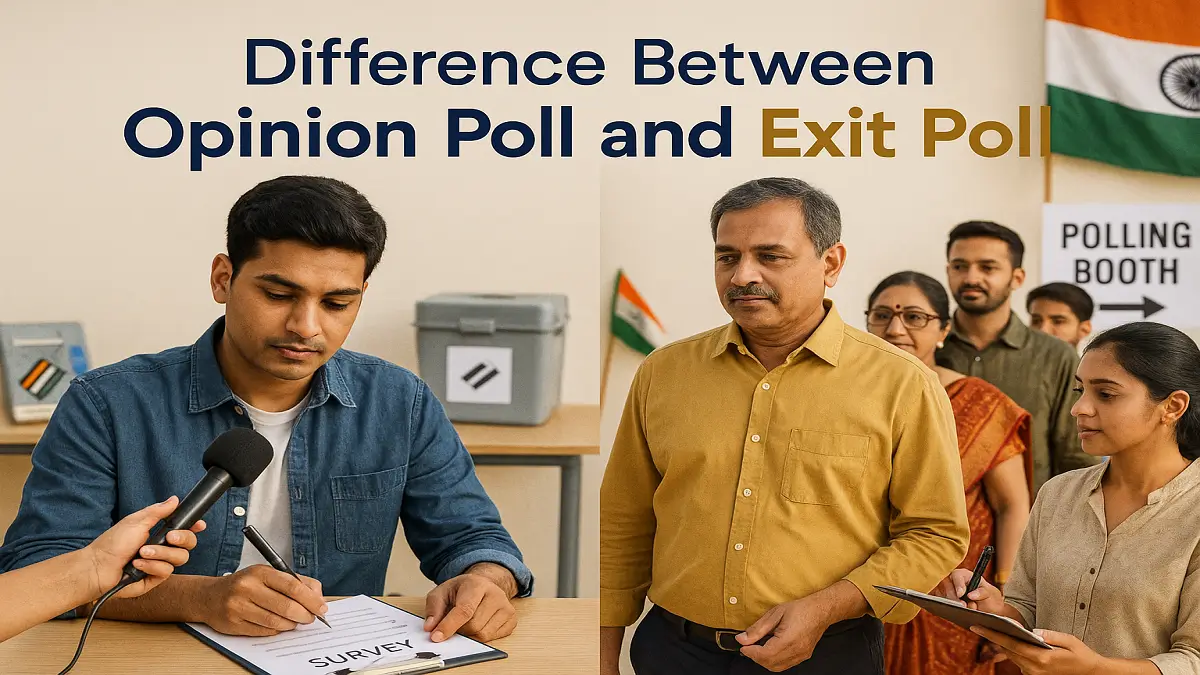
During every election season, you might notice headlines filled with numbers predicting which political party could win. These predictions often come from Opinion Polls and Exit Polls — two popular tools used by media and researchers to analyse voting trends.
At first glance, both seem similar since they deal with elections and voter choices. But there’s one major difference that sets them apart — the timing and purpose.
While Opinion Polls are conducted before voting, to know what people intend to do, Exit Polls are conducted after voting, to find out what people actually did. Understanding this difference is crucial for students, competitive exam aspirants, and anyone interested in how democracy functions.
What Is an Opinion Poll?
An Opinion Poll is a pre-election survey that measures the intention of voters before they cast their votes. It helps political parties and analysts understand who people plan to vote for, what issues matter to them, and how public mood is shifting during campaigns.
These polls are conducted using telephone interviews, online surveys, or face-to-face interactions in public areas. Since people may change their minds later, Opinion Polls are less reliable for predicting final results. However, they are valuable for showing which way the political wind is blowing.
Example:
A month before the election, a news channel surveys 1,000 people. The results show 45% support Party A and 40% support Party B. This reflects the public mood before the polls begin.
What Is an Exit Poll?
An Exit Poll, on the other hand, is a post-voting survey conducted immediately after voters leave the polling station. It asks voters who they actually voted for.
The purpose of an Exit Poll is to give an early indication of election results before official counting starts. These polls are considered more accurate because they reflect real voter behaviour rather than intentions.
Example:
On election day, surveyors outside polling booths ask voters, “Which party did you just vote for?” The results show 48% of voters supported Party A. When the actual results are declared, Party A wins with 50% of the vote — showing how close Exit Polls can come to real outcomes.
Key Differences Between Opinion Poll and Exit Poll
| Feature | Opinion Poll | Exit Poll |
|---|---|---|
| Timing | Conducted before the election. | Conducted after voting on election day. |
| What It Measures | Voter intention – who people plan to vote for. | Voter action – who people actually voted for. |
| Location | Conducted anywhere – via phone, online, or in public spaces. | Conducted outside polling booths. |
| Accuracy | Less reliable – voters may change their mind. | More reliable – records actual voting behaviour. |
| Influence | Can influence voters if published before elections. | Published only after voting ends to prevent influence. |
| Purpose | To gauge public mood and campaign impact. | To predict results and analyse voter behaviour. |
Which Is More Reliable?
Both Opinion Polls and Exit Polls are useful, but in different ways:
- Opinion Polls provide early insight into voter sentiment and campaign performance.
- Exit Polls reveal actual voting patterns and give a closer estimate of final results.
However, neither is perfect. Factors like sampling error, voter hesitation, or biased responses can affect accuracy. That’s why Election Commissions regulate when such polls can be published.


 Israel Appoints Roman Gofman as Mossad C...
 Sinner stuns Alcaraz to win Monte Carlo ...
 Which River is known as the Lifeline of ...











