
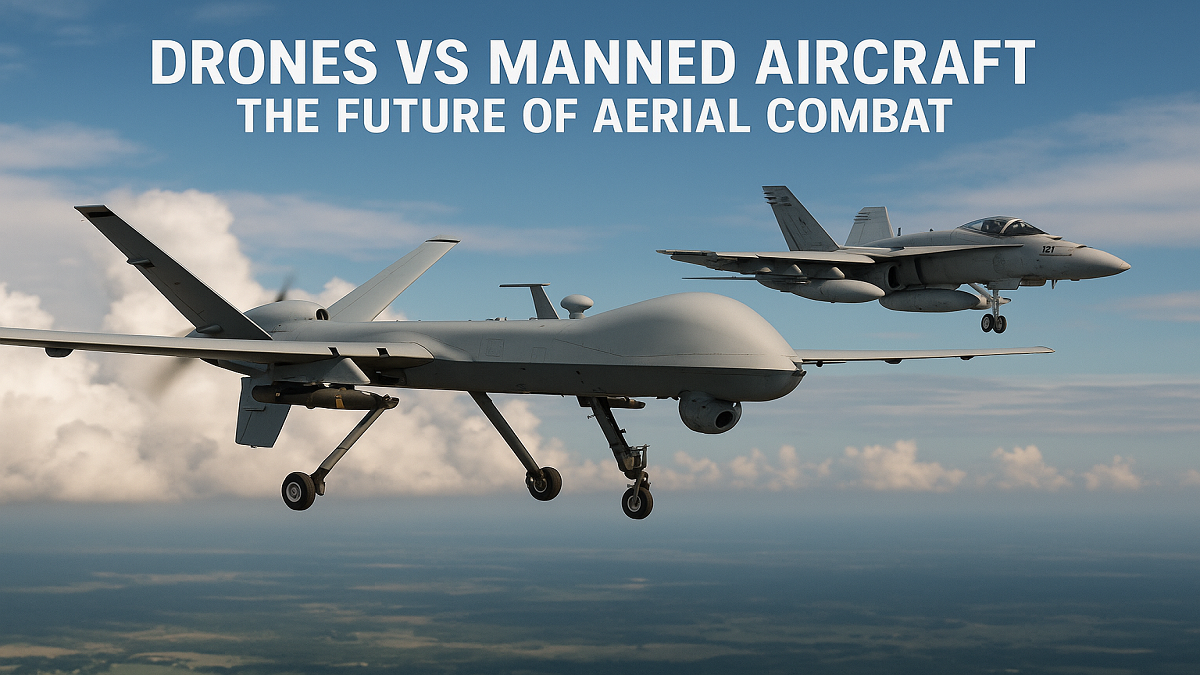
The world of aerial warfare is undergoing a revolution. With rapid advancements in drone technology, the question arises — will unmanned aerial vehicles (UAVs) eventually replace manned aircraft in combat, or will both continue to share the skies? Understanding the capabilities, advantages, and limitations of each is essential to predict the future of air combat.
1. The Rise of Drones in Modern Warfare
1.1 What Are Military Drones?
Military drones, also known as UAVs (Unmanned Aerial Vehicles), are aircraft without a human pilot on board. They are controlled remotely or operate autonomously using artificial intelligence (AI) and navigation systems.
1.2 Key Advantages of Drones
-
No risk to human life – Operators remain safe on the ground.
-
Lower operational costs – No need for life-support systems or cockpit protection.
-
Stealth capabilities – Many drones are smaller and harder to detect.
-
Longer endurance – Can remain in the air for hours without fatigue.
1.3 Current Drone Examples
Popular military drones include the MQ-9 Reaper, Bayraktar TB2, and RQ-170 Sentinel, each designed for surveillance, reconnaissance, and strike missions.
2. Manned Aircraft in the Modern Era
2.1 Why Manned Aircraft Still Dominate
Manned aircraft, such as fighter jets and attack helicopters, remain a critical part of air forces worldwide because they offer:
-
Human decision-making in complex combat
-
Greater versatility in various missions
-
High maneuverability in dogfights
2.2 Famous Manned Combat Aircraft
Examples include the F-35 Lightning II, Su-57 Felon, and Rafale, all capable of supersonic speeds and advanced weapons delivery.
3. The Battle of Capabilities
3.1 Speed and Agility
-
Manned aircraft excel in high-speed combat and quick maneuvering.
-
Drones are often slower but can stay airborne for much longer.
3.2 Firepower
-
Fighter jets can carry a wider range of weapons.
-
Drones are improving, but they usually carry smaller payloads.
3.3 Endurance
-
Drones can operate for 24 hours or more without rest.
-
Pilots have physical limits.
4. The Role of Artificial Intelligence (AI)
AI is becoming a game-changer in aerial combat:
-
Autonomous targeting systems allow drones to identify and engage threats.
-
Machine learning enables drones to learn from past missions.
-
AI could even help manned aircraft fly without constant pilot input, reducing fatigue.
5. Future Trends in Aerial Combat
5.1 Manned-Unmanned Teaming (MUM-T)
The future may not be drones vs manned aircraft, but drones with manned aircraft. In this system:
-
Fighter pilots control loyal wingman drones during missions.
-
Drones handle dangerous or repetitive tasks, while pilots focus on tactical decision-making.
5.2 Fully Autonomous Drone Squadrons
In the coming decades, entire drone fleets may be capable of carrying out missions without human oversight.
5.3 Hybrid Warfare
Future wars will likely involve a mix of drones and manned aircraft, each used where they are most effective.
6. Challenges and Concerns
6.1 Ethical and Legal Issues
-
Autonomous killing machines raise questions about accountability.
-
International laws are still catching up with AI-driven warfare.
6.2 Cybersecurity Threats
-
Drones are vulnerable to hacking and signal jamming.
-
A compromised drone could be turned against its own forces.


 President Droupadi Murmu Notifies Centra...
 India-Egypt Joint Special Forces Exercis...
 INS Aridhaman Nuclear Submarine Joins In...











