
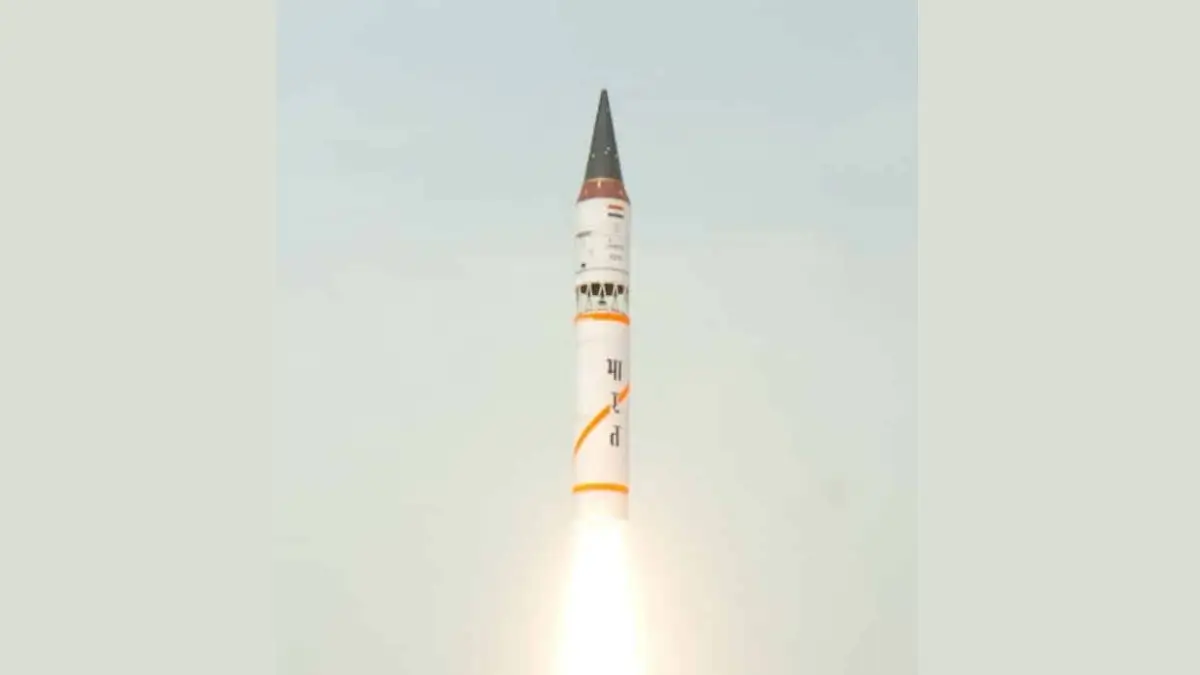
India has successfully test-fired the Agni-III intermediate-range ballistic missile from the Integrated Test Range (ITR) at Chandipur in Odisha. The test was carried out on 6 February 2026 as part of a routine training exercise. Defense officials confirmed that the missile met all mission objectives and validated critical technical and operational parameters. The launch highlights India’s focus on maintaining a high level of preparedness in its strategic missile forces and ensuring the reliability of its deterrence capabilities.
Agni-III Missile Test: What Exactly Was Tested?
- The Agni-III test launch was conducted under the supervision of the Strategic Forces Command, which manages India’s nuclear assets.
- The purpose was not development but operational validation, ensuring that the missile system remains fully ready for deployment.
- All subsystems, including propulsion, guidance, and control, performed as expected.
- Such tests are crucial to confirm that missiles inducted into service continue to meet required performance standards under real operational conditions.
Technical Features of Agni-III Missile
- Developed by the Defence Research and Development Organisation, the Agni-III is a two-stage,solid-fuelled ballistic missile.
- It has a strike range of over 3,000 kilometres, placing it in the intermediate-range ballistic missile (IRBM) category.
- The missile is capable of carrying both conventional and nuclear warheads, giving India flexible response options.
- Its solid-fuel design allows for faster launch readiness and easier storage compared to liquid-fuel missiles.
Role of Integrated Test Range, Chandipur
- The launch took place at the Integrated Test Range Chandipur, one of India’s most important missile testing facilities.
- Located along the Odisha coast, ITR provides the necessary infrastructure for testing advanced missile systems, radars, and weapon platforms.
- Over the years, it has supported the development and validation of several key missile systems under India’s strategic and tactical weapons programmes.
Why Agni-III Is Central to India’s Nuclear Doctrine
- Agni-III is a core pillar of India’s credible minimum deterrence posture.
- Inducted into the Strategic Forces Command in 2011, the missile strengthens India’s ability to deter adversaries by ensuring assured retaliation capability.
- Its range allows coverage of key strategic targets, while its reliability ensures confidence in second-strike capability.
- Regular tests like this reinforce deterrence by demonstrating readiness without escalating tensions.
Strategic Significance of the Test
- This successful test underscores India’s emphasis on operational readiness rather than expansion.
- Conducted as a training exercise, it signals continuity and stability in India’s strategic posture.
- Defence officials clarified that the test was routine and not aimed at any specific country.
- Such launches help maintain trained crews, validate command-and-control systems, and reassure policymakers of the effectiveness of India’s missile forces.
India’s Agni Missile Series
- The Agni series forms the backbone of India’s strategic missile programme.
- Starting from Agni-I to Agni-V, these missiles cover short to intercontinental ranges.
- Agni-III fills the crucial intermediate-range segment and complements longer-range systems
- . Together, they support India’s declared No First Use policy while ensuring credible deterrence through survivable and reliable delivery systems.
Question
Q. The Agni-III missile successfully tested by India belongs to which category?
A. Short-range ballistic missile
B. Intermediate-range ballistic missile
C. Intercontinental ballistic missile
D. Cruise missile


 President Droupadi Murmu Notifies Centra...
 India-Egypt Joint Special Forces Exercis...
 INS Aridhaman Nuclear Submarine Joins In...











