
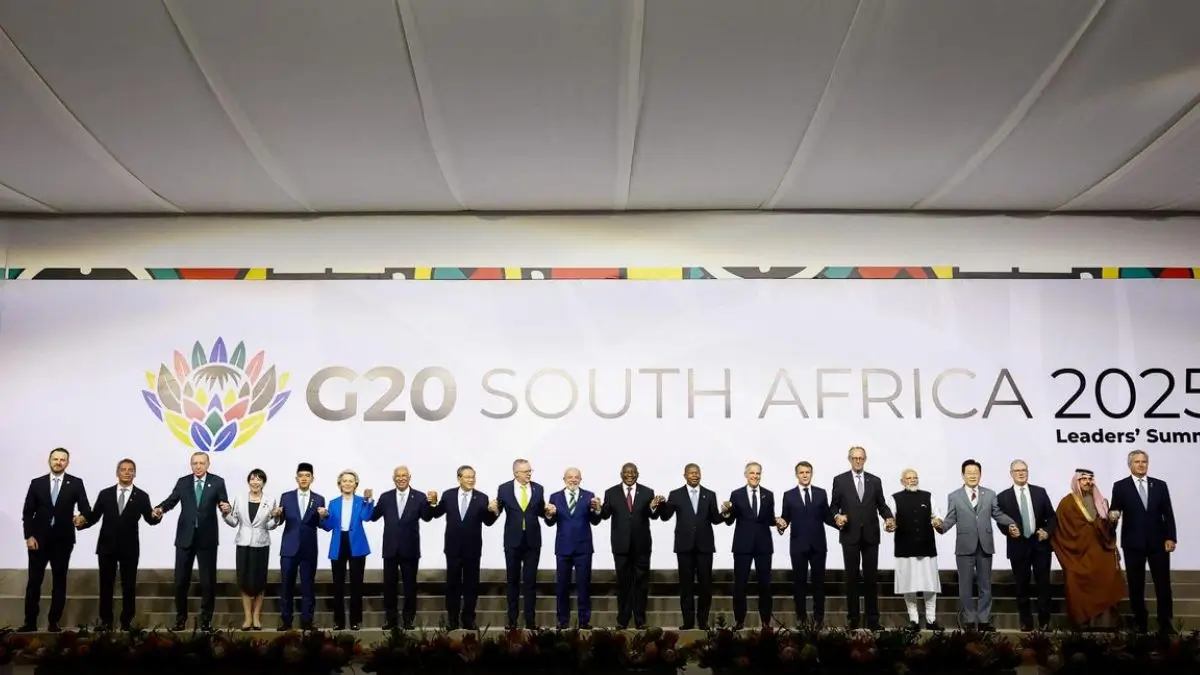
In a significant diplomatic achievement, leaders at the G20 Summit in Johannesburg, South Africa, adopted a joint declaration by consensus on 22 November 2025, despite notable opposition from the United States. The 39-page document, agreed upon after protracted negotiations, affirms the G20’s enduring commitment to multilateral cooperation, peaceful dispute resolution, and a shared agenda of inclusive, sustainable global development.
The declaration stands as a powerful expression of solidarity and global unity, particularly in the face of rising geopolitical tensions, climate challenges, and deepening economic inequality—challenges that have tested the effectiveness of global governance.
Declaration Highlights: A Framework for Inclusive Global Growth
1. Commitment to Multilateralism and Peace
The document reaffirms the G20’s foundation in multilateralism, international law, and peaceful resolution of disputes.
- While not naming specific countries, the text implicitly references territorial conflicts and urges respect for sovereignty, human rights, and fundamental freedoms.
- It emphasizes that a rules-based order and consensus-based cooperation remain crucial to global stability.
2. Energy Security, Climate Action, and Disaster Resilience
Climate concerns are central to the declaration, which backs,
- Energy transition strategies to meet global net-zero goals
- The Critical Minerals Framework to enable cleaner technologies
- Support for climate adaptation, especially for disaster-prone regions
The declaration acknowledges that climate change, extreme weather, and environmental degradation threaten global food and energy security.
3. Prioritising Vulnerable Nations
Special focus was placed on Small Island Developing States (SIDS) and Least Developed Countries (LDCs), which are disproportionately affected by natural disasters and economic volatility.
The G20 pledged support for,
- Disaster preparedness and recovery mechanisms
- Access to climate finance and resilient infrastructure
- Digital inclusion and technology transfer
4. Tackling Global Inequality and Debt
The declaration acknowledges that public debt in developing nations is a key barrier to progress. It stresses the importance of,
- Debt restructuring and financial sustainability
- Enhanced investments in healthcare, education, and infrastructure
- Support from Multilateral Development Banks (MDBs) to ease fiscal constraints
The group called for stronger roles for MDBs in addressing cross-border development challenges.
5. Digital Technology, Corruption, and Migration
Digital equity was another key theme. The G20 committed to,
- Expanding affordable digital access
- Investing in cybersecurity and digital public infrastructure
- Supporting responsible use of emerging technologies like AI
The declaration also reaffirmed global efforts to combat corruption, ensure the rights of migrants, and uphold inclusive labor mobility frameworks.
South Africa’s Role and Africa’s Voice
South Africa, as summit host, played a pivotal role in shaping the declaration’s inclusive tone. Ronald Lamola, Minister of International Relations and Cooperation, called the consensus a “milestone for the African continent” and a strong signal that multilateralism is alive and effective.
He highlighted that all 21 G20 members—including the African Union, now a permanent G20 member—were treated as equal partners in the process. Lamola also noted that the declaration incorporated African concerns like skills development, sustainable industrialisation, and climate justice.
About the G20
- Comprises 19 countries, the European Union, and now the African Union (as of 2023).
- Represents over 85% of global GDP, 75% of global trade, and two-thirds of the world’s population.
- Formed in 1999 as a platform to coordinate economic policy.
Key Terms in the Declaration
- Critical Minerals Framework: Supports collaboration on sustainable mining, recycling, and fair access to rare earths and essential materials for green technologies.
- Multilateralism: Cooperative approach involving multiple countries to solve global issues through institutions and diplomacy.
- Least Developed Countries (LDCs): Countries with low income, weak human assets, and economic vulnerability (as classified by the UN).
- Small Island Developing States (SIDS): Low-lying coastal countries highly vulnerable to climate change and environmental shocks.
Takeaways
- G20 adopted a 39-page consensus declaration in Johannesburg 2025, despite US objections.
- It reaffirmed multilateralism, respect for human rights, and peaceful conflict resolution.
- Supported critical minerals, climate resilience, and sustainable development.
- Highlighted vulnerabilities of SIDS, LDCs, and developing countries with high debt burdens.
- Recognised digital equity, MDB reforms, and support for migrants and anti-corruption efforts.


 India Pharma 2026 Conference: Advancing ...
 WTO MC14 2026 Explained: Agenda, Issues,...
 International Rail Coach Expo 2026 Inaug...











