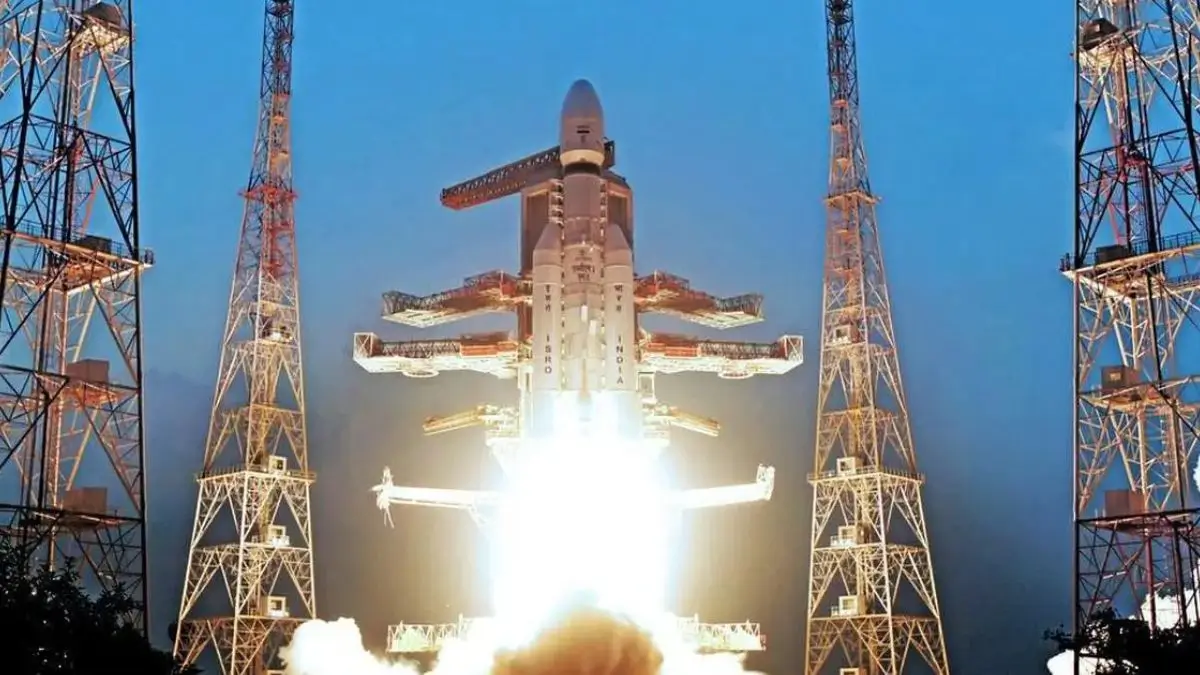
The year 2026 is expected to be a defining moment for global space exploration. India and the United States are preparing two major human spaceflight missions. While India’s Gaganyaan will test indigenous crewed spaceflight systems, NASA’s Artemis-II will take humans beyond the Moon after more than five decades, shaping the future of space travel.
Why in the News?
India’s Indian Space Research Organisation (ISRO) and the National Aeronautics and Space Administration (NASA) are preparing for historic missions in 2026. ISRO’s uncrewed Gaganyaan G1 mission and NASA’s Artemis-II mission are expected to lay the technological foundation for future human missions to space and deep space.
Gaganyaan Mission: India’s Human Spaceflight Program
- The Gaganyaan programme aims to establish India’s independent capability to send humans into space and bring them back safely.
- The first uncrewed orbital test mission, G1, is tentatively planned for March 2026.
- It will be launched aboard the LVM3 (Gaganyaan-Mk3) rocket, which has been human-rated for astronaut safety.
Role of Vyommitra and Mission Objectives
- A humanoid robot named Vyommitra will be onboard the G1 mission.
- It is designed to simulate astronaut behaviour and responses in space.
- The mission will test life-support systems, crew module safety, communication systems, re-entry procedures, and sea recovery mechanisms, all essential before attempting a crewed mission.
- Success would place India among a small group of nations with human spaceflight capability.
NASA’s Artemis-II Mission
- The Artemis II mission is scheduled no earlier than February 5, 2026.
- It will carry four astronauts aboard the Orion spacecraft, powered by the Space Launch System (SLS) rocket.
- This will be the first human mission beyond low-Earth orbit since Apollo-17 in 1972, marking a return to deep-space exploration.
Key Goals of Artemis-II
- Artemis-II will be a roughly 10-day mission flying around the Moon.
- The spacecraft is expected to travel over 5,000 nautical miles beyond the Moon, making it the farthest human journey ever.
- The mission will test deep-space navigation, radiation protection, long-duration life-support systems, and mission operations, serving as a precursor to future lunar landings and Mars missions.
Significance for Global Space Exploration
- Together, Gaganyaan and Artemis-II signal a shift towards a multipolar space era.
- India is consolidating its presence in low-Earth orbit, while the US is leading renewed deep-space exploration with international partners.
- The technologies developed in 2026 will influence space stations, private missions, lunar bases, and interplanetary travel in the coming decades.
Key Summary At Glance
| Aspect | Details |
| Why in news? | Gaganyaan and Artemis-II missions planned for 2026 |
| Indian mission | Gaganyaan G1 (uncrewed) |
| Launch vehicle (India) | LVM3 (Gaganyaan-Mk3) |
| Special feature | Vyommitra humanoid robot |
| NASA mission | Artemis-II |
| Crew size | 4 astronauts |
| Key objective | Test systems for future human missions |
Question
Q. Which launch vehicle will be used for the Gaganyaan mission?
A) PSLV
B) GSLV Mk-II
C) LVM3 (Gaganyaan-Mk3)
D) SSLV


 NASA’s Artemis 2 Set for April 2026 Laun...
 Akasha300 3D Printer Explained: How It W...
 IVRI Produces Sahiwal Calves Using Advan...