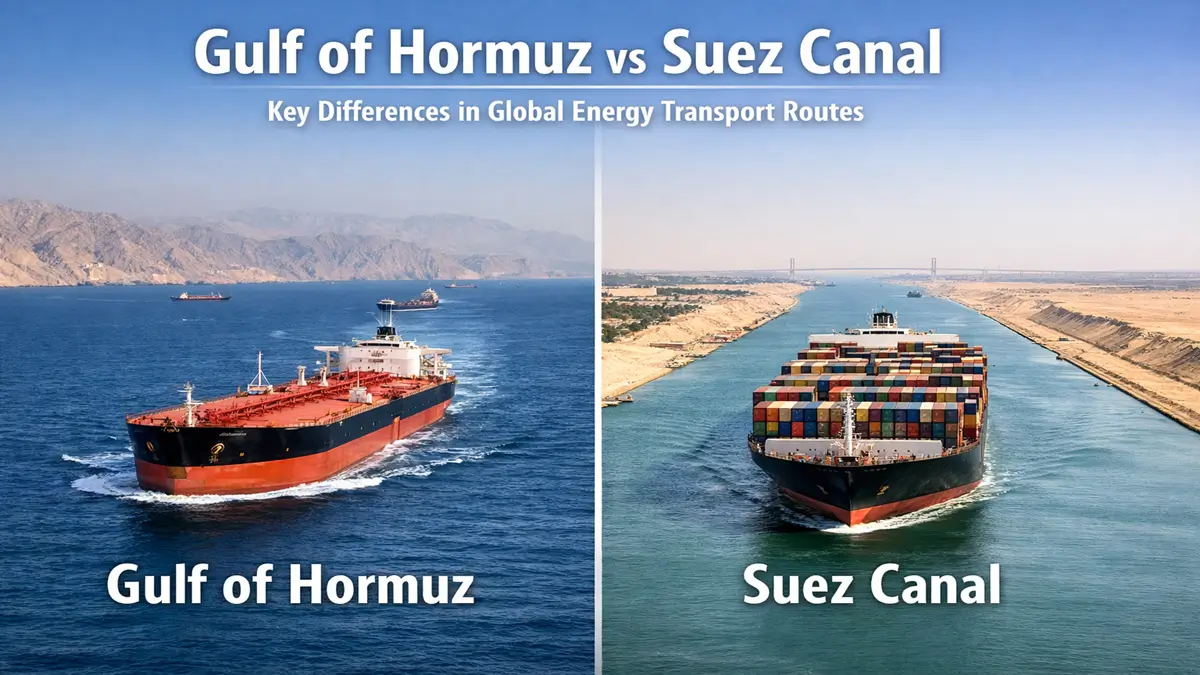
Global energy supply depends heavily on a few strategic maritime routes that allow oil and natural gas to move between continents. Two of the most important chokepoints are the Gulf of Hormuz and the Suez Canal.
While both play crucial roles in global energy trade, they function very differently in terms of geography, infrastructure, and the type of energy flows they support.
What is the Gulf of Hormuz?
The Gulf of Hormuz is a narrow natural strait located between Iran and Oman, linking the Persian Gulf with the Arabian Sea.
Key Features
- Around 20–21 million barrels of oil per day pass through the strait.
- It handles about 20% of the world’s petroleum consumption.
- Major exporters using this route include Saudi Arabia, Iraq, Kuwait, and the United Arab Emirates.
Why It Matters
The Gulf of Hormuz is considered the most important oil transit chokepoint in the world because most Middle Eastern oil exports must pass through it before reaching global markets.
What is the Suez Canal?
The Suez Canal is a man-made canal in Egypt that connects the Mediterranean Sea with the Red Sea. It provides the shortest maritime route between Europe and Asia.
Key Features
- About 8–9 million barrels of oil and petroleum products per day pass through the canal and the adjacent SUMED Pipeline.
- It allows ships to avoid the long route around the Cape of Good Hope.
- It is critical for energy shipments moving from the Middle East to Europe.
Why It Matters
The Suez Canal is one of the world’s most important trade corridors, carrying not only energy supplies but also a large portion of global container shipping.
Gulf of Hormuz vs Suez Canal: Key Differences
| Feature | Gulf of Hormuz | Suez Canal |
|---|---|---|
| Type | Natural strait | Man-made canal |
| Location | Between Iran and Oman | Located in Egypt |
| Main Function | Export route for Middle East oil | Shortcut between Europe and Asia |
| Oil Flow | ~20–21 million barrels/day | ~8–9 million barrels/day |
| Strategic Role | Primary outlet for Gulf oil exports | Transit route for global shipping |
| Alternative Routes | Very limited | Ships can go around Africa |
Role in Global Energy Transport
Gulf of Hormuz
- Acts as the main gateway for Middle Eastern oil exports.
- Supplies major economies in Asia, Europe, and North America.
- Any disruption can cause global oil price spikes.
Suez Canal
- Functions as a major transit corridor for oil, LNG, and goods.
- Reduces shipping distance between Asia and Europe by thousands of kilometers.
- Blockages, such as the famous container ship incident in 2021, can disrupt global trade.
Which Route is More Critical?
Both routes are extremely important, but their roles differ:
- Gulf of Hormuz: More critical for global oil supply because of the large volume of crude oil exports.
- Suez Canal: More important for global trade connectivity and shipping efficiency.
In simple terms, Hormuz controls the flow of oil, while Suez controls the speed of global trade.


 Do you Know Which is the Most Spoken Lan...
 Which is the Largest Black Pepper Produc...
 Which State is the Largest Consumer of L...