
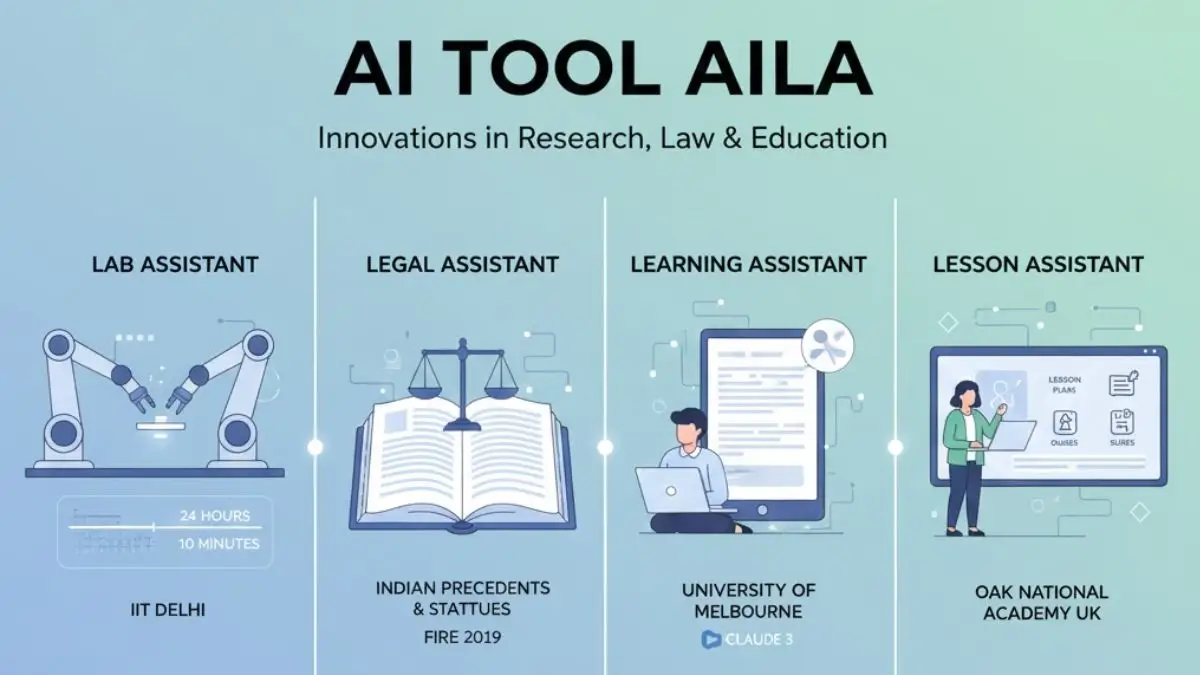
Researchers at the Indian Institute of Technology Delhi have developed an advanced AI driven system called AILA (Artificially Intelligent Lab Assistant). This innovation enables machines to independently design, conduct, and analyze real laboratory experiments, with minimal human intervention. The development of AILA places India at the forefront of agentic AI applications in experimental science a field that is rapidly transforming how research is conducted worldwide. The project highlights how AI is moving beyond data analysis to active decision-making in real-world scientific environments.
What Is AILA (Artificially Intelligent Lab Assistant)?
- AILA is an AI agent designed to function like a human research assistant.
- It can understand experimental goals, decide the steps required to achieve them, and execute those steps using laboratory equipment.
- The system operates through a simple chat based interface, similar to interacting with a chatbot.
- Researchers provide instructions in plain English, and AILA converts these instructions into executable computer code.
- This allows it to independently manage experiments without continuous human supervision.
Agentic AI Framework Behind AILA
The core of the AILA lies an Agentic AI Framework, which is designed to replicate the reasoning, planning, and decision making abilities of a human scientist. Unlike conventional AI models that follow fixed commands, agentic AI systems can,
- Interpret goals rather than just instructions
- Adapt to changing experimental conditions
- Learn from outcomes and adjust future actions
This framework allows AILA to design experiments, monitor progress, evaluate results, and decide next steps, making it a true autonomous research agent rather than a simple automation tool.
Real-Time Control of Scientific Instruments
- The research team successfully demonstrated AILA by integrating it with an Atomic Force Microscope a highly sophisticated instrument widely used in materials science and nanotechnology.
- This demonstration proved that AILA can directly control complex laboratory equipment.
- According to research scholar Indrajeet Mandal, AILA can take real-time decisions during experiments, adjust parameters dynamically, and analyze experimental data without human intervention.
- This capability is critical because many experiments require constant monitoring and fine adjustments, which AILA can now handle autonomously.
Efficiency Gains
One of the most striking outcomes of AILA is the dramatic reduction in experimental time. Tasks that typically take hours or even days can now be completed within minutes. This acceleration has several important implications,
- Faster research cycles and quicker discoveries
- Improved utilization of expensive laboratory equipment
- Increased productivity of skilled researchers
- Support for high throughput experimentation, where many experiments are conducted in parallel
Such efficiency gains are crucial for areas like materials discovery, nanotechnology, biotechnology, and applied physics.
Key Takeaways
- AILA stands for Artificially Intelligent Lab Assistant
- Developed by IIT Delhi researchers
- Uses an Agentic AI framework for autonomous experimentation
- Demonstrated using an Atomic Force Microscope
- Reduces experiment time from hours or days to minutes
Question
Q. What does AILA, developed by IIT Delhi, stand for?
A. Artificially Intelligent Learning Algorithm
B. Artificially Intelligent Lab Assistant
C. Advanced Integrated Laboratory Automation
D. Autonomous Intelligent Laboratory Agent


 Meet MAI-Transcribe-1: Microsoft’s Fast,...
 What is Outer Space Treaty 1967? Princip...
 What Is Mission Mitra? ISRO’s New Experi...











