
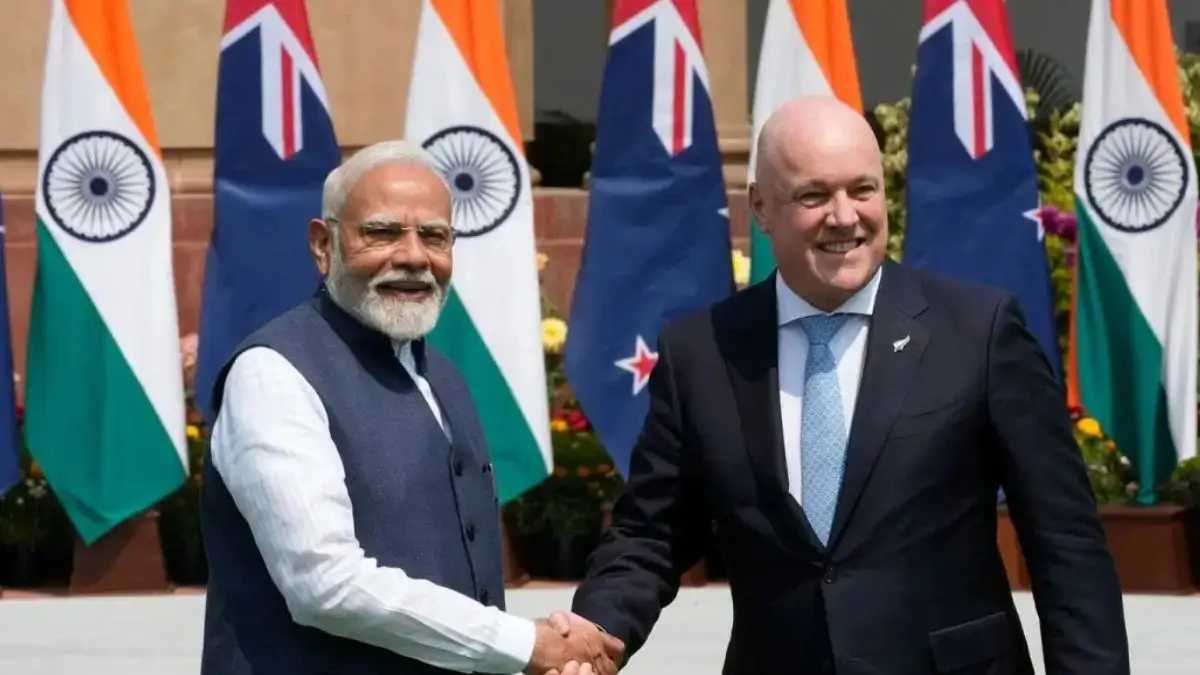
India and New Zealand have taken a major step in strengthening their economic partnership by successfully concluding negotiations for a comprehensive Free Trade Agreement (FTA). The announcement was made on December 22, 2025 witha phone conversation between Narendra Modi and Christopher Luxon. The conclusion of talks in just nine months reflects strong political commitment and a shared ambition to deepen bilateral trade, investment, and strategic cooperation.
Key Features of the India–New Zealand FTA
According to official sources, the agreement is expected to significantly deepen economic engagement between the two countries. A major highlight is the reduction or removal of tariffs on 95% of New Zealand’s exports to India.
The FTA aims to,
- Improve market access for goods and services
- Encourage investment flows
- Support MSMEs, farmers, entrepreneurs, students, and innovators
- Strengthen strategic and economic cooperation
New Zealand has projected that its exports to India could increase by $1.1 to $1.3 billion annually over the next two decades due to the agreement.
Trade and Investment Targets
- Both leaders expressed confidence that the FTA would help double bilateral trade within the next five years.
- In addition, New Zealand is expected to invest around $20 billion in India over the next 15 years especially in areas such as agriculture, education, clean energy, technology, and food processing.
- For New Zealand the agreement is expected to generate more jobs, higher wages, and expanded opportunities while India gains better access to high quality products, technology, and global value chains.
Why the FTA Matters for India
For India, the FTA supports key national priorities such as,
- Expanding exports under Make in India
- Integrating with global supply chains
- Supporting the long-term vision of economic growth
The agreement is also aligned with India’s ambition to become a developed nation, by boosting trade-led growth and attracting long-term foreign investment.
India’s Growing Network of Trade Agreements
With the conclusion of the India–New Zealand FTA this becomes India’s seventh Free Trade Agreement in the last few years. India has already signed FTAs with.
- UAE
- Australia
- UK
- Oman
- Mauritius
- EFTA countries (European Free Trade Association)
This reflects India’s broader strategy of integrating with global markets while supporting domestic growth.
Key Takeaways
- India and New Zealand concluded FTA negotiations on December 22, 2025
- Talks began in March 2025 during PM Christopher Luxon’s visit to India
- The FTA was concluded in a record time of nine months
- Tariffs on 95% of New Zealand exports to India will be reduced or removed
- Bilateral trade is expected to double in five years
- New Zealand may invest $20 billion in India over 15 years
- This is India’s seventh FTA in recent years
Question
Q. With the conclusion of the India–New Zealand FTA, it becomes India’s:
A. Fifth FTA in recent years
B. Sixth FTA in recent years
C. Seventh FTA in recent years
D. Eighth FTA in recent years


 Preeti Saran Re-Elected as UN Committee ...
 Global Trade Hits New High in 2025: Key ...
 Iran–US Ceasefire: Iran’s 10 Conditions ...











