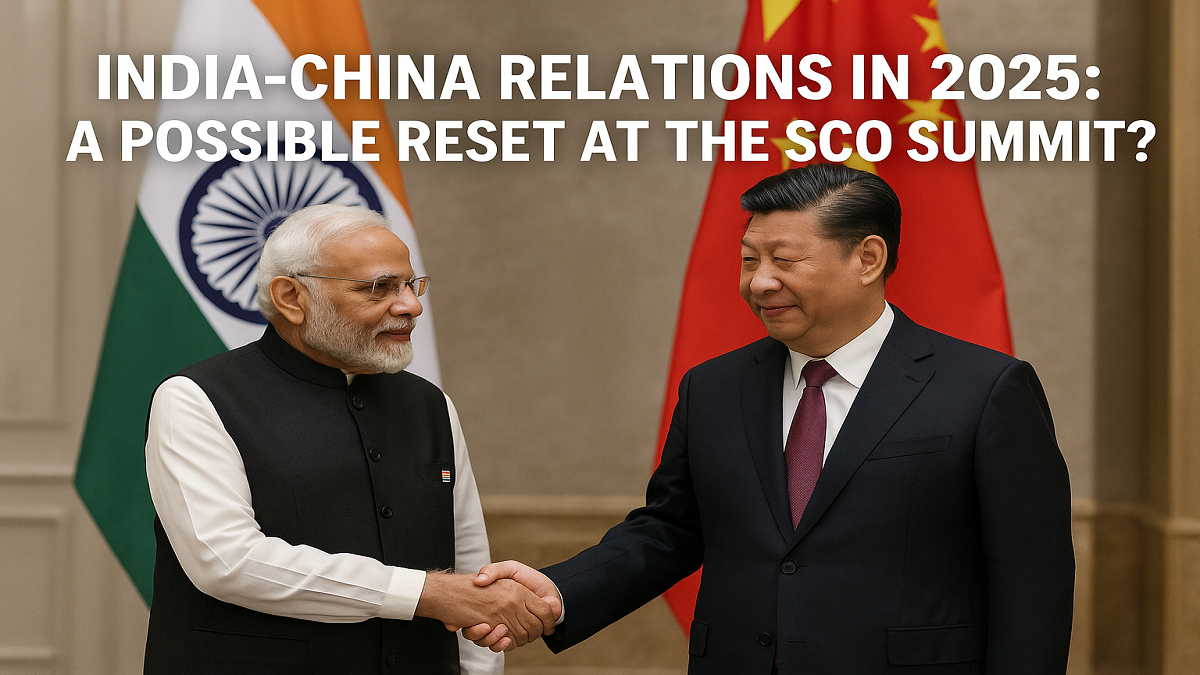
The upcoming Shanghai Cooperation Organisation (SCO) Summit will witness Indian Prime Minister Narendra Modi visiting China for the first time since the Galwan Valley clash of 2020. This high-profile trip is being viewed as a potential reset in India-China relations, signaling a cautious shift after years of tensions.
For government job aspirants and policy observers, understanding the historical evolution, present dynamics, and strategic challenges in this relationship is crucial—not just for exams, but also for grasping India’s geopolitical position in 2025.
Evolution of India-China Relations
Early Years: The Spirit of Friendship (1950s)
- 1950: India became the first non-socialist bloc country to establish diplomatic ties with the People’s Republic of China.
- The “Hindi-Chini Bhai Bhai” phase peaked with the 1954 Panchsheel Agreement (Five Principles of Peaceful Coexistence).
The Break: Border War and Tensions (1960s–1980s)
- 1962: A war over Aksai Chin and Arunachal Pradesh dealt a heavy blow to ties.
- 1988: PM Rajiv Gandhi’s China visit initiated a thaw, leading to mechanisms like the Working Mechanism for Consultation and Coordination (WMCC) on border affairs.
Economic Engagement and Border Friction (1990s–2000s)
- China emerged as India’s largest trading partner by 2008.
- Despite agreements like the 1993 Peace and Tranquility Accord, standoffs persisted in areas like Aksai Chin.
- 2003: India recognized Tibet as part of China; China accepted Sikkim’s accession to India.
Recent Turbulence (2010s–Present)
- 2017 Doklam Standoff: 73-day confrontation over road construction in disputed territory.
- 2020 Galwan Clash: Fatal border violence deepened mistrust.
- 2024: Limited patrolling agreements in Depsang and Demchok marked cautious progress, reinforced by a Modi–Xi meeting at the Kazan Summit.
Why China Matters to India
Economic Interdependence
- Trade Scale: In FY25, bilateral trade hit $127.7 billion; imports rose 11.52% to $113.45 billion, exports fell 14.5% to $14.25 billion, leaving a trade deficit of $99.2 billion.
- Critical Supplies: India relies heavily on China for electronics, telecom equipment, lithium-ion batteries, APIs, fertilizers, and auto parts.
- Investment Links: Cumulative Chinese investment in India since 2015 stands at $3.2 billion, especially in tech startups.
Geopolitical Significance
- Border Security: A 3,488 km border directly impacts national security.
- Regional Influence: China’s Belt and Road Initiative and projects like the CPEC in Pakistan challenge India’s influence.
- Global Forums: Cooperation continues in BRICS, SCO, AIIB, and the G20 on issues like climate diplomacy and multipolarity.
Challenges in India-China Relations
1. Border Disputes & Militarization
- China occupies 38,000 sq km of Aksai Chin and claims 90,000 sq km of Arunachal Pradesh.
- Infrastructure buildup and dual-use villages along the border raise Indian security concerns.
2. Strategic Trust Deficit
-
The Galwan clash remains a turning point, creating deep mistrust despite partial disengagements.
3. Economic Imbalance
-
Heavy import dependence and China’s critical mineral export controls affect India’s green energy transition.
4. Pakistan Nexus
- CPEC’s route through Pakistan-Occupied Kashmir violates India’s sovereignty.
- In the May 2025 India-Pakistan conflict, China backed Pakistan militarily and diplomatically.
5. Maritime & Regional Rivalry
- China’s “String of Pearls” strategy in the Indian Ocean challenges India’s dominance.
- India’s “Necklace of Diamonds” counters with strategic port development and naval partnerships.
6. Technological Dependence & Cyber Threats
- Chinese firms dominate India’s smartphone market (~75% share).
- Huawei’s exclusion from 5G trials reflects security concerns.
7. Water Security Risks
-
China’s Brahmaputra and Sutlej dam projects pose environmental and water flow risks for India.
The Way Forward
- Sustained Strategic Dialogue: Keep SR-level and WMCC talks active to ensure full disengagement along the LAC.
- Economic Rebalancing: Advance the “China+1” strategy, strengthen Make in India, and boost domestic manufacturing.
- Enhanced Border Infrastructure: Accelerate LAC road, airstrip, and surveillance development under the Vibrant Villages Programme.
- Maritime Deterrence: Strengthen Indian Ocean presence via Sagarmala and Quad cooperation.
- Lead Regional Alternatives: Expand South Asian connectivity projects to compete with the BRI.
- Technological Self-Reliance: Invest in semiconductors, APIs, and renewable technologies under PLI schemes.
- Cultural Diplomacy: Resume pilgrimages like Kailash Mansarovar Yatra to build people-to-people trust.


 Easter Sunday 2026: Meaning, History &am...
 Weekly Current Affairs One Liners (30th ...
 ECINet KYC Feature Explained: How Voters...