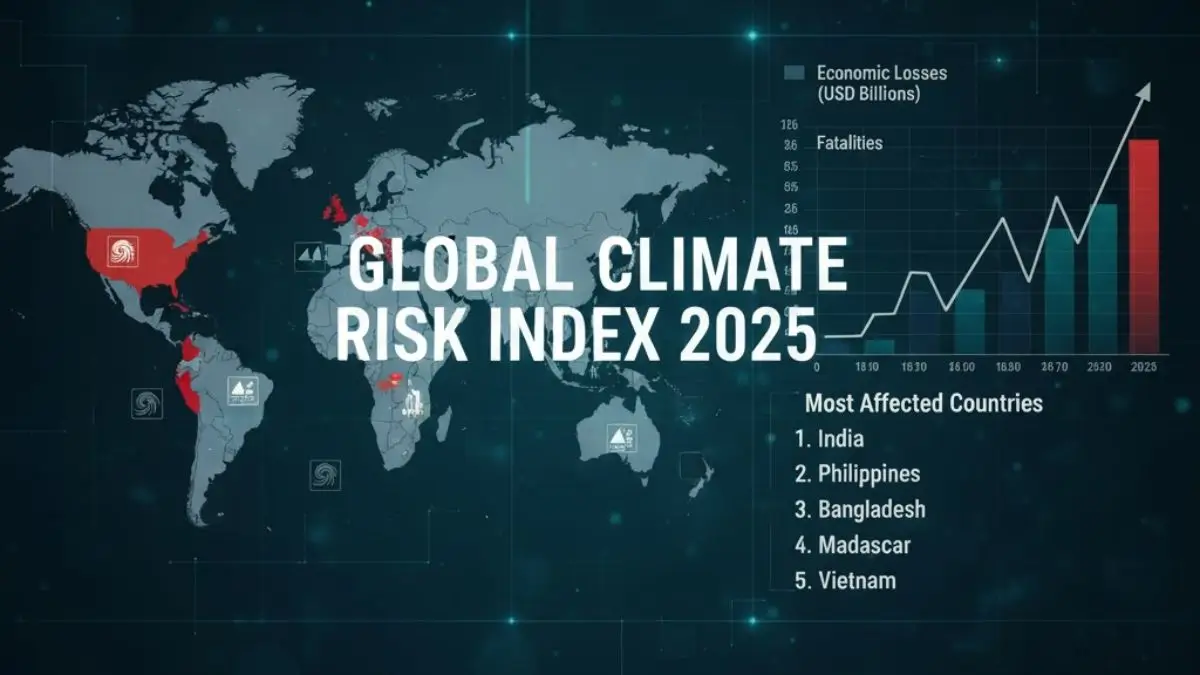
India has shown notable progress in the Global Climate Risk Index (CRI) 2025, improving its position in both short-term and long-term rankings. The report, released by German environmental think tank Germanwatch during the UN Climate Summit (COP30) in Belem, Brazil, reflects India’s increasing resilience to climate-related disasters. In the 2024 annual index, India now ranks 15th, an improvement from 10th last year. In the long-term index (1995–2024), India moved from 8th to 9th place. A lower rank in the index indicates less vulnerability, underscoring gains in disaster preparedness, risk mitigation, and climate adaptation.
India’s Performance and Key Findings
India has historically been one of the countries most affected by climate-related disasters. Over the past three decades.
- The country faced 430 extreme weather events
- Recorded over 80,000 fatalities
- Suffered economic losses of nearly USD 170 billion
These include devastating events like Cyclones Hudhud (2014) and Amphan (2020), the Uttarakhand floods (2013), and multiple heatwaves in 1998, 2002, 2003, and 2015.
The report attributes India’s improved ranking to,
- Strengthened early warning systems
- Enhanced disaster recovery frameworks
- Implementation of climate policies such as the National Action Plan on Climate Change (NAPCC)
- Leadership in global initiatives like the Coalition for Disaster Resilient Infrastructure (CDRI)
These developments indicate better institutional readiness and coordination in response to extreme weather.
Global Impact of Climate Disasters
Between 1995 and 2024, more than,
- 9,700 extreme weather events occurred worldwide
- Resulted in over 832,000 deaths
- Caused approximately USD 4.5 trillion in economic losses
Countries most affected long-term include,
- Dominica
- Myanmar
- Honduras
For the year 2024, the most-affected countries were,
- St Vincent and the Grenadines
- Grenada
- Chad
The data reveals that over 3 billion people, nearly 40% of the world’s population, live in the top 11 most-affected nations—many of which are developing or emerging economies like India, Bangladesh, and the Philippines.
India’s Climate Response and Policy Framework
India’s relatively improved performance in the CRI reflects a multi-pronged approach toward managing climate risks,
- National Action Plan on Climate Change (NAPCC): Comprising eight missions focused on energy efficiency, solar power, sustainable agriculture, and ecosystem conservation.
- State Action Plans on Climate Change (SAPCCs): Localised implementation of climate adaptation strategies.
- Coalition for Disaster Resilient Infrastructure (CDRI): A global initiative led by India to promote infrastructure resilience against climate shocks.
- Expansion of climate-smart agriculture, flood forecasting systems, and urban heatwave preparedness in vulnerable cities.
These policy measures aim to protect lives, reduce economic losses, and build long-term climate resilience across sectors.
Implications and the Road Ahead
India’s improved rank in the CRI is both an encouraging sign and a reminder of the ongoing climate challenges it faces. Key implications include,
- Recognition of climate preparedness efforts on the global stage
- Enhanced opportunity for international collaboration and climate financing
- Greater emphasis on sustainable urban planning, resilient agriculture, and renewable energy adoption
- The need for community-based adaptation, especially in flood-prone, coastal, and arid regions
Experts warn that while India’s progress is visible, recurring climate shocks—heatwaves, cyclones, floods—continue to impact millions. The need for long-term investment in green infrastructure, early warning systems, and ecosystem restoration remains critical.
Static GK Facts
- CRI (Climate Risk Index) is published annually by Germanwatch, a Germany-based environmental think tank.
- The CRI 2025 was presented during the UN Climate Summit COP30 in Belem, Brazil.
- A lower rank in CRI means lower climate risk or better resilience.
- India ranks 15th in the 2024 CRI annual index and 9th in the 1995–2024 long-term index.
- Over 80,000 deaths and USD 170 billion in losses were recorded in India due to extreme weather events since 1995.


 Gurgaon Tops the List of India's Most Po...
 Parliament Rejects Impeachment of Chief ...
 Against All Odds: Indian Cyclist Divya S...