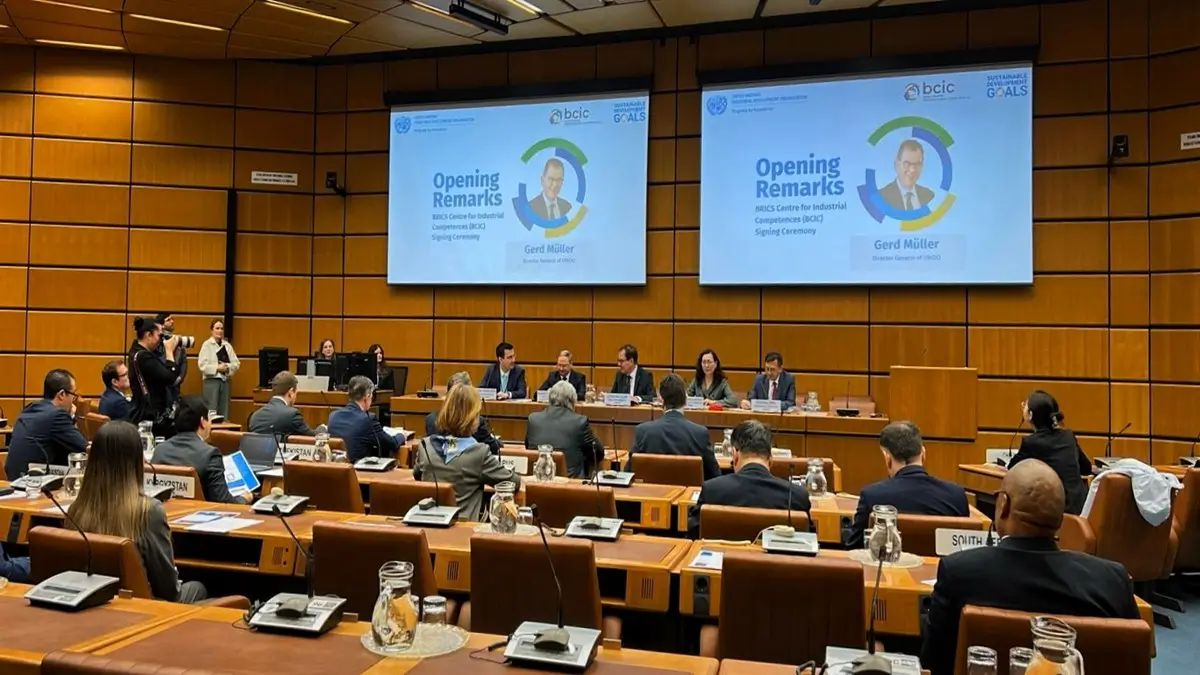
India has officially joined the BRICS Centre for Industrial Competencies (BCIC), marking a significant milestone in the nation’s commitment to advancing industrial capabilities and supporting its manufacturing and MSME sectors. The formal joining was announced at an event organized by the Department for Promotion of Industry and Internal Trade (DPIIT), Ministry of Commerce & Industry, at Vanijya Bhavan, New Delhi.
This strategic partnership with the United Nations Industrial Development Organization (UNIDO) and the broader BRICS framework represents India’s dedication to strengthening Industry 4.0 competencies and providing integrated support services to manufacturing companies and Micro, Small and Medium Enterprises (MSMEs). The initiative comes at a critical juncture when India is advancing its ambitious manufacturing agenda and positioning itself as a global manufacturing hub.
What is the BRICS Centre for Industrial Competencies?
Overview and Purpose
The BRICS Centre for Industrial Competencies (BCIC) is a multilateral platform designed to serve as a one-stop centre providing integrated support services to manufacturing companies and MSMEs across BRICS nations (Brazil, Russia, India, China, and South Africa). The centre functions as a knowledge and resource hub, facilitating capacity building, technological advancement, and adoption of best practices in manufacturing.
The BCIC is launched in partnership with the United Nations Industrial Development Organization (UNIDO), bringing together the expertise and resources of both BRICS member nations and a respected international development organization with decades of experience in industrial development.
Focus Areas
Industry 4.0 Competencies: The primary focus of BCIC is strengthening Industry 4.0 capabilities—the integration of digital technologies, artificial intelligence, the Internet of Things (IoT), and advanced analytics into manufacturing processes. Industry 4.0 represents the fourth industrial revolution, characterized by smart factories, automated processes, and data-driven decision-making.
Manufacturing Support: The centre provides comprehensive support to manufacturing enterprises, from small workshops to large industrial facilities, helping them modernize operations, improve efficiency, and enhance competitiveness.
MSME Development: Recognizing the critical role of MSMEs in economic growth, employment creation, and regional development, BCIC dedicates significant resources to supporting small and medium enterprises in adopting advanced manufacturing practices.
Cross-Border Collaboration: By bringing together expertise and best practices from BRICS nations, the centre facilitates knowledge sharing and collaboration among enterprises across member countries.
India’s Formal Entry into BCIC
The Trust Fund Agreement
On the occasion of India’s joining, a Trust Fund Agreement was formally signed between the Department for Promotion of Industry and Internal Trade (DPIIT) and the United Nations Industrial Development Organization (UNIDO). This agreement formalizes India’s participation in the BCIC framework and establishes the financial and operational mechanisms through which India will contribute to and benefit from the centre.
Signatories: The agreement was signed by Economic Adviser, DPIIT, Shri Agrim Kaushal, and Director, UNIDO, Dr. Cristiano Pasini, representing both the Indian government and the international development organization.
Significance: The Trust Fund Agreement represents a binding commitment to the BCIC framework, establishing clear terms for India’s participation, financial contributions, resource allocation, and expected outcomes in terms of capacity building and industrial development.
Governance and Leadership
The event was presided over by Secretary, DPIIT, Shri Amardeep Singh Bhatia, underscoring the high-level importance the Indian government places on this initiative. The presence of senior officials from multiple government ministries and agencies reflects the whole-of-government approach to industrial development in India.
National Productivity Council as India’s BCIC Centre
Designation and Role
The National Productivity Council (NPC) has been designated as the India Centre for BRICS Industrial Competencies, making it the primary institutional focal point for India’s engagement with BCIC. This designation leverages NPC’s established expertise, institutional capacity, and network across India’s industrial sector.
NPC’s Mandate and Responsibilities
Under the policy guidance of DPIIT and with technical support from UNIDO, the National Productivity Council will spearhead India’s engagement with BCIC and lead efforts in several critical areas:
Capacity Building: NPC will design and deliver training programs, workshops, and certification courses aimed at developing industrial competencies among manufacturing professionals, MSME owners, and workers across India.
Productivity Enhancement: Drawing on its core mandate as the National Productivity Council, NPC will work to improve operational efficiency, reduce costs, and enhance output quality across manufacturing enterprises.
Adoption of Advanced Manufacturing Practices: NPC will facilitate the adoption of modern manufacturing methodologies, digital technologies, and best practices drawn from BRICS nations and international experience.
Knowledge Creation and Dissemination: NPC will create resources, case studies, and knowledge products that help enterprises understand and implement Industry 4.0 technologies and practices.
Stakeholder Engagement: NPC will engage with manufacturers, MSMEs, industry associations, government agencies, and other stakeholders to ensure the centre’s activities are aligned with actual needs and challenges.
NPC’s Institutional Advantages
NPC brings several institutional advantages to this role:
Historical Expertise: With decades of experience in productivity improvement and industrial development, NPC has established credibility with India’s manufacturing sector.
National Network: NPC has presence and connections across India’s industrial regions, enabling effective reach to enterprises in different states and sectors.
Research Capacity: NPC’s research capabilities allow it to develop context-specific solutions and contribute to understanding India’s unique manufacturing challenges and opportunities.
Partnership Experience: NPC has existing relationships with industry associations, government agencies, and international organizations, facilitating collaborative implementation.
Stakeholder Participation and Coordination
Government Agencies Involved
The event brought together representatives from multiple government ministries and agencies, reflecting the interdisciplinary nature of industrial development:
Department for Promotion of Industry and Internal Trade (DPIIT): As the lead policy agency for industrial promotion, DPIIT provides overall policy guidance and coordination.
Ministry of MSME: Given the focus on small and medium enterprises, the Ministry of MSME’s participation ensures alignment with national MSME policies and programs.
Ministry of External Affairs: Representation from MEA underscores the international dimension of BCIC and India’s multilateral commitments.
National Productivity Council: As the designated India Centre, NPC plays a central operational role.
International and Private Sector Participation
UNIDO: The United Nations Industrial Development Organization provides technical expertise, global best practices, and coordination with BCIC frameworks across other countries.
Federation of Indian Chambers of Commerce and Industry (FICCI): As a leading industry confederation representing Indian businesses, FICCI bridges the gap between government initiatives and private sector needs and capabilities.
Director General, NPC: Smt. Neerja Sekhar, Director General of NPC, participated in the event, emphasizing NPC’s readiness to execute its new responsibilities.
This multi-stakeholder approach ensures that the initiative is grounded in policy, responsive to business needs, and aligned with international standards and best practices.
Why This Initiative Matters for India
Supporting the Manufacturing Sector
India has ambitious goals for manufacturing growth, including the “Make in India” initiative and the Production-Linked Incentive (PLI) scheme. These programs aim to make India a global manufacturing hub by attracting investment and creating employment. BCIC provides crucial support by helping Indian manufacturers meet international standards, adopt modern technologies, and improve competitiveness.
Empowering MSMEs
MSMEs are the backbone of India’s economy, contributing significantly to GDP, employment, and exports. However, many MSMEs face challenges in accessing technology, capital, and knowledge needed for modernization. BCIC provides a dedicated platform to address these challenges through capacity building, technology access, and peer learning.
Technology Adoption and Industry 4.0
The transition to Industry 4.0 is not automatic. It requires investment, knowledge, skilled personnel, and supportive ecosystems. BCIC helps bridge this gap by:
- Providing affordable access to knowledge and training on Industry 4.0 technologies
- Facilitating technology adoption through demonstration and pilot projects
- Creating networks of enterprises learning and advancing together
- Offering technical assistance tailored to Indian manufacturing contexts
Leveraging BRICS Partnership
BRICS countries collectively represent over 40% of the world’s population and over 23% of global GDP. By joining BCIC, India gains access to the industrial expertise, technological capabilities, and market opportunities of other BRICS nations. This creates a South-South cooperation framework that is particularly relevant for emerging economies with similar development challenges.
International Quality Standards and Competitiveness
BCIC’s connection to UNIDO and international best practices ensures that Indian manufacturers have access to globally competitive knowledge and practices. This helps Indian enterprises meet international quality standards, improve export competitiveness, and participate in global value chains.
Employment and Skills Development
As enterprises adopt advanced manufacturing practices, the demand for skilled workers increases. BCIC’s capacity building programs help ensure that workers and professionals have the skills needed for employment in modernized manufacturing environments, supporting inclusive growth.
Industry 4.0 and Its Importance
What is Industry 4.0?
Industry 4.0, also known as the fourth industrial revolution, refers to the integration of digital technologies, data analytics, artificial intelligence, and the Internet of Things into manufacturing processes. Key characteristics include:
Smart Factories: Manufacturing facilities equipped with interconnected machines and systems that can communicate, make autonomous decisions, and optimize operations in real time.
Data-Driven Decision Making: The use of advanced analytics on production data to identify inefficiencies, predict maintenance needs, and optimize processes.
Automation and Robotics: Increased use of automated systems and robotic processes to handle repetitive tasks, improve precision, and enhance safety.
Supply Chain Integration: Digital connectivity across the entire supply chain, enabling better coordination, reduced waste, and faster response to market changes.
Customization and Flexibility: The ability to quickly adapt production to customize products for individual customers without significant cost penalties.
Why Industry 4.0 Matters for India
Competitiveness: Manufacturers who embrace Industry 4.0 technologies can produce better products at lower costs, making them more competitive in global markets.
Efficiency Gains: Digital technologies and automation lead to substantial improvements in productivity, reduced material waste, and lower energy consumption.
Quality Improvement: Advanced monitoring and control systems ensure consistent product quality and reduce defects.
Employment Transformation: While some routine jobs may be automated, Industry 4.0 creates demand for skilled workers in areas such as data analysis, systems maintenance, and programming.
Sustainability: Digital optimization can reduce resource consumption and waste, contributing to environmental sustainability goals.
The UNIDO Partnership
Role of UNIDO
The United Nations Industrial Development Organization (UNIDO) is a specialized agency of the United Nations with a mandate to promote industrial development for poverty reduction, inclusive globalization, and environmental sustainability. UNIDO brings several critical contributions to BCIC:
Technical Expertise: UNIDO has deep expertise in industrial development strategies, technology transfer, and capacity building across diverse sectors and countries.
Global Network: UNIDO’s presence in over 170 countries provides access to global best practices, case studies, and lessons learned.
Impartial Facilitation: As a UN agency, UNIDO provides neutral, technical support that helps ensure fairness and objectivity in knowledge sharing among BRICS members.
Quality Assurance: UNIDO’s standards and methodologies ensure that capacity building and technical assistance meet international quality benchmarks.
Alignment with Sustainable Development: UNIDO’s work is grounded in the United Nations Sustainable Development Goals, ensuring that industrial development is linked to broader sustainability objectives.
Expected Outcomes and Benefits
For Manufacturing Companies
Manufacturing enterprises will gain access to:
- Training and certification programs in Industry 4.0 technologies and practices
- Technical assistance in assessing and upgrading manufacturing capabilities
- Peer learning networks connecting them with other manufacturers in India and BRICS countries
- Best practice case studies and implementation guides
- Support in accessing finance and technology for modernization
For MSMEs
Small and medium enterprises will benefit from:
- Affordable access to capacity building tailored to MSME contexts
- Customized technical assistance considering resource constraints
- Networks and partnerships that can improve supply chain integration
- Support in accessing market information and export opportunities
- Help in meeting quality standards and certifications required for larger customers
For the Indian Economy
The broader Indian economy will benefit through:
- Increased competitiveness of Indian manufacturing in global markets
- Job creation in both manufacturing and supporting service sectors
- Technology transfer and innovation spillovers across the industrial sector
- Improved integration into global value chains
- Enhanced export potential and foreign exchange earnings
For BRICS Cooperation
BCIC strengthens BRICS cooperation by:
- Creating practical, results-oriented mechanisms for South-South cooperation
- Building institutional relationships among industrial development organizations
- Facilitating technology transfer among developing economies
- Creating mutual learning and knowledge sharing opportunities
- Strengthening economic ties among BRICS members
Implementation Roadmap
Immediate Steps
In the immediate term, NPC will:
- Establish operational mechanisms and protocols for BCIC India Centre
- Conduct needs assessments to understand specific challenges and opportunities in Indian manufacturing
- Develop baseline capacity building programs in key Industry 4.0 areas
- Establish coordination mechanisms with DPIIT, MSME Ministry, and other stakeholders
- Strengthen partnerships with FICCI and other industry associations
Medium-Term Initiatives
Over the medium term, the centre will:
- Launch comprehensive capacity building programs across different states and sectors
- Establish demonstration centres and innovation labs showcasing Industry 4.0 technologies
- Create certification and credentialing programs recognized across BRICS countries
- Facilitate bilateral exchanges and study visits among manufacturers in BRICS countries
- Develop research and knowledge products on India-specific manufacturing challenges
Long-Term Vision
Looking ahead, BCIC India Centre aims to:
- Position India as a leader in Industry 4.0 adoption among developing economies
- Create a network of manufacturing enterprises transformed through modern practices
- Build a skilled workforce ready for advanced manufacturing environments
- Integrate Indian manufacturers more deeply into BRICS industrial cooperation
- Contribute to India’s broader manufacturing and economic development objectives


 India Withdraws Its Plan to Host COP33 S...
 IIM Rohtak Wins BIMTECH's 'Hermes' Dialo...
 Gurgaon Tops the List of India's Most Po...