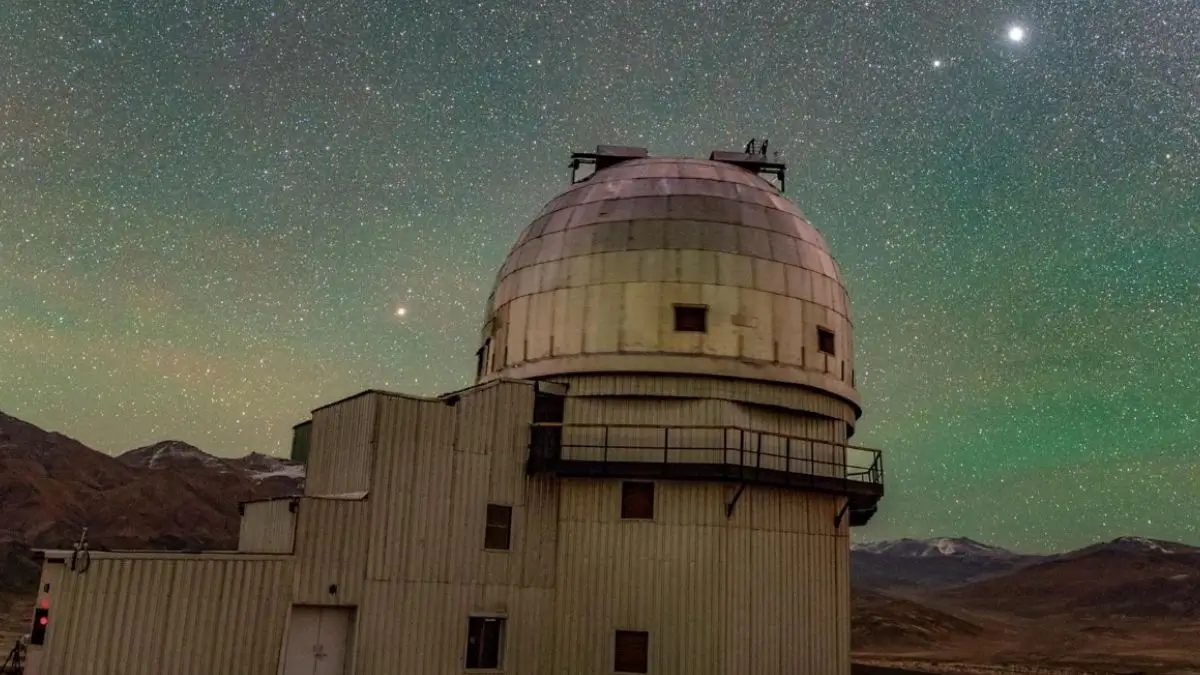
India has cleared a major astronomy expansion in the Union Budget 2026, approving two new telescopes and upgrading an existing one in Ladakh. The upcoming National Large Solar Telescope (NLST) and National Large Optical–Near Infrared Telescope (NLOT), along with the upgraded Himalayan Chandra Telescope, are expected to significantly boost India’s observational astronomy capabilities. Located in Hanle, India’s first Dark Sky Reserve, these projects are being described as a potential game-changer for solar physics, exoplanet research, and studies on the origins of the universe.
National Large Solar Telescope (NLST): Studying the Sun in Detail
- The National Large Solar Telescope (NLST) will be a 2-metre aperture solar telescope built in Merak near Pangong Tso.
- It will operate in the visible and near-infrared wavelengths, helping scientists study solar magnetism, solar flares, and space-weather events.
- Solar activity directly affects Earth’s satellites, communication systems, and space missions.
- With NLST, India will improve its ability to monitor space weather, which is crucial for protecting national space assets.
- Once operational in the next 5-6 years, NLST will become India’s third ground-based solar observatory, complementing facilities at Kodaikanal and Udaipur, and supporting data from Aditya-L1, India’s first space-based solar mission.
National Large Optical Near Infrared Telescope (NLOT): Exploring the Universe
The National Large Optical Near Infrared Telescope (NLOT) will be a 13.7-metre segmented-mirror telescope constructed in Hanle. It will consist of 90 hexagonal mirror segments working together as one large mirror.
Due to Ladakh’s high altitude, dry climate, and clear skies, NLOT will capture sharper images with minimal atmospheric distortion. It will allow frontier research in,
- Exoplanets
- Stellar evolution
- Supernovae
- Origins of the universe
NLOT will rank among the world’s largest telescopes in the optical-infrared range. India’s experience in the Thirty Meter Telescope (TMT) project strengthens its technical expertise in segmented mirror technology.
Upgrade of Himalayan Chandra Telescope (HCT)
The existing Himalayan Chandra Telescope (HCT), operational for 25 years, will be upgraded from a 2-metre mirror to a 3.7-metre segmented mirror.
HCT has played a key role in transient astronomy, studying short-lived cosmic events such as supernovae. The upgraded version will operate in optical-infrared wavelengths and complement global facilities like,
- LIGO-India
- Square Kilometre Array
- This upgrade will significantly improve India’s ability to study gravitational waves and cosmic explosions.
Why Ladakh and Hanle Are Ideal for Telescopes
Hanle is home to the Hanle Dark Sky Reserve, India’s first protected dark sky area. The region offers,
- Minimal light pollution
- High altitude (Nearly 4,500 metres)
- Dry, stable atmosphere
- Clear skies most of the year
These conditions reduce atmospheric distortion and improve data accuracy, making Ladakh one of the best astronomical sites in Asia.
Why These Telescopes Are a Game Changer
Both NLST and NLOT will operate at a unique longitude, filling observational gaps in global astronomy networks. Indian scientists will gain,
- Better access to observation time
- Independent data generation
- Enhanced international collaboration
- Stronger position in heliophysics and cosmology
This expansion also strengthens India’s scientific leadership in the Global South, where access to large observatories remains limited.
Question
Q. The National Large Optical–Near Infrared Telescope (NLOT) will be built in,
A. Kodaikanal
B. Udaipur
C. Hanle, Ladakh
D. Bengaluru


 IVRI Produces Sahiwal Calves Using Advan...
 What is Terafab Project? Elon Musk Large...
 OpenAI Launches It's Smallest GPT-5.4 Mi...