
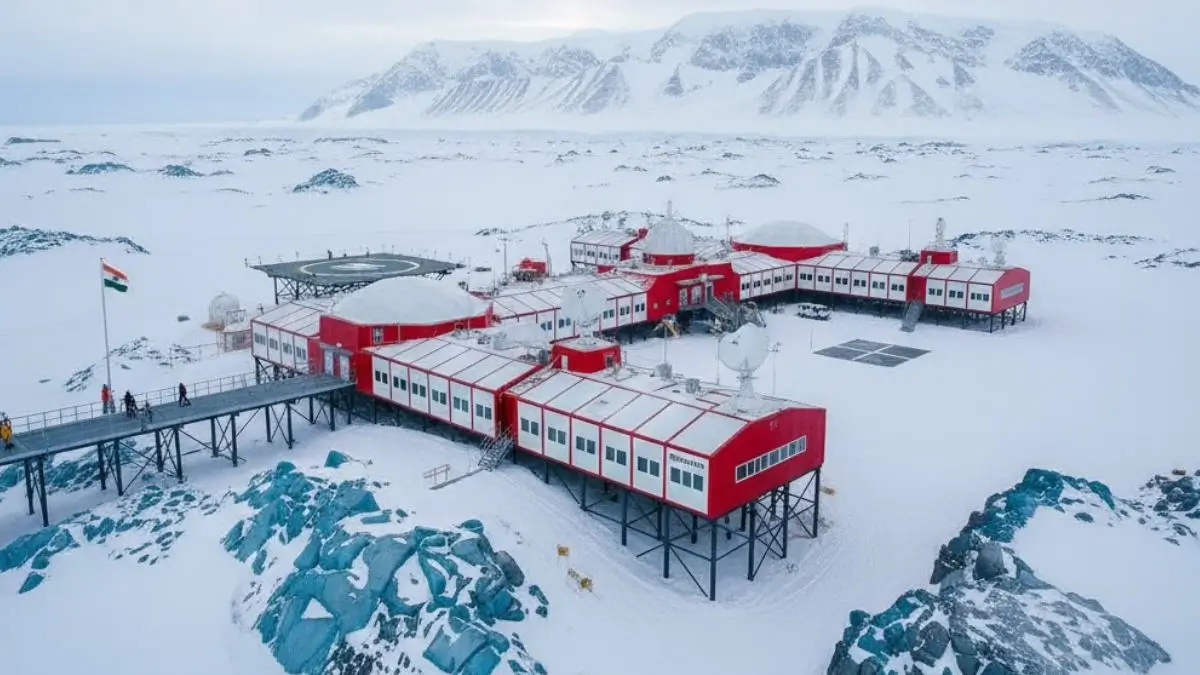
India is set to expand its polar research footprint with Maitri II, a next-generation research station in East Antarctica. The government has announced that the station is now expected to be completed by 2032, marking a revised timeline from earlier projections. The project reflects India’s long-term commitment to scientific research, climate studies, and environmental monitoring in the polar regions.
What Is Maitri II Station?
- Maitri II is India’s proposed fourth research station in Antarctica and will replace the existing Maitri I, which has been operational since 1989 in the Schirmacher Oasis.
- It is designed as a modern, all-weather facility capable of supporting advanced scientific research throughout the year.
- The station will significantly upgrade India’s research infrastructure in Antarctica with state-of-the-art laboratories and improved logistics.
Background: India’s Antarctic Presence
- India began its Antarctic research journey in 1981. Its first station, Dakshin Gangotri, later ceased operations around 1989.
- Since then, India has operated two permanent stations Maitri in East Antarctica and Bharati near the Antarctic coast.
- These stations have supported Indian scientists working in fields such as meteorology, glaciology, geology, atmospheric sciences, biology, zoology, and seismology.
Revised Timeline and Cost
- Initially, when Maitri II was announced in December 2023, its construction was expected to be completed by January 2029.
- However, the government has now revised the timeline, with completion expected by 2032, and scientific operations likely to begin later.
- The total estimated cost of building Maitri II over seven years is ₹2,000 crore.
Pre Investment Approval by MoES
- The Ministry of Earth Sciences (MoES) has approved ₹29.20 crore for pre-investment activities.
- This includes architectural design, site planning, and preparation of the Detailed Project Report (DPR).
- The announcement was made by Dr Jitendra Singh, Minister of State (Independent Charge) for Science and Technology and Earth Sciences, in a written reply to Parliament.
Objectives of Maitri II
- Maitri II aims to enhance India’s ability to conduct multidisciplinary scientific research in Antarctica.
- According to the government, the station will significantly strengthen research in biology, earth sciences, glaciology, atmospheric sciences, climate studies, and long-term environmental monitoring.
- It will allow India to generate high-quality scientific data and contribute meaningfully to global climate and polar research efforts.
Key Features of the New Station
- The upgraded research station will include modern laboratories, advanced ice-core storage and processing systems, and dedicated biological and microbial research facilities.
- It will also have expanded atmospheric observation infrastructure.
- A stronger and more reliable logistical support system will ensure uninterrupted operations during both summer and harsh Antarctic winters.
Why Maitri II Is Important
- Antarctica plays a critical role in regulating the global climate system. Long-term scientific observations from the continent are essential for understanding climate change, sea-level rise, and environmental shifts.
- Maitri II will enhance India’s role in international polar science, strengthen its commitments under the Antarctic Treaty System, and position the country as a serious contributor to global climate research.
Key Takeaways
- Maitri II is India’s next-generation research station in East Antarctica.
- Expected completion year: 2032.
- Total estimated project cost: ₹2,000 crore.
- ₹29.20 crore approved by MoES for pre-investment activities.
- Maitri II will replace Maitri I (established in 1989).
- Research focus includes climate studies, glaciology, biology, and earth sciences.
Question
Q. Maitri II will replace which existing Indian Antarctic station?
(A) Bharati
(B) Dakshin Gangotri
(C) Maitri I
(D) Himadri


 Meet MAI-Transcribe-1: Microsoft’s Fast,...
 What is Outer Space Treaty 1967? Princip...
 What Is Mission Mitra? ISRO’s New Experi...











