
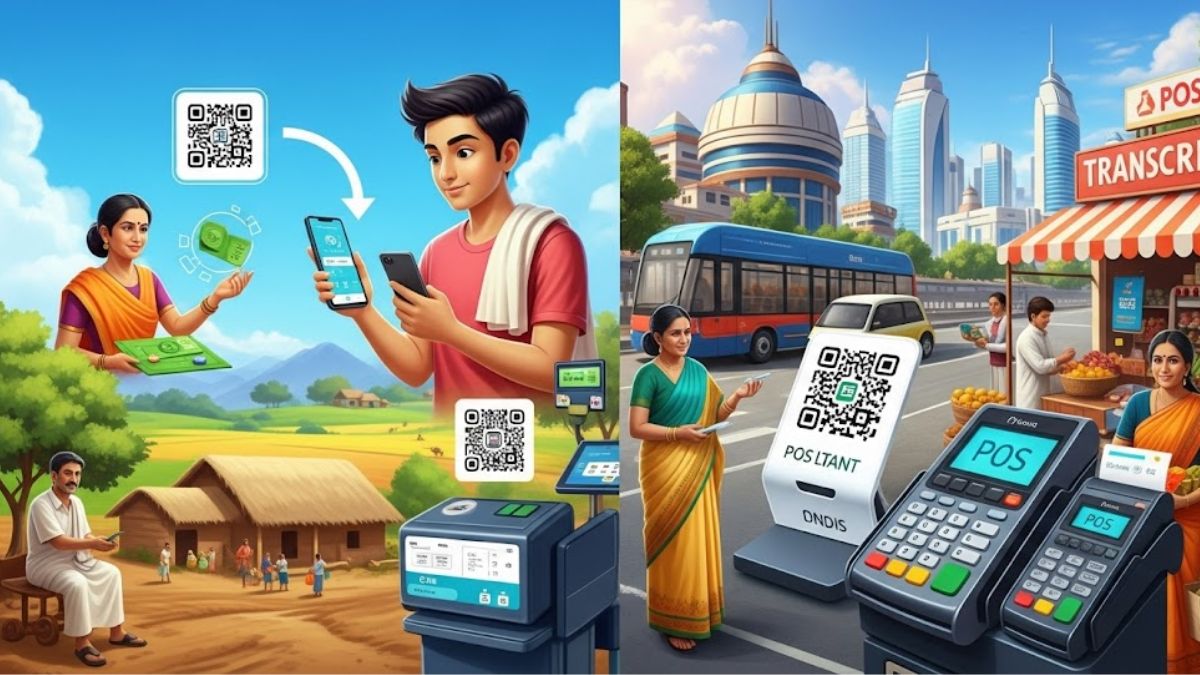
India’s journey toward becoming a digital economy has seen remarkable progress over the last six years. According to the government, between FY19 and FY25, the country recorded over 65,000 crore digital payment transactions worth ₹12,000 trillion. This surge, primarily driven by the Unified Payments Interface (UPI) and targeted policy initiatives, has significantly enhanced financial inclusion by reaching small towns, villages, and underserved communities.
Scale of Digital Transactions
In a written reply to the Lok Sabha, Minister of State for Finance Pankaj Chaudhary highlighted that digital transactions have grown beyond metropolitan areas, bringing millions of vendors and rural users into the formal economy.
- 65,000 crore transactions recorded from FY19 to FY25.
- Transaction value: ₹12,000 trillion.
- Reduced reliance on cash, strengthening India’s formal financial ecosystem.
Government and Institutional Efforts
Stakeholders Involved
The expansion of digital payments has been achieved through collaboration between the government, the Reserve Bank of India (RBI), National Payments Corporation of India (NPCI), fintechs, banks, and state governments. Together, they have rolled out multiple initiatives to ensure wider adoption.
Payments Infrastructure Development Fund (PIDF)
- Established by RBI in 2021 to promote digital acceptance infrastructure.
- Special focus on small towns, remote areas, the Northeast, and Jammu & Kashmir.
- As of May 31, 2025, around 4.77 crore digital touch-points were deployed across the country.
Measuring Digital Adoption: RBI’s Digital Payments Index
- To track the extent of digitization, the RBI launched the Digital Payments Index (RBI-DPI), with March 2018 set as the base period (index = 100).
- As of September 2024, the RBI-DPI stood at 465.33, reflecting strong growth in digital payment adoption, infrastructure, and performance nationwide.
Support for MSMEs and Small Merchants
The government, along with RBI and NPCI, has rolled out various measures to help small businesses and MSMEs embrace digital payments,
Incentive schemes for low-value BHIM-UPI transactions among small merchants.
- Trade Receivables Discounting System (TReDS) guidelines enabling MSMEs to get invoices discounted at competitive rates.
- Rationalization of Merchant Discount Rate (MDR) for debit card transactions, reducing costs for small businesses.
Impact on Financial Inclusion
Empowering the Underserved
Digital payments have revolutionized financial access, particularly for unserved and underserved communities. Through platforms like UPI, individuals and small businesses are now able to conduct seamless, traceable, and reliable transactions.
Boosting Access to Credit
Digital transaction histories provide alternative data points for banks and financial institutions. This enables them to assess creditworthiness even for customers without traditional financial documents, helping more people gain access to formal credit channels and integrate into the financial ecosystem.


 India Forex Reserves Fall by $30.5 Billi...
 IRDAI Retains The Systemically Important...
 India’s GST Collections Hit ₹1.78 Lakh C...











