
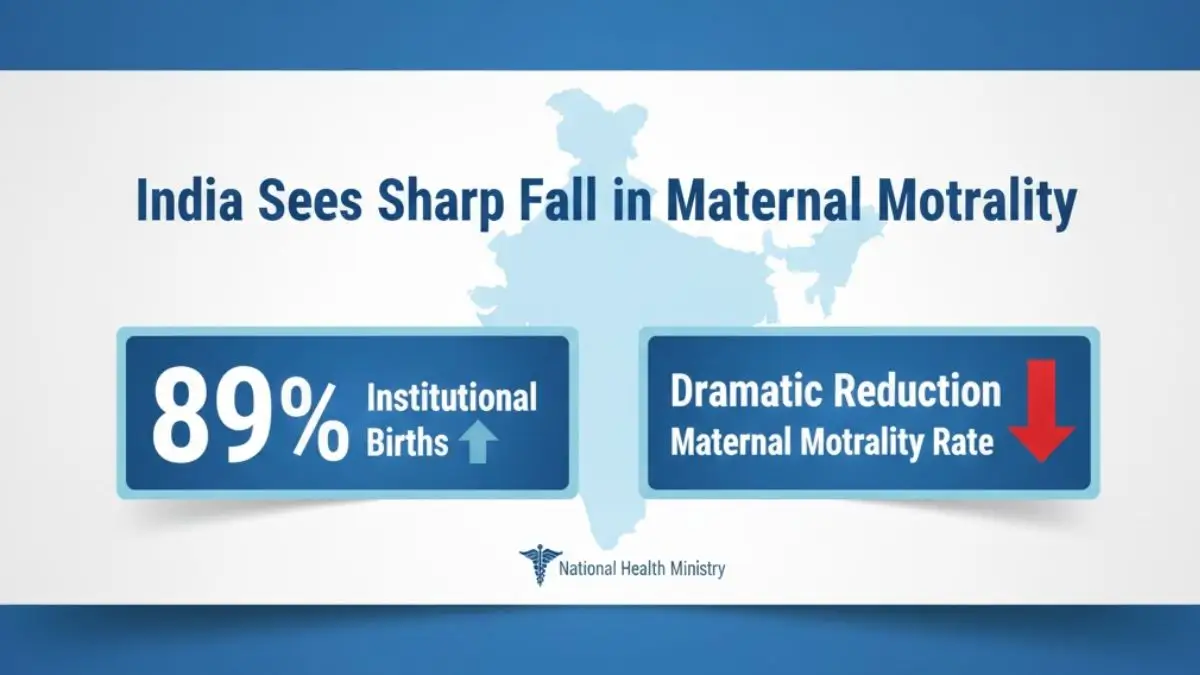
India has made strong progress in improving maternal health. According to the Ministry of Health and Family Welfare (MoHFW) institutional deliveries in the country have increased to 89%. Which has played a major role in reducing the Maternal Mortality Ratio (MMR). This marks a significant public health achievement.
About Maternal Mortality?
Maternal death refers to the death of a woman during pregnancy or within 42 days of the end of pregnancy due to causes related to pregnancy or its management.
- Maternal Mortality Ratio (MMR): Number of maternal deaths per 1,00,000 live births.
- Maternal Mortality Rate: Maternal deaths among women aged 15–49 years per lakh women, measured under the Sample Registration System (SRS).
Globally, United Nations Sustainable Development Goal SDG 3.1 aims to reduce MMR to below 70 per 1,00,000 live births by 2030.
Progress Made by India
India has shown consistent improvement in maternal health outcomes.
- MMR declined from 130 (2014–16) to 97 (2018–20) per 1,00,000 live births
- Institutional deliveries increased from 79% (2015–16) to 89% (2019–21)
- 100% institutional deliveries in Kerala, Goa, Lakshadweep, Puducherry, and Tamil Nadu
- More than 90% coverage in 18 other States and UTs
- Rural areas: Nearly 87% institutional births
- Urban areas: Nearly 94% institutional births
These improvements reflect better access to hospitals, skilled birth attendants, and emergency care.
Importance of Institutional Delivery
Institutional deliveries ensure,
- Skilled medical supervision during childbirth
- Quick response to complications
- Access to emergency obstetric care
- Reduced risk of maternal and newborn deaths
- This is one of the most effective ways to lower MMR.
Challenges Still Faced by India
Despite progress, several challenges remain,
- High Out-of-Pocket Expenses (OOPE): Families still spend on diagnostics, medicines, and private care during emergencies.
- Sociocultural Barriers: Low education, gender inequality, and delayed decision-making often prevent timely care.
- Rise in High-Risk Pregnancies: Factors like late pregnancies, obesity, hypertension, diabetes, and short birth gaps increase risks.
- Weak Infrastructure in Remote Areas: Tribal, rural, and hilly regions lack emergency care, transport, and blood storage facilities.
Government Initiatives to Reduce MMR
India has launched multiple schemes to address maternal health
- Janani Suraksha Yojana (JSY): Encourages institutional deliveries, especially among poor and vulnerable women.
- Pradhan Mantri Matru Vandana Yojana (PMMVY): ₹5,000 maternity benefit for the first living child
- PMMVY 2.0 under Mission Shakti gives extra incentive if the second child is a girl
- Pradhan Mantri Surakshit Matritva Abhiyan (PMSMA): Free, quality antenatal check-ups on the 9th of every month.
- LaQshya Programme: Improves quality of care in labour rooms and maternity operation theatres.
- Capacity Building: Training MBBS doctors in anesthesia (LSAS) and emergency obstetric care (EmOC), especially for rural areas.
- Maternal Death Surveillance Review (MDSR): Tracks maternal deaths at facility and community levels to improve care quality.
- VHSND and RCH Portal: Monthly Village Health, Sanitation and Nutrition Days and Digital tracking of pregnant women and newborns for timely services
Key Takeaways
- Institutional deliveries in India have reached 89%
- MMR declined to 97 per 1,00,000 live births
- Rural institutional births stand at 87%, urban at 94%
- Multiple government schemes support maternal healthcare
- Challenges remain in costs, awareness, and remote infrastructure
Question
Q. Maternal Mortality Ratio (MMR) is defined as:
A. Maternal deaths per 1,000 women
B. Maternal deaths per 1,00,000 live births
C. Maternal deaths per 1,00,000 population
D. Maternal deaths per 10,000 live births


 India Withdraws Its Plan to Host COP33 S...
 IIM Rohtak Wins BIMTECH's 'Hermes' Dialo...
 Gurgaon Tops the List of India's Most Po...











