
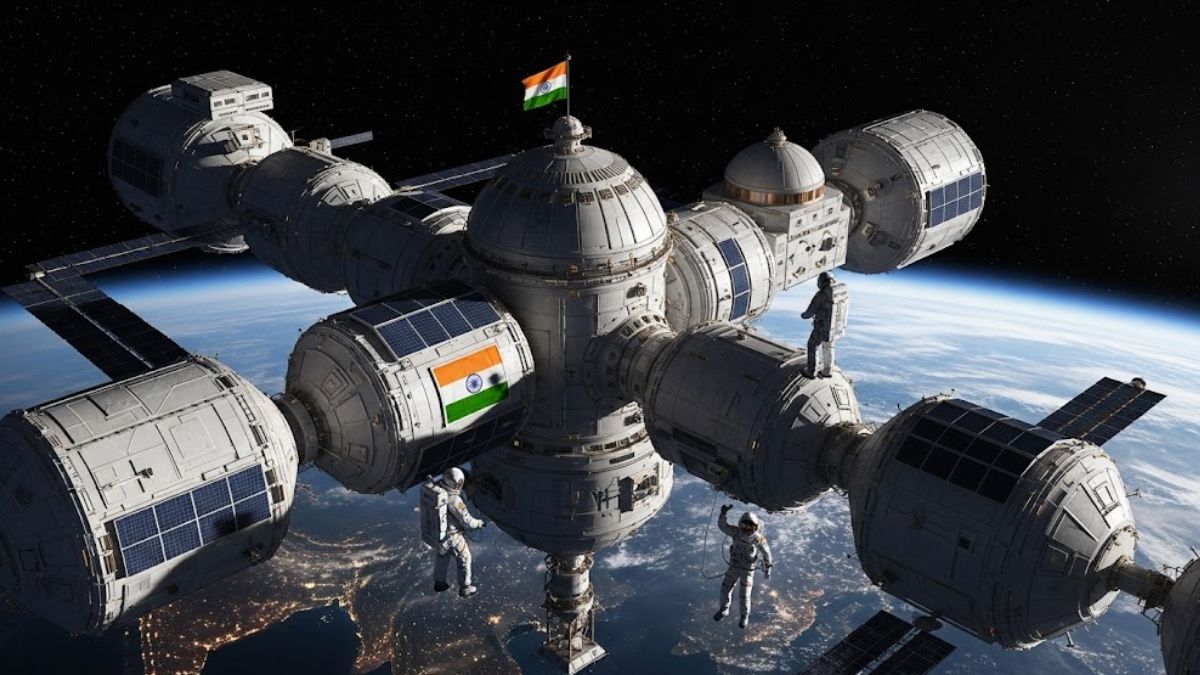
India is setting ambitious new goals in the global space race. Speaking in the Lok Sabha, Union Minister of Science and Technology Dr. Jitendra Singh reaffirmed the government’s vision to establish a fully operational Bharatiya Antariksh Station by 2035 and to send Indian astronauts to the Moon by 2040. These missions are positioned as key scientific milestones on the path to realizing the vision of ‘Viksit Bharat’ by 2047.
India’s Space Ambitions: From ISS to the Moon
Dr. Singh’s announcement came during a special parliamentary session celebrating the historic mission of Indian Air Force Group Captain Subhanshu Shukla, the first Indian astronaut to board the International Space Station (ISS). This achievement was hailed as a moment of national pride and a testament to the country’s growing space capabilities.
The minister outlined that India’s next frontier includes,
- Bharatiya Antariksh Station by 2035: A permanent, indigenous space station marking India’s entry into long-duration human spaceflight.
- Crewed Moon Mission by 2040: An Indian astronaut will set foot on the Moon, marking a monumental milestone in the nation’s space exploration journey.
Foundation of the Vision: 11 Years of Space Reforms
Dr. Singh highlighted how India’s space journey has been revolutionized over the last 11 years, particularly under Prime Minister Narendra Modi’s leadership. He credited several major policy shifts that have paved the way for this ambitious trajectory.
Key Developments
- Opening the Space Sector to Private Players: This has led to an ecosystem of innovation, with multiple space-tech startups emerging across India.
- Increased R&D: Investments in cutting-edge research have enhanced ISRO’s capabilities and inspired indigenous technological breakthroughs.
- Operation Sindoor: Technologies used in this operation were developed during the Modi government’s tenure, showcasing space tech’s real-world utility.
Socio-Economic Impact of Space Innovation
The minister emphasized that India’s space research is not limited to rockets and satellites; it is also deeply linked to the growth of the national economy and public welfare.
Notable Benefits
- Satellite data aids agriculture, disaster management, and urban planning
- Navigation and communication systems support transport and logistics
- Remote sensing assists in infrastructure development and environmental monitoring
- These examples underscore how space technology contributes to improving quality of life and advancing economic development across sectors.


 Meet MAI-Transcribe-1: Microsoft’s Fast,...
 What is Outer Space Treaty 1967? Princip...
 What Is Mission Mitra? ISRO’s New Experi...











