
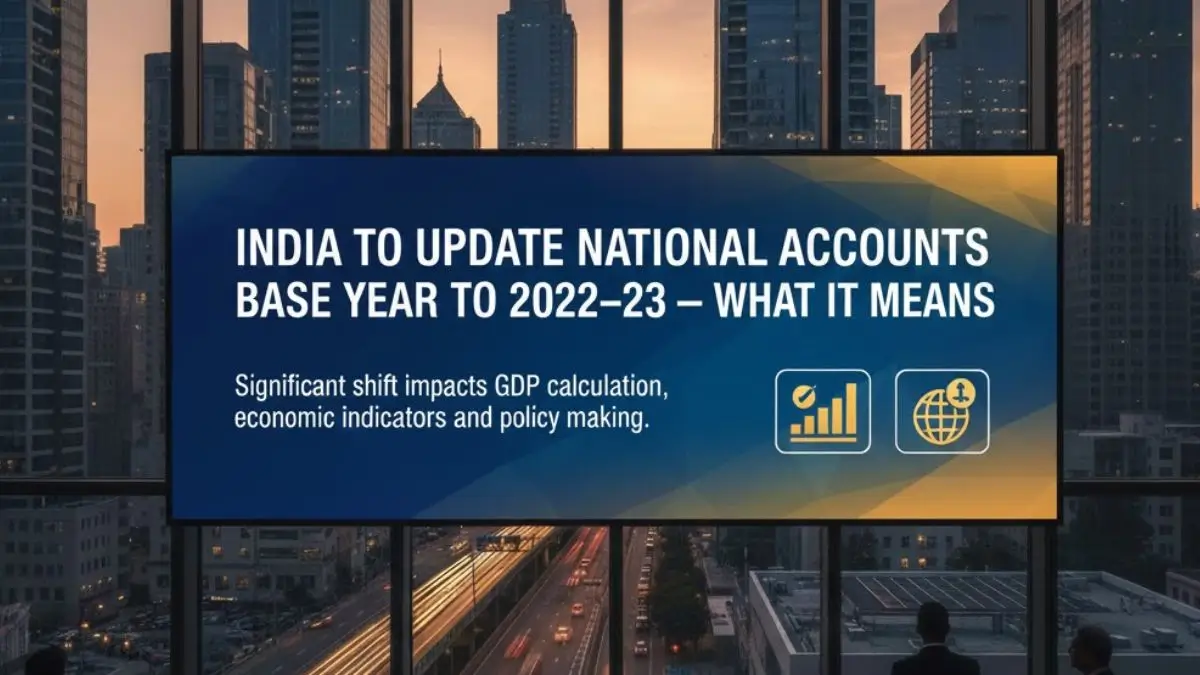
India will soon update the base year used for calculating national accounts — a move that will bring economic data in line with the country’s current realities. Announced during the Winter Session of Parliament, the new base year of 2022–23 will replace the existing 2011–12 series and become effective from February 26–27, 2026. The decision was announced by Union Finance Minister Nirmala Sitharaman, who stated that the outdated base was impacting the credibility and global perception of India’s economic data. The update will help policymakers, economists, and analysts assess economic performance more accurately using modern indicators.
Why Was the Update Needed?
Base years are periodically revised to reflect structural changes in the economy.
- The 2011–12 base year has been in place for over a decade. Since then, India has seen major transformations — including the growth of the digital economy, changes in consumption patterns, new employment sectors, GST rollout, post-COVID recovery, and rapid technological shifts.
- The update to 2022–23 addresses these shifts and responds to concerns raised by international institutions, including a recent “C” grade assigned by the International Monetary Fund (IMF) — based not on data quality, but on the outdated statistical framework.
An updated base year ensures economic statistics are more relevant, timely, and globally comparable.
What Will Change?
The update affects several core economic indicators,
GDP (Gross Domestic Product)
The new base year will recalibrate real GDP growth and sectoral contributions. With fresh price levels and structural data, future GDP numbers will reflect the real-time economy more accurately.
IIP (Index of Industrial Production)
This industrial index will also adopt 2022–23 as its base year, better representing India’s evolving manufacturing and production landscape.
Inflation and Price Indices
Though CPI (Consumer Price Index) follows its own schedule, future revisions may align with this base. It ensures consistency when comparing growth with inflation-adjusted figures.
Sectoral Data
Emerging sectors like renewables, digital services, fintech, and gig economy jobs will find more accurate representation, especially as part of services and industrial segments.
Implications of the Base Year Shift
Updating the base year enhances the quality, accuracy, and usability of economic data. Here’s what this means in practice,
- Improved Policy Decisions: More realistic indicators help the government design better policies, subsidies, budgets, and growth strategies.
- Reliable Growth Tracking: Economic growth figures based on recent price and volume data give a clearer picture of development and productivity.
- Enhanced Credibility: Updated statistics improve investor confidence and India’s standing with global institutions.
- Better Sector Representation: Industries that have grown or emerged in the past decade will be captured with appropriate weightage.
Debate Over GDP Figures and Data Interpretation
While India recently posted a strong 8.2% GDP growth for the July–September 2025 quarter, some experts and opposition leaders argued that deeper economic challenges — such as slow private investment and rising living costs — were being masked.
Concerns were raised about the GDP deflator, which implied very low inflation despite everyday price pressures. Critics claimed this understated inflation made GDP growth look stronger. The base year change is expected to address some of these issues by aligning with newer consumption and price data.
Challenges Ahead
Despite its advantages, rebasing also brings technical and analytical challenges,
- Initial Confusion: Growth rates may appear different under the new base, requiring careful interpretation.
- Data Gaps: Some sectors — especially informal and gig-based — still lack structured data, which could impact accuracy.
- Transition Phase: Comparing historical data across old and new series may complicate long-term trend analysis.
- Pandemic Impact: The chosen base year (2022–23) may still carry residual distortions from COVID-era disruptions.
Nonetheless, the benefits of modernization outweigh the temporary statistical uncertainties.
Key Takeaways
- India will change the base year for national accounts from 2011–12 to 2022–23, effective February 26–27, 2026.
- The update includes key indicators like GDP and Index of Industrial Production (IIP).
- Aimed at reflecting the current economic structure, especially post-COVID and digital-era shifts.
- Responds to international concerns over outdated data, including an IMF report.
- Will improve accuracy, sectoral coverage, and international comparability.
- Challenges include transitional data gaps, interpretation differences, and post-pandemic distortions in the base year.


 RBI MPC Meeting 2026, Kept Repo Rates Un...
 India's Major Ports Handle Record 915.17...
 Moody's Cuts India's FY27 Growth Forecas...











