
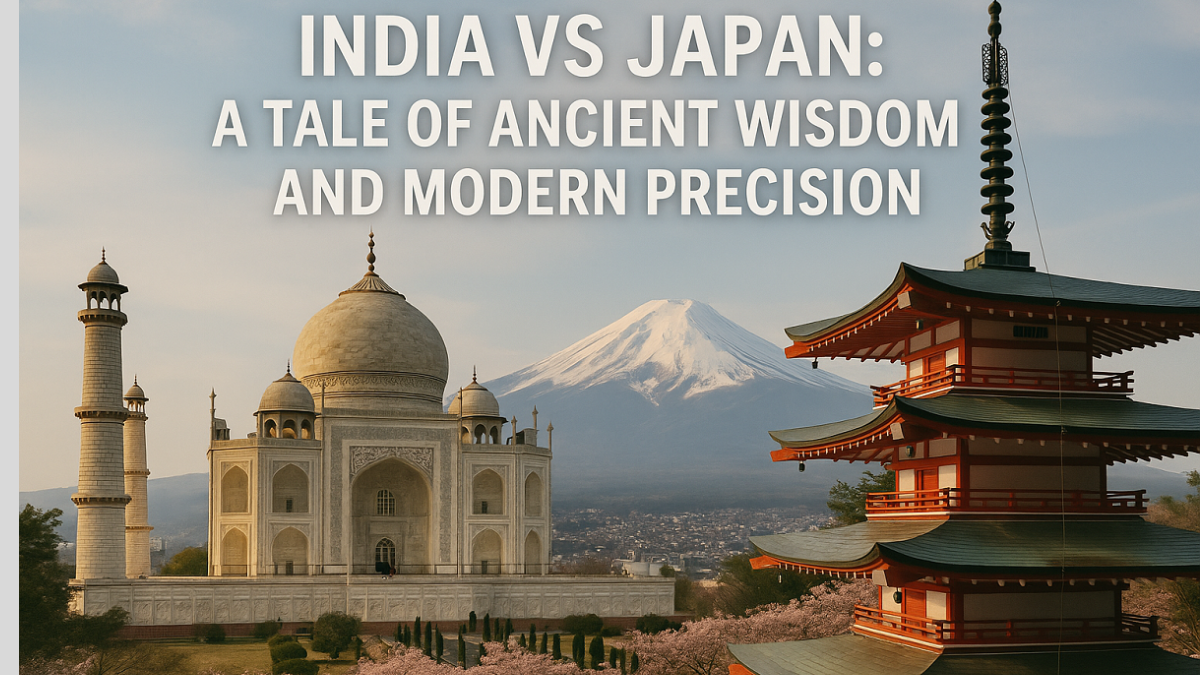
India and Japan are two remarkable countries with their own special histories and cultures that have developed over thousands of years. India is known for its deep spiritual beliefs, old traditions and wise teachings from the past. Japan is famous for its modern technology, strict discipline and doing things with great care and accuracy. Even though they are different in many ways, both countries have given a lot to the world – India through its ancient wisdom and Japan through its modern ideas. In this article, we will see how these two great nations are different.
Ancient Wisdom of India
India is one of the oldest civilizations in the world. It gave birth to religions like Hinduism, Buddhism, Jainism and Sikhism. The ideas of yoga, meditation and Ayurveda (natural medicine) all came from India.
- Yoga and meditation help people stay calm and healthy.
- The Vedas and Upanishads, ancient Indian texts, teach deep truths about life, nature and the universe.
- India taught the world about zero and advanced mathematics and astronomy long ago.
Japan’s Culture of Precision
Japan is known for being neat, clean and organized. Everything in Japan is planned with care – from trains that are almost never late, to factories that make cars and electronics with perfect accuracy.
- The Japanese work ethic is admired worldwide.
- They believe in Kaizen, which means ”continuous improvement.”
- Japan is a leader in robotics, high-speed trains and quality manufacturing.
Difference Between India and Japan
India and Japan are two very different countries with their own special cultures, traditions and ways of life. While India is known for its ancient wisdom and spiritual roots, Japan is known for its modern technology and discipline. Both countries have unique strengths and global importance.
Here is the different between India and Japan:
| Basis of Difference | India | Japan |
| Cultural Roots | One of the world’s oldest civilizations; home to major religions and philosophies | Deeply rooted traditions with influence from Shinto and Zen Buddhism. |
| Spiritual Practices | Meditation, yoga and Ayurveda for inner peace and health | Discipline, mindfulness and respect in everyday actions |
| Education & Knowledge | Ancient texts like the Vedas, early advanced in maths and astronomy | Focus on science, engineering and technical education. |
| Technology | Fast-growing tech sector, strong in IT and space programs | World leader in robotics, electronics and high-speed trains |
| Way of Life | Flexible, spiritual, family-oriented | Organized, punctual and focused on efficiency |
| Traditions & Festivals | Diwali, Holi and spiritual rituals that bring communities together | Cherry Blossom (Hanami), tea ceremonies and seasonal festivals. |
| Work Culture | Often more relaxed, flexible working style | Highly disciplined, team-oriented, continued improvement (Kaizen) |
| Global Influence | Spread of yoga, meditation and spiritual teachings worldwide. | Known for innovation, design and product quality around the globe. |


 Weekly Current Affairs One Liners (30th ...
 Who is known as the Father of Mobile Pho...
 Which is the Highest Airport in the Worl...











