
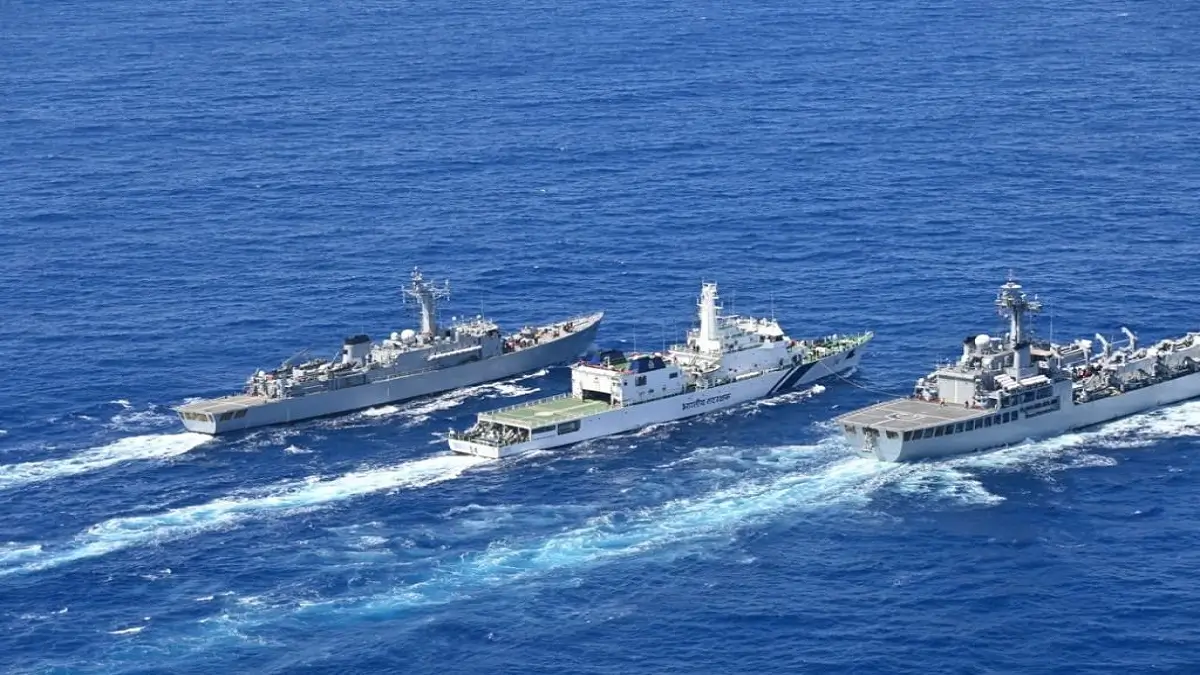
The First Training Squadron (1TS) of the Indian Navy (IN) embarked on a Long-Range Training Deployment (LRTD) to Southeast Asia. This significant maritime mission is part of the 110th Integrated Officers’ Training Course (IOTC) and represents a major initiative to provide naval cadets with practical, real-world operational experience at sea. The deployment sends multiple naval vessels across extended distances into foreign waters, demonstrating India’s growing naval capabilities and strategic engagement in the Indo-Pacific region.
Why This Deployment Matters?
Long-Range Training Deployments are crucial for developing the next generation of naval officers. They provide hands-on experience that cannot be replicated in classroom or harbor environments. The mission strengthens India’s Act East Policy by maintaining active diplomatic and security partnerships with Southeast Asian nations. It demonstrates India’s commitment to a free, open, and inclusive Indo-Pacific, a principle increasingly important for regional stability and maritime security.
The deployment also showcases India’s naval professionalism and operational capability to friendly nations. Through scheduled port calls and professional engagements, the Indian Navy reinforces bilateral relationships and promotes regional maritime cooperation.
Vessels and Composition
The deployment comprises four significant maritime vessels:
- INS Tir – Indian Navy vessel
- INS Shardul – Indian Navy vessel
- INS Sujata – Indian Navy vessel
- ICGS Sarathi – Indian Coast Guard vessel
This mix of naval and coast guard vessels demonstrates India’s integrated maritime security approach. The inclusion of coast guard assets highlights the synergy between different maritime forces in training and operational contexts.
Operational Experience and Training Focus
Naval cadets aboard these vessels gain comprehensive training in crucial maritime skills:
- Seamanship – Advanced sailing and maritime operations
- Navigation – Precision navigation across open oceans
- Professional Operations – Real-world naval procedures
- Decision-Making – Leadership under pressure
- Maritime Protocols – International standards
- Varied Environments – Open ocean to territorial waters
Operating in diverse maritime conditions provides invaluable experience that shapes future naval leaders. The cadets develop expertise through real-world scenarios and hands-on operational exposure.
Port Calls and Regional Engagement
The squadron will make scheduled port calls in key Southeast Asian countries:
- Singapore – Major strategic hub
- Indonesia – Regional maritime partner
- Thailand – Southeast Asian engagement point
These port visits serve multiple purposes beyond the training mission:
- Cultural exchanges between naval personnel
- Crew welfare activities in foreign ports
- Demonstration of India’s sustained naval presence
- Professional exchanges with friendly nation navies
- Strengthening bilateral maritime relationships
- Showcasing India’s naval professionalism
Strategic Significance
This deployment embodies India’s Act East Policy through concrete maritime action. Key strategic aspects include:
- Regional Engagement – Demonstrates proactive involvement in Southeast Asia
- Security Architecture – Reinforces India’s role in regional security
- Freedom of Navigation – Maintains navigation rights in international waters
- Naval Power Projection – Shows capability to project power across vast distances
- Indo-Pacific Stability – Contributes to free, open, inclusive Indo-Pacific
- Training Excellence – Validates naval officer development capacity
- Bilateral Relations – Strengthens ties with Southeast Asian nations
The LRTD underscores India’s ability to project naval power across vast ocean distances and validates India’s training infrastructure and institutional capacity to develop professional naval officers capable of handling complex international maritime situations.


 India's Defense Exports Hit Record ₹38,4...
 INS Malwan Delivered to Indian Navy: Nex...
 Indian Army Appoints New Commanders for ...











