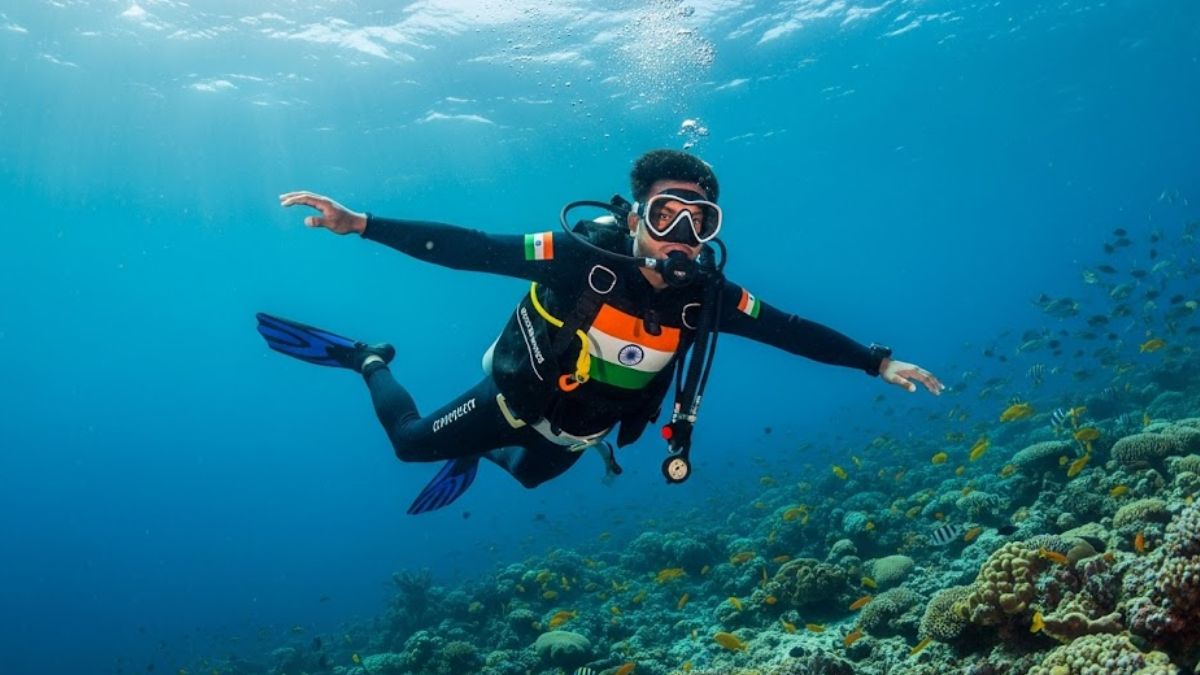
India has scripted history in its quest to explore the ocean’s mysteries. Under the Deep Ocean Mission, an Indian aquanaut descended to a depth of 5,002 metres in the North Atlantic Ocean, marking India’s deepest human dive ever. The dive, carried out in collaboration with France, reflects India’s determination to build advanced deep-sea technology for exploration, resource utilization, and scientific research.
The Record-Breaking Dives
The milestone dives were conducted aboard the French submersible Nautile on August 5 and 6, 2025,
- Raju Ramesh, a scientist from the National Institute of Ocean Technology (NIOT), descended to 4,025 metres on August 5.
- Jatinder Pal Singh, retired Navy Commander, set a new Indian record of 5,002 metres on August 6.
- These achievements make India one of the few nations capable of undertaking deep manned ocean expeditions.
Indo-French Collaboration and Technology Exchange
The mission was carried out in partnership with France, leveraging the Nautile, a proven manned deep-sea submersible. This collaboration,
- Provides India with practical expertise in extreme ocean conditions
- Helps Indian aquanauts train for future indigenous missions
- Enhances bilateral cooperation in marine science and technology
The Deep Ocean Mission & Samudrayaan Project
India’s Deep Ocean Mission aims to boost national capabilities in manned submersibles, unmanned vehicles, and deep-sea mining. A key component is the Samudrayaan project, under which the Matsya 6000—a human-rated deep-sea submersible—is being developed.
- Matsya 6000 is designed for depths up to 6,000 metres
- Trials are expected by December 2027
- Focus areas include resource exploration, biodiversity studies, and climate research
- The 2025 dives serve as a prelude to India’s own indigenous missions, providing critical real-world data and operational insights.
Why This Matters for India
This achievement holds both scientific and strategic significance,
- Technological Leap: Enhances India’s expertise in deep-sea exploration and pressure-resistant submersible engineering
- Resource Access: Supports exploration of minerals, hydrocarbons, and rare-earth elements in India’s Exclusive Economic Zone (EEZ)
- Global Prestige: Positions India alongside a handful of countries like the US, France, Russia, and China in manned deep-ocean expeditions
- National Pride: Complements India’s space achievements, showcasing the nation’s capability to conquer both the depths of the oceans and the heights of space


 New COVID Variant BA.3.2: Symptoms, Risk...
 NASA’s Artemis 2 Set for April 2026 Laun...
 Akasha300 3D Printer Explained: How It W...