
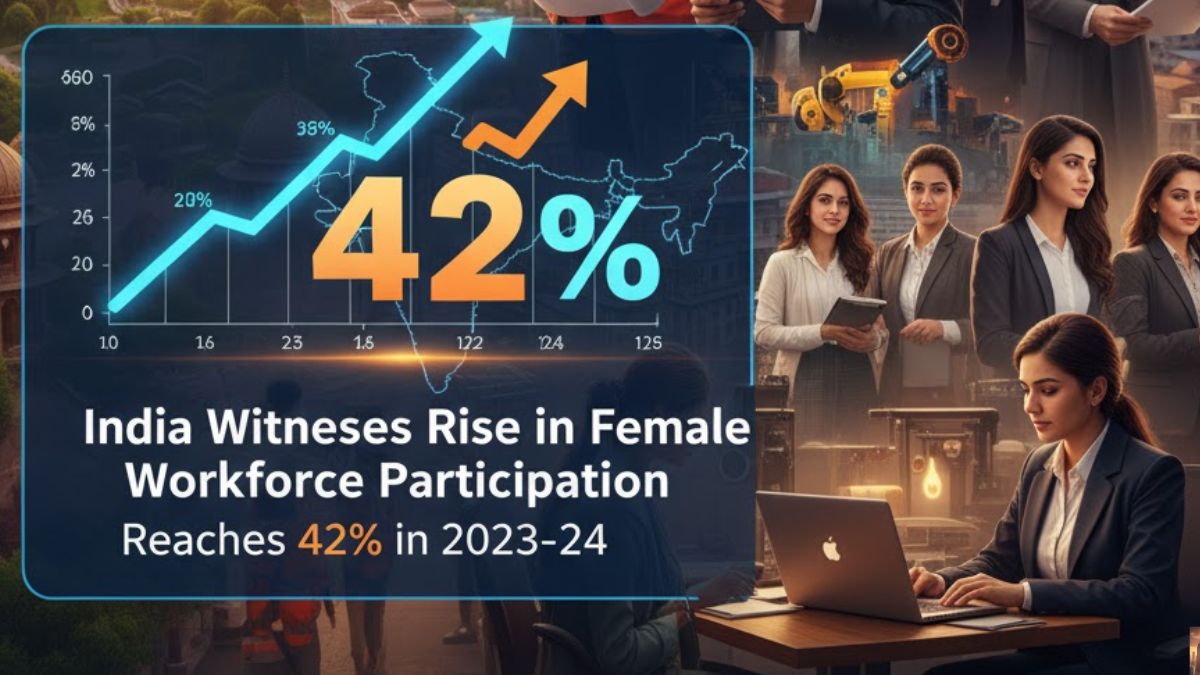
India has recorded a remarkable increase in female workforce participation, a key indicator of gender inclusion and economic progress. According to the Ministry of Labour and Employment, the Female Labour Force Participation Rate (FLFPR) has risen from 23% in 2017–18 to around 42% in 2023–24. This surge marks a major transformation in India’s labour landscape and positions the country as a leader in women’s economic inclusion among BRICS nations.
Rapid Increase in Participation
- As per World Bank data, India has seen the sharpest rise in women’s labour force participation over the past decade among BRICS countries (Brazil, Russia, India, China, South Africa).
- The nearly 19 percentage point jump between 2017–18 and 2023–24 reflects a significant shift in both social norms and government interventions.
- This increase has taken place despite global uncertainties and structural employment challenges, making India’s achievement especially notable.
Driving Factors
- The government attributes this growth to a combination of targeted policy measures, access to skilling and credit, and formal job creation, particularly in rural and semi-urban areas.
- The expansion of digital platforms, work-from-home options, and growth in the service sector have also contributed to more women entering the workforce.
Policy Support for Women in the Workforce
Key Government Initiatives
The government has implemented a series of women-centric policies that promote inclusivity, support work-life balance, and enable greater participation in formal employment. These include,
- Exemption of examination fees for women in various competitive exams
- 730 days of Child Care Leave (CCL) for female government employees
- 180 days of paid maternity leave, ensuring maternal health and employment continuity
- Co-location of spouses, allowing husband and wife to be posted in the same station
- Workplace wellness programmes and psychosocial support in public services
Skill Development & Employment Programs
Multiple Ministries have launched schemes to equip women with job-relevant skills. These include,
- Skill India Mission, with a special focus on female trainees
- Entrepreneurship promotion schemes for women-led startups
- Digital literacy programmes to bridge the tech-access gap
- Support for women in STEM fields, research, and innovation roles
These efforts aim to enhance women’s employability across sectors—from construction to IT, healthcare to education.
Safety, Wellbeing, and Support Systems
One Stop Centres (OSCs)
To address gender-based violence and ensure a safe environment for working women, the government has established One Stop Centres (OSCs) across the country. These centres offer,
- Medical assistance
- Legal aid
- Counselling services
- Temporary shelter
By integrating these services, OSCs play a vital role in ensuring that safety and support extend beyond the workplace.
Key Takeaways for Exams
- Female Labour Force Participation Rate (FLFPR) rose from 23% in 2017–18 to 42% in 2023–24
- India recorded the highest growth in female workforce participation among BRICS nations
- Key policies: 730 days Child Care Leave, 180 days maternity leave, exam fee waivers, co-location of spouses
- Government initiatives include Skill India, One Stop Centres, and entrepreneurship programs
- Central to achieving the goal of Viksit Bharat by 2047


 ECINet KYC Feature Explained: How Voters...
 BIRAC-BioNEST Incubation Centre Inaugura...
 E20 Petrol India 2026: Nationwide Rollou...











