
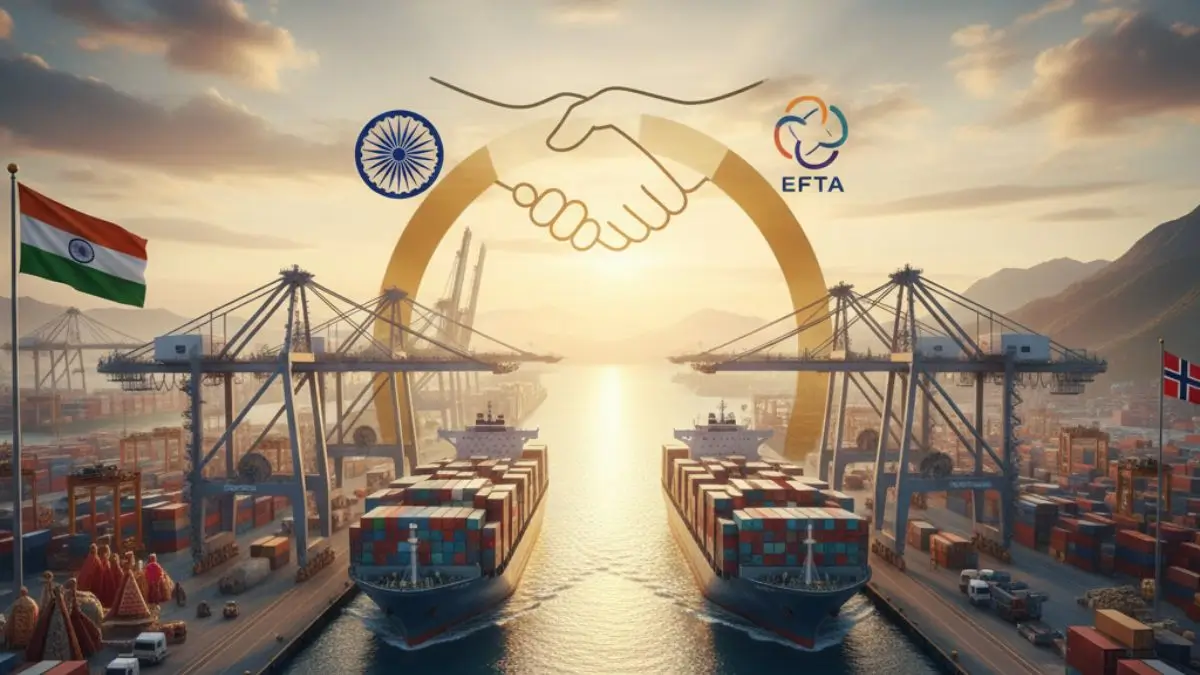
India is set to operationalize its first Free Trade Agreement (FTA) with a European bloc as the Trade and Economic Partnership Agreement (TEPA) with EFTA countries—Switzerland, Norway, Iceland, and Liechtenstein—comes into effect on October 1, 2025. Announced by Union Minister Piyush Goyal, this FTA represents a landmark in India’s global trade strategy, combining tariff concessions with a massive investment promise from advanced economies.
What is the EFTA-India Agreement?
The European Free Trade Association (EFTA) comprises four non-EU countries: Switzerland, Norway, Iceland, and Liechtenstein. The TEPA, signed in March 2024, opens Indian and EFTA markets to each other with progressive tariff liberalization and investment facilitation.
Key highlights include,
- Phased tariff reductions across goods
- Market access in services, investment, intellectual property
- Commitment of $100 billion in investments into India over 15 years
- Focus on technology transfer, innovation, and skills development
Strategic Importance for India
1. First FTA with a European Bloc
This is India’s first such pact with developed European economies, deepening ties with high-income markets and diversifying export destinations.
2. Boost to Key Indian Exports
Indian sectors like pharmaceuticals, textiles, gems and jewellery, auto components, and chemicals stand to benefit from better access to EFTA markets with reduced or zero duties.
3. Foreign Investment & Job Creation
The deal is expected to bring $100 billion in investments and generate up to 1 million jobs over the next 15 years, enhancing India’s manufacturing and services sectors.
4. Supply Chain Integration
Improved trade logistics and harmonized standards will allow India to integrate more deeply into European supply chains, especially in pharmaceuticals, engineering, and clean technologies.
Opportunities and Challenges
Opportunities
- Market expansion in high-value European economies
- R&D collaboration in pharma, AI, clean tech, and med-tech
- Start-up funding and innovation ecosystems supported by EFTA capital
- Sustainability provisions encouraging green manufacturing and climate-friendly trade
Challenges
- Sensitive Indian sectors like agriculture and dairy remain partially protected due to concerns over import surges
- Trade imbalances may arise unless Indian exports gain competitiveness quickly
- Implementation and awareness across Indian MSMEs and exporters will be key to reaping benefits
Alignment with India’s Trade Vision
This FTA aligns with India’s broader aim to become a $5 trillion economy and a global manufacturing hub. It follows other recent FTAs signed with UAE and Australia, and ongoing talks with EU, US, New Zealand, Oman, and Chile. It also complements domestic reforms like GST simplification, PLI schemes, and infrastructure upgrades.
Key Facts
- Effective date: October 1, 2025
- Countries involved: Switzerland, Norway, Iceland, Liechtenstein
- Name: Trade and Economic Partnership Agreement (TEPA)
- Investment commitment: $100 billion over 15 years
- First European bloc FTA for India
- Expected job creation: 1 million
- Covers: Goods, services, investment, IPR, sustainable development


 Iran–US Ceasefire: Iran’s 10 Conditions ...
 Russia and China Veto UN Resolution to R...
 France Hosts One Health Summit Under G7 ...











