
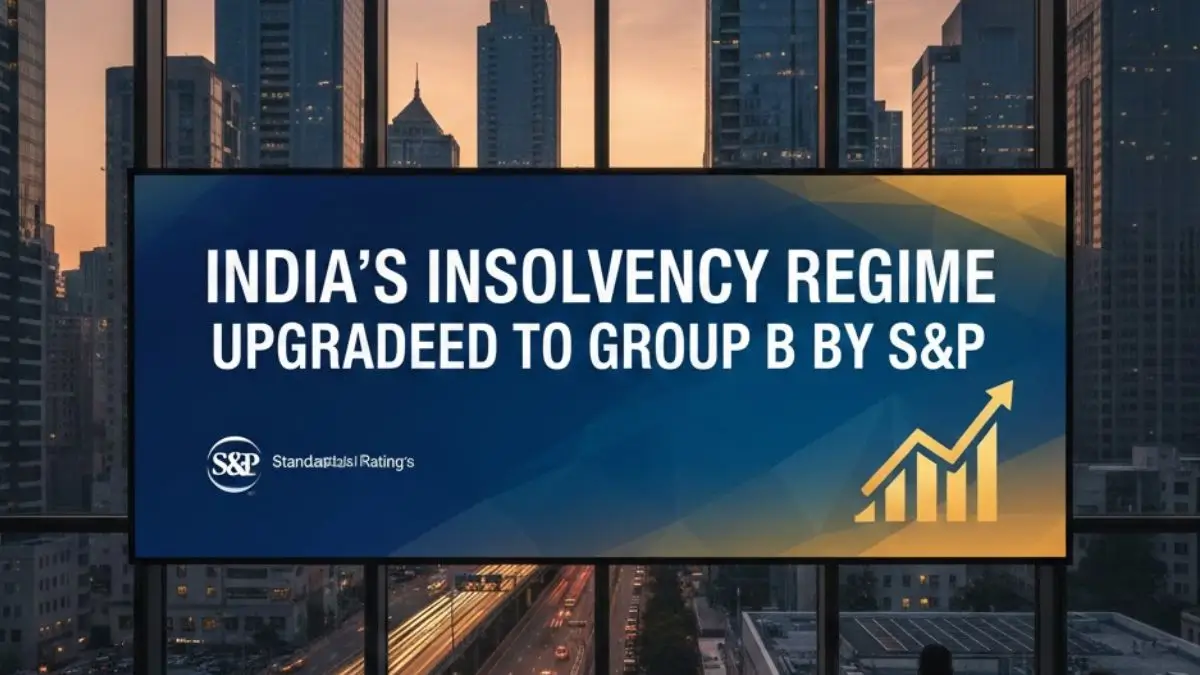
In a significant recognition of India’s progress in financial and legal reform, S&P Global Ratings has upgraded the jurisdiction ranking assessment of India’s insolvency regime from Group C to Group B. This move reflects notable improvements in creditor recovery values, resolution timelines, and the legal framework for dealing with corporate defaults, largely driven by the Insolvency and Bankruptcy Code (IBC).
While this development marks a step forward in the maturity of India’s financial system, S&P also cautioned that India still lags behind more advanced Group A and select Group B jurisdictions, particularly in areas like predictability, legal delays, and protection of secured creditors.
Understanding Jurisdiction Ranking and Why It Matters
A jurisdiction ranking assessment is an important measure used by global rating agencies like S&P to evaluate how well a country’s insolvency framework protects creditor interests and the predictability of legal outcomes in default situations. Rankings are grouped into Group A (most efficient), Group B (moderately effective), and Group C (least effective).
The ranking directly affects credit ratings of debt instruments, especially those issued by speculative-grade or sub-investment-grade companies. A move up the ladder reflects stronger legal frameworks, improved enforcement mechanisms, and better recovery prospects for investors.
Key Improvements That Led to the Upgrade
India’s rise to Group B was driven by structural reforms and performance improvements under the IBC regime, implemented in 2016. According to S&P,
- Average recovery values have doubled, rising from 15–20% under the old system to over 30% now.
- Resolution time has improved, with the average duration reduced to around two years, compared to 6–8 years earlier.
- Secured creditors have benefited the most, often recovering significantly more than unsecured ones.
- The Bhushan Power & Steel Ltd. case, upheld by the Supreme Court, has strengthened confidence in creditor rights, despite procedural delays.
Additionally, the threat of promoters losing control of their businesses has instilled a greater sense of credit discipline, marking a shift in the balance of power toward creditors.
Challenges That Still Remain
Despite progress, S&P flagged several areas where India still needs improvement,
- Average recovery rates (around 30%) are still lower than many developed jurisdictions.
- Unpredictability in resolution processes persists, especially in the initiation and implementation phases, often due to legal challenges from multiple stakeholders.
- The current practice of secured and unsecured creditors voting as a single class can weaken secured creditors’ influence, especially when unsecured debt is significant.
- More clarity is needed in safeguards such as recovery values exceeding liquidation thresholds and court-supervised distributions.
These challenges reflect the need for legal clarity, procedural streamlining, and capacity building within insolvency courts and resolution professionals.
Impact on Credit Ratings and Financial Markets
With the Group B upgrade, S&P can now assign recovery ratings on speculative-grade debt in India. Key outcomes include,
- Recovery ratings and estimated recoveries will now be attached to rated debt.
- Issue ratings may be notched down by up to two levels if expected recoveries are below 30%.
- In rare cases, issue ratings may be upgraded by one notch if recovery exceeds 90%, particularly for secured debt.
This enhances transparency for global investors, better aligns risk assessment with actual insolvency outcomes, and is likely to improve India’s attractiveness to foreign investors in distressed assets and debt markets.
Significance for India’s Financial Ecosystem
The S&P upgrade is a signal to global markets that India is steadily reforming its credit and resolution systems. This can help,
- Reduce borrowing costs for Indian firms by improving perception of legal enforceability.
- Encourage foreign investment in Indian distressed assets and corporate debt.
- Deepen credit markets by improving investor confidence in legal recoverability.
- Support India’s broader aim of becoming a $5 trillion economy with a robust and accountable financial system.


 BoB Launches AI-based 'bob SAMVAD' Platf...
 RBI MPC Meeting 2026, Kept Repo Rates Un...
 Vinay Tonse Takes Charge as MD & CEO...











