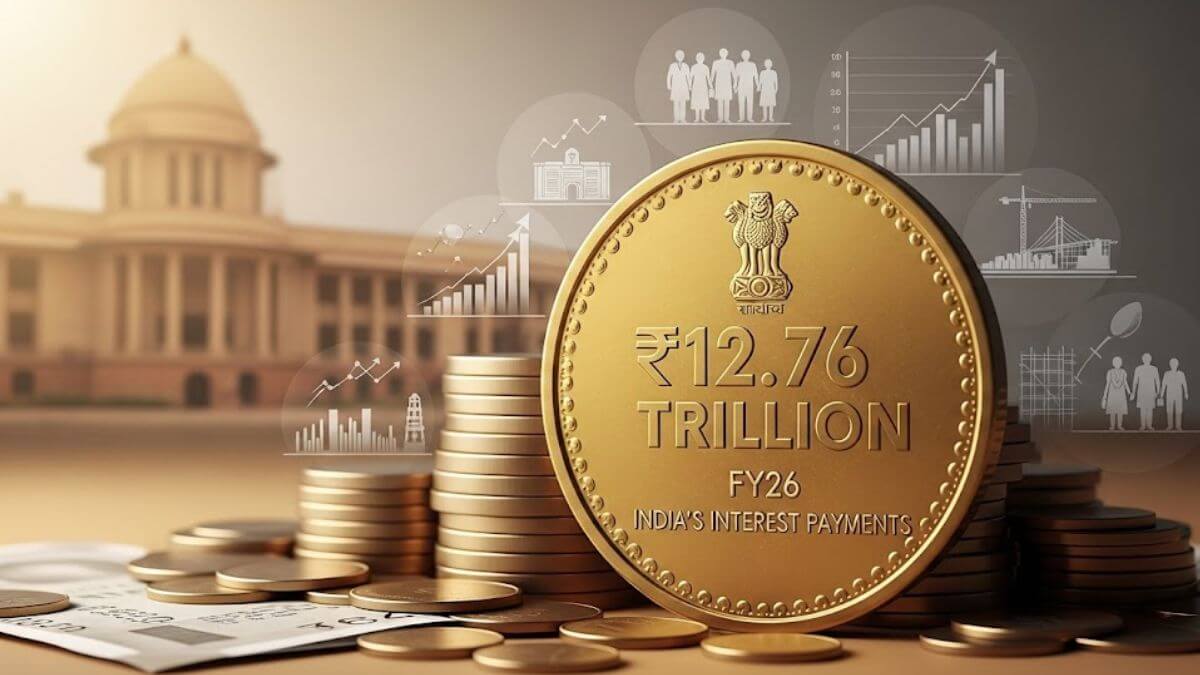
India’s interest payments on public debt have surged, nearly tripling over the past decade. As of the fiscal year 2025–26 (FY26), the interest bill is projected to reach ₹12.76 trillion—a striking escalation that underscores shifting debt dynamics and rising financing pressures. This article unpacks this development to help exam aspirants grasp its significance in India’s current economic context.
1. How the Interest Burden Has Escalated
In FY16, India’s interest outgo stood significantly lower, but by FY26, it has escalated to ₹12.76 trillion, nearly triple the amount a decade ago.
This sharp upturn stems from several factors,
- Elevated borrowing costs: Much of the debt was contracted during the pandemic when interest rates were high.
- Debt servicing pressure: A large volume of medium- and long-term bonds are maturing, leading to higher immediate outflows.
2. Debt Volume and Debt-to‑GDP Trend
- Gross government debt climbed from around ₹71 trillion (51.5% of GDP) in FY16 to a projected ₹200 trillion (56.1% of GDP) by FY26.
- The debt-to-GDP ratio peaked at 61.4% in FY21—during the pandemic—as fiscal deficits soared, before easing to the current projection of 56.1%. The government aims to bring this ratio down to around 50% by 2031.
3. Borrowing Costs and Bond Market Trends
- Borrowing costs remained elevated due to pandemic-era rates, despite some recent easing.
- The 10-year government bond yield, which averaged around 6.6% in FY20–21, now hovers between 6.5–6.55%, briefly dipping to a three-year low of 6.4% in April 2025.
- Although these yields suggest improved investor sentiment and potential for softening rates, the legacy of high-cost debt continues to weigh on interest outflows.
4. Debt Management Strategies: Buybacks and Switches
To manage the mounting repayment burden, the government is ramping up the use of,
- Bond buybacks: Repurchasing bonds before maturity.
- Bond switches: Exchanging short-term securities for longer-term ones to smooth maturities and reduce rollover risk.
- These tools help spread repayments over a longer period, though they extend debt tenure and postpone actual outflows.
5. Fiscal Consolidation and Deficit Trends
- The fiscal deficit for FY25 stood at 4.8% of GDP, improving over earlier estimates. For FY26, the target is 4.4%.
- In May 2025, the fiscal deficit was only 0.8% of the budgeted target, down from 3.1% a year earlier, driven by strong revenue collections.
- Lower deficits reduce the need for fresh borrowing and, in turn, can alleviate upward pressure on interest rates.
Why It Matters
- Economic sustainability: Rising interest costs could crowd out development expenditure.
- Debt servicing pressures: High-interest debt from the pandemic era remains a fiscal drag despite recent yield easing.
- Debt-to-GDP trajectory: Understanding this ratio’s movement—from a peak of 61.4% in FY21 to 56.1% in FY26—and the path to 50% by 2031 is crucial.
- Policy tools for debt management: Buybacks and switches demonstrate the government’s proactive approach to smoothing out repayment obligations.


 India Forex Reserves Fall by $30.5 Billi...
 IRDAI Retains The Systemically Important...
 India’s GST Collections Hit ₹1.78 Lakh C...