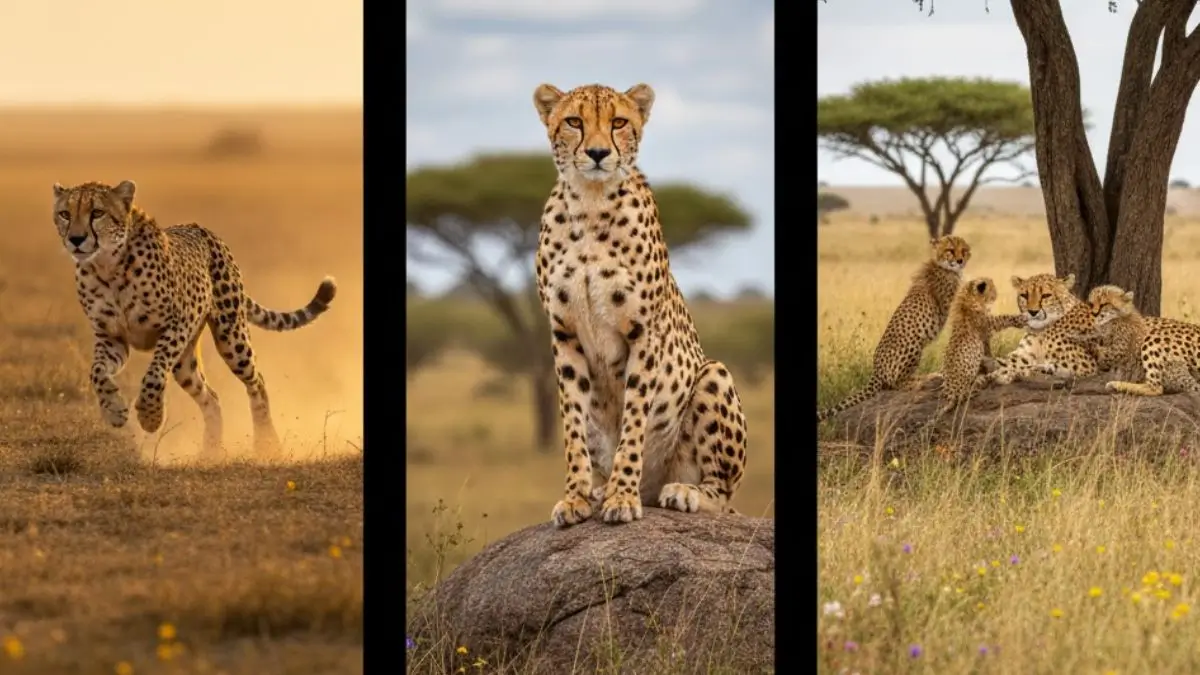
Every year, December 4 is observed as International Cheetah Day, a date chosen to raise awareness about the fastest land animal and to highlight ongoing efforts to prevent its extinction. Initiated in 2010 by American zoologist Dr Laurie Marker, who founded the Cheetah Conservation Fund (CCF), this day honors not only the species but also the people and projects dedicated to saving it.
The Cheetah: A Glimpse into Evolution and Endangerment
The cheetah is one of the oldest big cat species, with evolutionary roots dating back over five million years to the Miocene era. Famous for their incredible speed, cheetahs can accelerate from 0 to 112 km/h in just three seconds.
Despite their evolutionary success, cheetahs today are vulnerable to extinction. Only about 6,500 to 7,100 remain in the wild, mostly in Africa. The International Union for Conservation of Nature (IUCN) lists all subspecies as vulnerable, with the Northwest African and Asiatic cheetahs being critically endangered.
India had declared the species extinct in 1952, making cheetahs the only large carnivore to vanish from the country due to hunting and habitat loss. But that is changing, thanks to Project Cheetah.
Project Cheetah: India’s Wildlife Revival Story
India’s bold wildlife conservation plan took shape in September 2022, when eight African cheetahs from Namibia were introduced into Kuno National Park in Madhya Pradesh. This was followed by twelve more from South Africa in early 2023. Despite skepticism over their survival and adaptation, the project has evolved into an unprecedented success.
As of December 2025, the cheetah population in India has risen to 32, including 21 cubs born on Indian soil. One significant moment came in November 2025, when Mukhi, an India-born female, gave birth to five healthy cubs, signaling the cheetahs’ acceptance of their new habitat.
This shift from relocation to natural breeding is critical—it proves that India’s grasslands can indeed support these predators and may serve as a model for global species restoration.
Where to Spot Cheetahs in India
India is now home to multiple locations under Project Cheetah,
- Kuno National Park: The flagship site where cheetahs were first reintroduced. It is currently home to the majority of India’s cheetah population.
- Gandhi Sagar Wildlife Sanctuary: Located in Madhya Pradesh, this sanctuary welcomed its first cheetah, “Dheera,” in 2025, expanding the conservation effort.
- Banni Grasslands, Gujarat: Still under development, this location is being prepared to diversify cheetah habitats and strengthen the population.
These locations not only support conservation but also aim to promote eco-tourism, turning wildlife protection into a community-supported effort.
Cheetah vs Leopard: Clearing the Confusion
Cheetahs and leopards are often confused due to their spotted appearance, but key differences set them apart,
- Facial Markings: Cheetahs have distinct black tear-like streaks from eyes to mouth; leopards do not.
- Body Build: Cheetahs are slender, taller, and built for speed, whereas leopards are shorter, stockier, and built for power.
- Claws: Cheetahs have semi-retractable claws aiding their speed; leopards have fully retractable claws, useful for climbing.
- Vocalizations: Cheetahs chirp, while leopards roar.
Understanding these differences is essential for wildlife enthusiasts and conservationists alike.
Global Efforts and Safaris for Big Cat Lovers
Apart from India, some of the best places to see cheetahs in their natural habitat include,
- Serengeti (Tanzania)
- Masai Mara (Kenya)
- Okavango Delta (Botswana)
- Phinda and Kwandwe Reserves (South Africa)
- Hwange (Zimbabwe)
- Lewa Conservancy (Kenya)
These reserves play a crucial role in global cheetah conservation and eco-tourism.
Key Takeaways
- December 4: International Cheetah Day, initiated in 2010 by Dr Laurie Marker.
- India declared cheetahs extinct in 1952.
- Project Cheetah began in 2022 with 20 African cheetahs in Kuno National Park.
- As of 2025, 32 cheetahs in India, including 21 cubs born locally.
- All cheetah subspecies are vulnerable, with two critically endangered.


 World Health Day 2026 - Theme, Date, Sig...
 List of Important Days in April 2026, Na...
 International Day of Sport for Developme...