
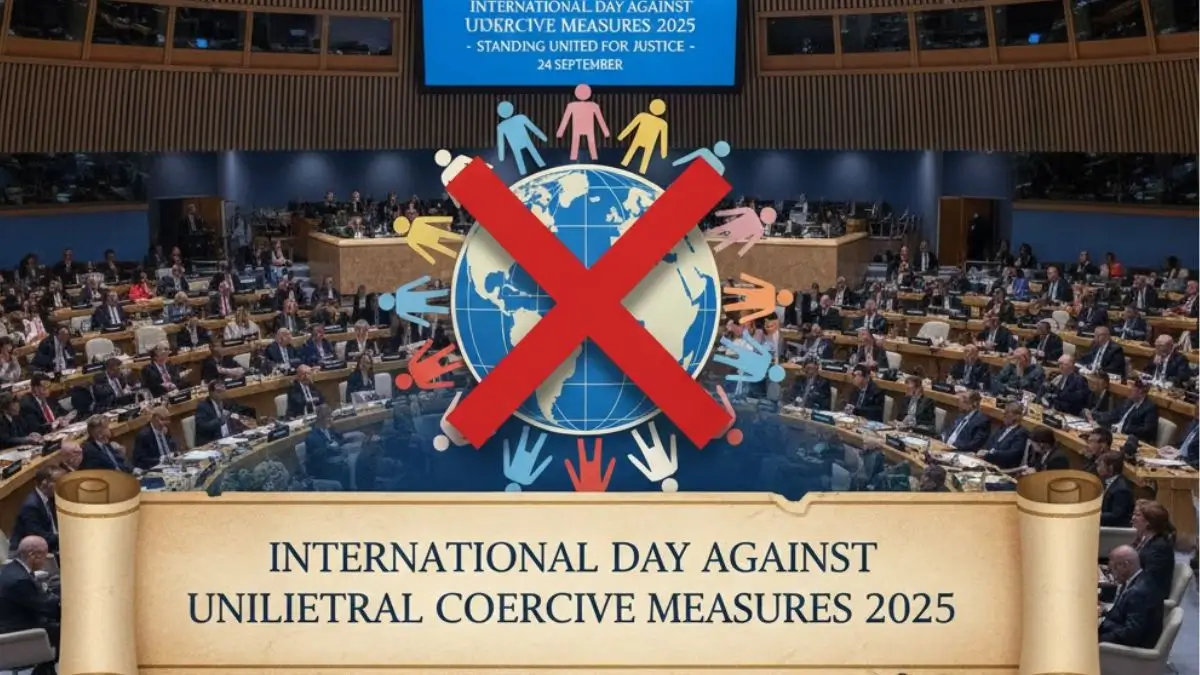
On December 4, 2025, the world marks the first-ever International Day Against Unilateral Coercive Measures, following a declaration by the United Nations General Assembly in June 2025. This global observance brings attention to the harmful effects of sanctions and economic restrictions imposed unilaterally—i.e., by one State against another—outside the bounds of international law and the UN Charter. These measures, often framed as tools for policy change or punishment, undermine the sovereignty of states and have significant repercussions on human rights, development, and humanitarian access, especially in developing nations.
What Are Unilateral Coercive Measures?
According to the UN Office of the High Commissioner for Human Rights (OHCHR), unilateral coercive measures (UCMs) are economic, financial, or trade restrictions imposed by one state to influence the internal policies of another. These include,
- Trade embargoes
- Investment restrictions
- Freezing of assets
- Travel bans on individuals
- Blocking of financial transactions
While sometimes called “smart sanctions” when targeted at individuals, these actions can have broad and unintended humanitarian consequences, impacting ordinary citizens, including access to food, medicine, housing, and healthcare.
Legal and Human Rights Concerns
The imposition of UCMs violates the principles of international law, including,
- International human rights law
- International humanitarian law
- The Charter of the United Nations, which promotes peaceful resolution of disputes and sovereign equality among states
- The Declaration on Principles of International Law regarding Friendly Relations and Cooperation Among States also denounces coercive economic actions as incompatible with global peace and cooperation.
The human rights impact is especially alarming as UCMs often impede access to basic services, exacerbate poverty, and restrict development, especially in conflict-affected or economically vulnerable regions.
Why December 4 Was Declared an International Day
In June 2025, the UN General Assembly passed a resolution to designate December 4 as the International Day Against Unilateral Coercive Measures, aiming to,
- Raise global awareness of the negative effects of UCMs
- Promote international solidarity, especially with developing nations
- Call for respect for international law in global diplomacy
- Encourage dialogue and multilateralism as peaceful alternatives to coercion
The resolution urges all States to refrain from enacting any economic or political restrictions that hinder development, particularly when not sanctioned by the UN Security Council.
Human Rights at the Core
Unilateral coercive measures directly challenge the Universal Declaration of Human Rights, especially,
- Article 25: The right to an adequate standard of living, including food, housing, healthcare, and social services
- Right to development, recognized as a universal right essential to dignity and progress
- When a country is denied access to international trade, medicine, technology, or financial systems, the well-being of its citizens suffers, regardless of political leadership.
Importance for Developing Countries
Developing nations are disproportionately affected by UCMs. These measures,
- Disrupt public service delivery
- Worsen economic instability
- Increase poverty and inequality
- Hinder progress toward the Sustainable Development Goals (SDGs)
The International Day aims to amplify the voices of affected countries and promote multilateral partnerships to ensure no nation is left behind due to politically motivated restrictions.
How Nations and Citizens Can Observe the Day
On December 4, governments, civil society groups, and global institutions are encouraged to,
- Host dialogues and panel discussions on international cooperation and peaceful diplomacy
- Launch campaigns on the humanitarian consequences of sanctions
- Promote academic and policy research on alternative diplomatic tools
- Advocate for reforms ensuring UN oversight of global economic restrictions
This observance also offers an opportunity to recommit to the principles of non-intervention, sovereignty, and international solidarity.


 World Health Day 2026 - Theme, Date, Sig...
 List of Important Days in April 2026, Na...
 International Day of Sport for Developme...











