
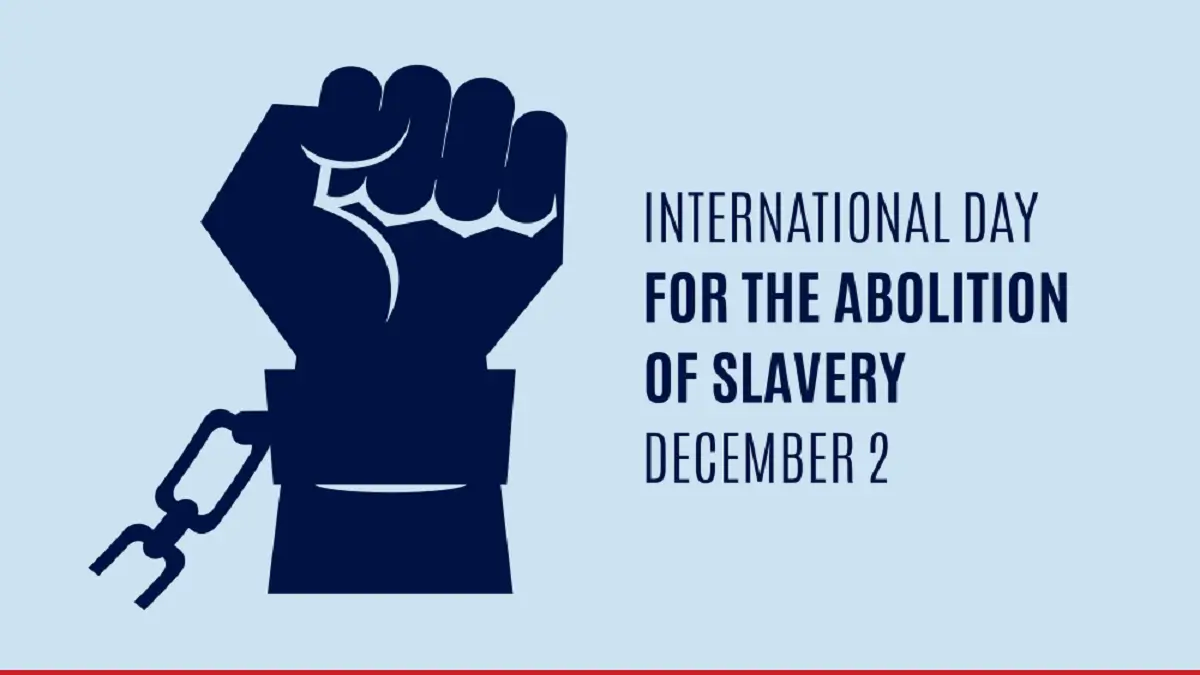
Every year on 2 December, the world observes the International Day for the Abolition of Slavery. This United Nations observance highlights the urgent need to eliminate modern forms of slavery, including forced labour, child exploitation, trafficking, sexual abuse, and the recruitment of children into armed conflict. The day reminds us that slavery did not disappear with history—it still exists in evolving forms.
Why This Day Matters
The observance commemorates the 1949 UN Convention for the Suppression of the Traffic in Persons and the Exploitation of the Prostitution of Others. Its focus today is on tackling contemporary slavery rather than historical systems, emphasizing human dignity, legal protection, and global awareness.
Modern Slavery: What It Means Today
Modern slavery is not legally defined, but it broadly refers to situations where individuals are controlled and cannot refuse or escape exploitation due to threats, coercion, deception, or abuse of power. It includes forced labour, debt bondage, trafficking in persons, forced marriage, and child labour. Women and children remain the most vulnerable, often trapped due to discrimination, poverty, and lack of economic opportunities.
Rising Global Concern: Key Statistics
According to the International Labour Organisation (ILO), around 50 million people were living in modern slavery in 2021, an increase of 10 million since 2016. More than half of these cases exist in upper-middle and high-income countries, showing that exploitation is a global issue cutting across borders and economic systems.
Forced Labour Dominates Modern Slavery
The ILO estimates that 27.6 million people are victims of forced labour, with numbers rising by 2.7 million between 2016 and 2021. The majority of forced labour takes place in the private sector, affecting industries such as construction, manufacturing, services, agriculture, domestic work, and sexual exploitation. Smaller but significant areas include forced begging and activities linked to criminal networks.
Modern Slavery as a Profitable Crime
Modern slavery is also an economic menace. Forced labour generates approximately US$236 billion every year, meaning workers lose income, families remain in poverty, governments lose taxes, and criminal networks expand. These stolen wages weaken national economies and fuel corruption.
Geographical Spread of the Problem
No region is exempt. Asia and the Pacific has the highest number of forced labour victims at 15.1 million, followed by Europe and Central Asia, Africa, the Americas, and Arab States. In terms of prevalence, the Arab States have the highest rate, followed by Europe, Central Asia, and the Americas.
Main Areas Highlighted on 2 December
The day focuses attention on three major aspects. Forced labour remains widespread in industries and through trafficking, where migrant workers and vulnerable groups face exploitation. Child labour affects one in ten children globally, most engaged in work harmful to their education, health, and development. Trafficking in persons involves recruitment, transport, and exploitation for forced labour, sexual exploitation, servitude, or organ removal. Importantly, trafficking of children is punishable even without the use of force, since their consent has no legal validity.
Global Efforts and Awareness Campaigns
The ILO’s 2016 Forced Labour Protocol enhances enforcement and survivor protection worldwide. The UN observance on 2 December encourages nations to strengthen laws, improve victim support, protect migrants, and invest in awareness campaigns. It also pushes for cooperation among governments, civil society organisations, and global agencies.


 World Homoeopathy Day 2026: Advancing Ho...
 World Health Day 2026 - Theme, Date, Sig...
 List of Important Days in April 2026, Na...











