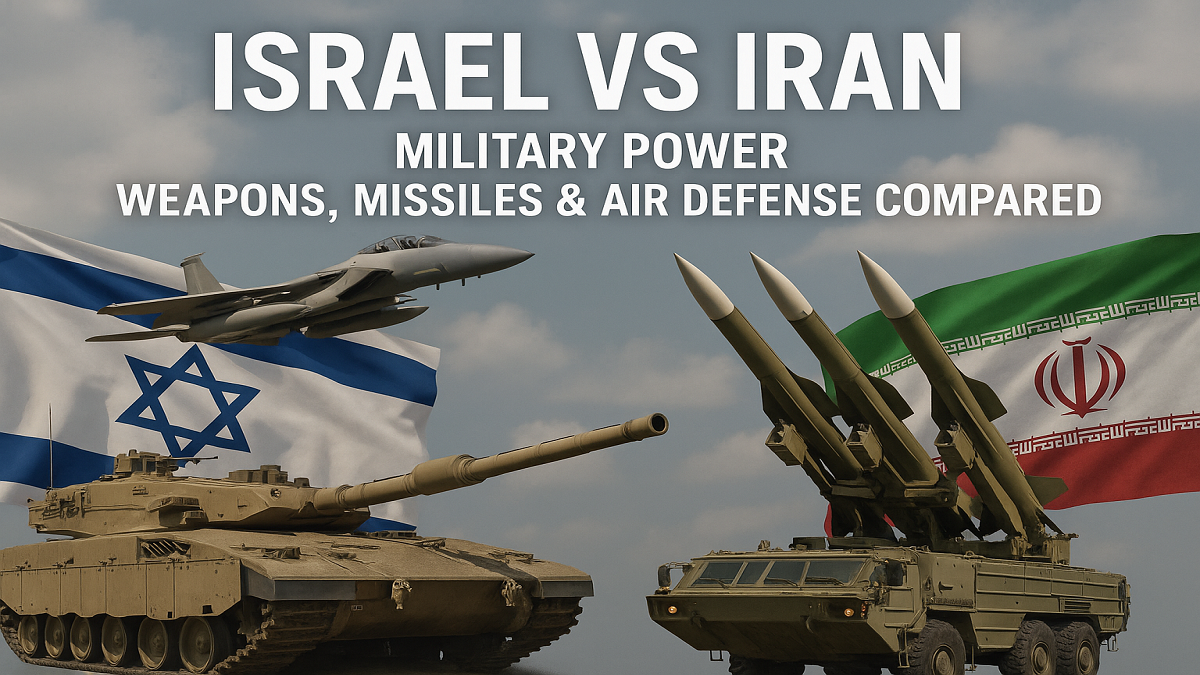
The geopolitical tensions between Israel and Iran have kept the Middle East on edge for decades. With rising hostilities, cyber threats, and proxy wars in play, the spotlight is increasingly falling on their military capabilities. This in-depth comparison analyzes the weapons systems, missile arsenals, air defense technologies, and overall military strength of these two regional powers.
Strategic Overview
Israel: A Technology-Driven Defense Power
Israel, despite its smaller size, boasts one of the most technologically advanced militaries in the world. Its Israel Defense Forces (IDF) are known for superior training, real-time intelligence capabilities, and cutting-edge systems like the Iron Dome, David’s Sling, and Arrow-3. Backed by the United States and homegrown defense giants like Rafael and Elbit Systems, Israel’s military doctrine is centered on preemption, rapid response, and layered defense.
Iran: A Regional Asymmetric Force
Iran’s military power, led by the Islamic Revolutionary Guard Corps (IRGC) and the Artesh (regular army), is shaped by its need to counter technologically superior foes. Iran invests heavily in ballistic missiles, drones, and proxy militias (like Hezbollah and Houthis) to project power asymmetrically across the region. Sanctions have limited its access to modern systems, but it compensates with quantity and regional reach.
Missile Capabilities
Iran’s Ballistic Might
Iran possesses the largest missile arsenal in the Middle East, with weapons capable of reaching targets over 2,000 kilometers away. Key missile systems include:
- Shahab-3: Capable of striking Israel from Iranian territory.
- Sejjil-2: Solid-fueled, medium-range missile with better accuracy.
- Fateh-110: Tactical, short-range missile, widely used in regional conflicts.
Iran also exports missiles to allies, destabilizing surrounding regions.
Israel’s Precision Missiles
Israel focuses on precision-guided munitions and missile defense. Notable systems include:
- Jericho III: A long-range, potentially nuclear-capable missile.
- Delilah Cruise Missile: Air-launched and used for surgical strikes.
- Rampage Missile: Designed to destroy fortified targets.
Unlike Iran, Israel uses missiles sparingly but with strategic precision.
Air Power
Israel: Air Superiority with F-35s
Israel’s Air Force (IAF) is among the most powerful in the world. It includes:
- F-35I Adir: A stealth variant of the U.S. F-35, customized for Israel.
- F-15I Ra’am and F-16I Sufa: Multirole fighters with advanced avionics.
- Heron and Eitan UAVs: Drones used for surveillance and strikes.
The IAF has demonstrated the ability to carry out long-range precision operations, including missions deep inside Iran and Syria.
Iran: Defensive and Russian-Sourced Air Fleet
Iran’s air power is more defensive. Its fleet includes aging American F-14s (pre-Revolution era) and Russian aircraft:
- Su-24, MiG-29, and F-4 Phantom jets form the backbone.
- Iran also relies on drones like Shahed-129 and Shahed-136, the latter being used in Ukraine via Russian deployment.
Iran lacks modern multirole fighters but compensates with drone swarms and surface-to-air defenses.
Air Defense Systems
Israel: Layered Air Defense Network
Israel leads in air defense technology, boasting a multi-tiered shield:
- Iron Dome: Intercepts short-range rockets and artillery shells.
- David’s Sling: Targets medium- to long-range threats.
- Arrow-2 and Arrow-3: Designed to counter ballistic missile attacks from Iran.
This layered approach has been battle-tested during rocket barrages from Gaza and threats from Syria and Lebanon.
Iran: Indigenous Missile Defense
Iran has developed its own air defense systems in response to sanctions:
- Bavar-373: Iran’s equivalent of the Russian S-300, designed to shoot down cruise missiles and stealth aircraft.
- Khordad-15: Targets stealth fighters and cruise missiles.
- Reliance on Russian systems like Tor-M1 and S-300 adds depth to its coverage.
However, Iran’s air defense is still considered inferior to Israel’s in detection, integration, and kill probability.
Ground Forces & Artillery
Iran: Numerical Strength and Proxies
Iran’s ground forces are large and deeply embedded across the region via proxy groups:
- IRGC Quds Force: Operates in Iraq, Syria, Lebanon, and Yemen.
- Tanks: Includes older models like T-72s, as well as Iranian variants such as Zolfaghar.
- Rocket Artillery: Extensively used by Hezbollah and other proxies.
The strategic use of non-state actors gives Iran a hybrid edge.
Israel: Compact but Highly Mobile
Israel’s ground forces are elite and tech-equipped:
- Merkava Mk.4 tanks: Among the most advanced tanks globally.
- Trophy APS: Active protection system to counter anti-tank missiles.
- Sayeret Matkal and Golani Brigade: Elite units trained for high-risk operations.
Although smaller in number, Israel’s ground units are faster and better networked.
Cyber and Intelligence Warfare
Israel: Intelligence Supremacy
Israel leads in cyber capabilities, largely driven by Unit 8200, its elite cyber-intelligence wing. It has been linked to cyber operations like Stuxnet, which targeted Iran’s nuclear infrastructure.
Iran: Rising Cyber Threat
Iran’s cyber units have shown increased sophistication in attacks on infrastructure in Israel, the U.S., and Saudi Arabia. Groups like APT33 and Charming Kitten are often linked to the IRGC.
Nuclear Ambitions
Iran’s Controversial Nuclear Program
Iran continues uranium enrichment despite global pressure. Though Iran denies seeking weapons, its nuclear breakout time has drastically shortened. The 2015 JCPOA agreement is nearly defunct.
Israel’s Undeclared Nuclear Arsenal
Israel maintains a policy of nuclear ambiguity but is widely believed to possess 90–200 nuclear warheads, delivered via aircraft, submarines, or missiles.


 Who is known as the Father of Mobile Pho...
 Which is the Highest Airport in the Worl...
 Which Country is the Largest Exporter of...