
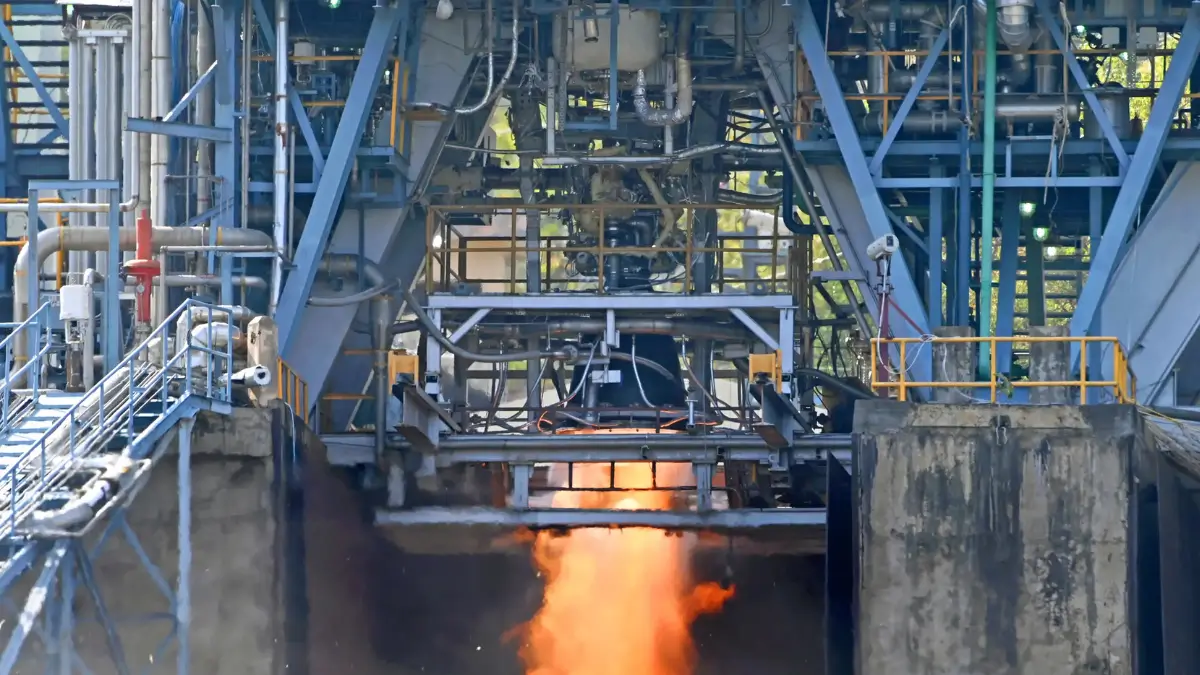
The Indian Space Research Organisation (ISRO) has achieved another important milestone in rocket technology by successfully conducting a sea-level hot test of its CE20 cryogenic engine. The test was performed at a thrust level of 22 tonnes at the ISRO Propulsion Complex. This successful experiment is expected to improve the payload capability of India’s heavy-lift rocket, the Launch Vehicle Mark‑3 (LVM3).
Successful Sea-Level Hot Test of CE20 Engine
ISRO carried out a sea-level hot test of the CE20 cryogenic engine on March 10. The engine operated successfully for 165 seconds at a thrust level of 22 tonnes using advanced systems designed to ensure safe testing.
Key highlights of the test include:
- The engine was tested using a Nozzle Protection System (NPS).
- A multi-element igniter was used to start the engine.
- The test ran smoothly for 165 seconds without any issues.
- Engine performance and testing facility operations were as expected throughout the experiment.
Earlier sea-level tests with the nozzle protection system were performed at 19-tonne thrust, making this a significant upgrade.
Role of CE20 Engine in LVM3 Rocket
The CE20 cryogenic engine is a crucial component of India’s heavy-lift launch vehicle.
- It powers the upper cryogenic stage (C25) of the Launch Vehicle Mark‑3.
- The rocket is capable of launching heavy satellites and space missions.
- It is also used in important missions like communication satellite launches and deep space missions.
ISRO now plans to operate future LVM3 missions with an upgraded C32 stage, which will use the CE20 engine at 22-tonne thrust to increase payload capacity.
Why Testing at Sea Level is Challenging?
Testing cryogenic engines at sea level is technically complex because of the design of the nozzle.
Major challenges include:
- High area ratio nozzle: The nozzle is designed mainly for space conditions.
- Low exit pressure: Around 50 millibar, which can cause unstable flow.
- Flow separation inside the nozzle: This may lead to:
- Strong vibrations
- High thermal stress
- Possible mechanical damage
To manage these challenges, ISRO used the Nozzle Protection System, which helps maintain stable engine operation during testing.
Engine with a Record Number of Tests
The CE20 engine used in this experiment has already undergone a record 20 successful hot tests, making it one of the most extensively tested cryogenic engines developed by ISRO.
These tests helped demonstrate several important technologies, including:
- Multi-element igniter system for engine ignition
- Wide ignition margin tests for the Gaganyaan mission
- Engine qualification for human spaceflight missions
- Operation at higher thrust levels
These developments are crucial for improving the reliability of India’s space missions.
Importance for Future Space Missions
This successful test is an important step toward improving the performance of India’s heavy-lift rocket system.
Benefits include:
- Increased payload capacity of LVM3
- Better support for future satellite launches
- Stronger preparation for human spaceflight missions like Gaganyaan
- Advancement of India’s cryogenic propulsion technology
With such technological improvements, ISRO continues to strengthen its position among the leading space agencies in the world.


 What is Outer Space Treaty 1967? Princip...
 Who is known as the Father of Mobile Pho...
 What Is Mission Mitra? ISRO’s New Experi...











