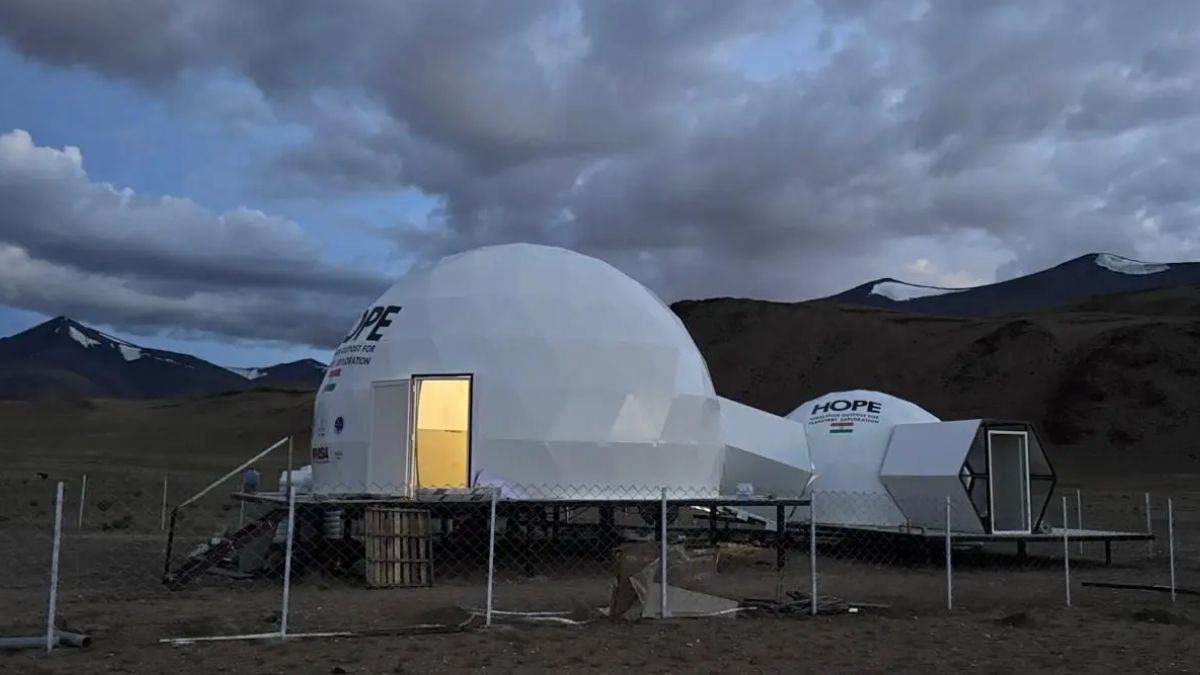
On August 1, 2025, the Indian Space Research Organisation (ISRO) launched a 10-day high-altitude isolation experiment in Ladakh. Conducted at 14,000 feet, this mission simulates the extreme conditions astronauts might face on long-duration space missions to the Moon or Mars. The initiative is part of preparations for India’s Gaganyaan human spaceflight programme and future interplanetary exploration.
HOPE: India’s Space Analogue Research Facility
The mission takes place at the Himalayan Outpost for Planetary Exploration (HOPE), located near Tso Kar in Ladakh. Built by Bengaluru-based space technology firm Protoplanet, the site was inaugurated by ISRO Chairman V. Narayanan just a day before the mission began.
HOPE was selected for its lunar-like rocky terrain, cold desert climate, and low oxygen environment—conditions that closely mimic extraterrestrial landscapes and stressors. Night-time temperatures drop well below freezing, adding another layer of challenge for the participants.
The Two-Person Crew
From 135 applicants, ISRO selected Rahul Mogalapalli, a PhD candidate at Purdue University, and Yaman Akot, a planetary science graduate from the University of Aberdeen.
Selection criteria included,
- Medical fitness
- Psychological resilience
- Experience in confined environment simulations
Before deployment, both underwent a 15-day acclimatisation programme at lower altitudes to prepare for Ladakh’s extreme conditions.
Mission Goals
The HOPE mission focuses on understanding the effects of isolation, high altitude, and extreme environments on human health and performance. Key research objectives include,
- Physical Health Monitoring – Collecting blood, urine, and stool samples to study genomic, proteomic, and metabolomic responses to stress.
- Mental Health Evaluation – Tracking mood changes, sleep cycles, cognitive performance, and interpersonal dynamics.
- Operational Readiness – Testing astronaut-like daily routines, including work schedules, exercise regimens, and mission control communications.
The experiment mirrors routines on the International Space Station (ISS) and will guide planning for long-duration missions beyond Earth orbit.
How HOPE Compares to Other Space Analogues
Globally, space agencies run similar analogue missions,
- Mars Desert Research Station (USA) – Desert environment studies since 2001.
- Flashline Mars Arctic Station (Canada) – Arctic terrain simulations.
- HI-SEAS (Hawaii) – Crew psychology and isolation studies.
- SIRIUS (Russia) – Long-term isolation missions up to 340 days.
- ESA CAVES (Italy) – Underground astronaut training.
HOPE stands out because it combines multiple space-like stressors—high altitude, cold desert conditions, and lunar-like terrain—in one integrated facility.
Why It Matters for India’s Space Ambitions
The Ladakh simulation will provide critical human performance data for Gaganyaan and future missions to the Moon and Mars. It also marks India’s entry into the elite group of nations conducting realistic planetary surface simulations.
By developing HOPE, ISRO now has a homegrown facility to test crew adaptability, mission equipment, and operational strategies without relying solely on foreign collaborations.


 New COVID Variant BA.3.2: Symptoms, Risk...
 NASA’s Artemis 2 Set for April 2026 Laun...
 Akasha300 3D Printer Explained: How It W...